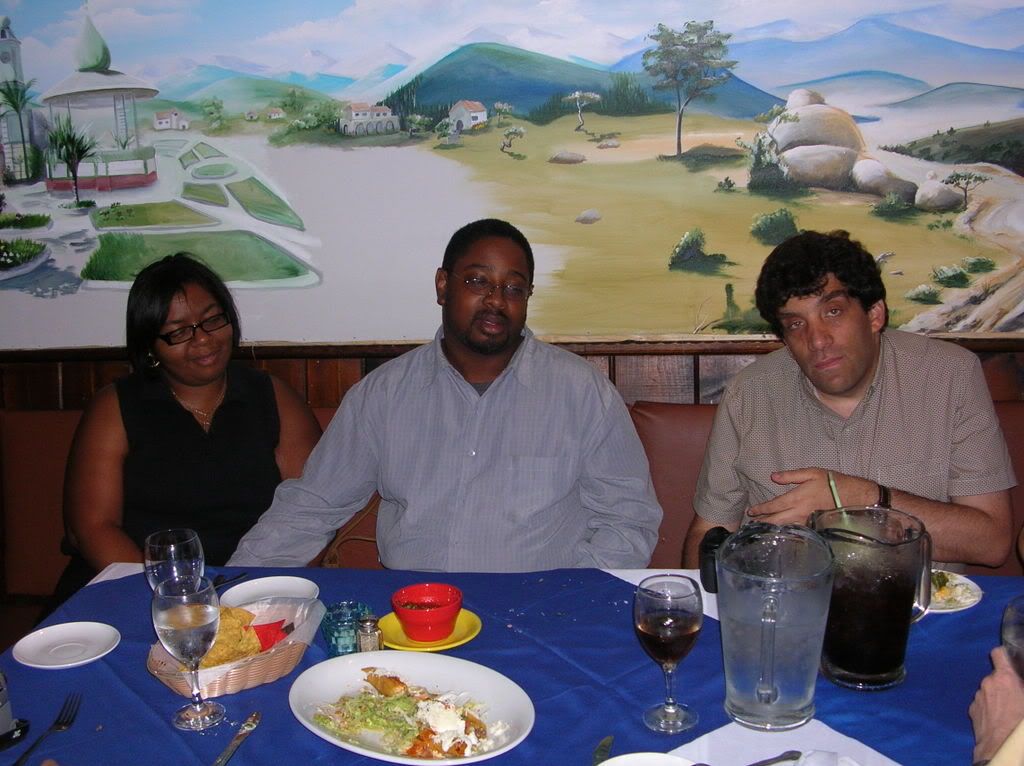
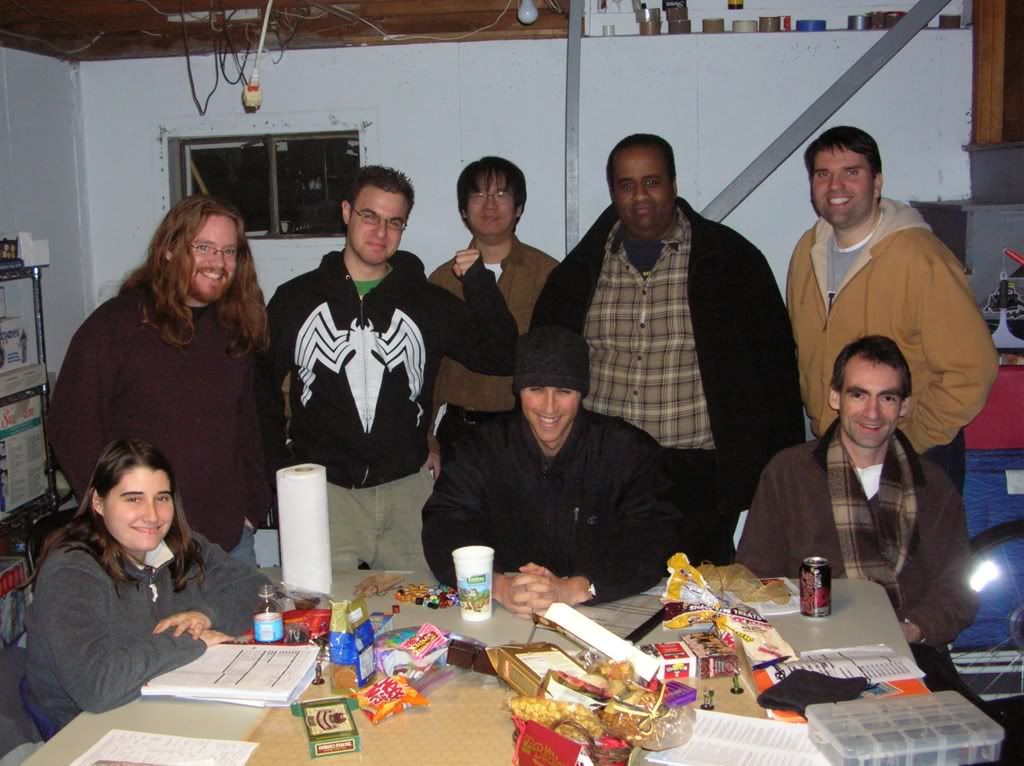
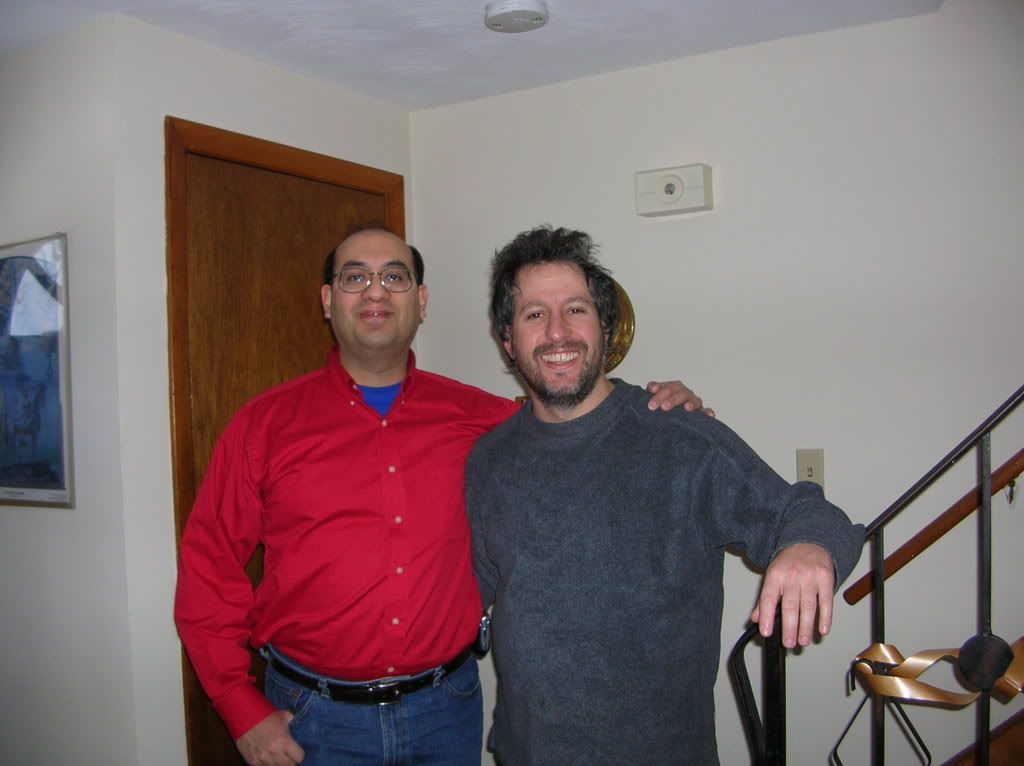
Here are my results from an online survey. In the past, such tests have come up with the results of a Lawful Good human Paladin, a Neutral Good Half-Elf Ranger/Bard, and a Chaotic Neutral Halfling Rogue/Wizard.
>You Are a: Lawful Good Elf Wizard (5th Level)
>Ability Scores (and what I’d give myself):
–Strength: 12 (11)
–Dexterity: 12 (12)
–Constitution: 12 (11)
–Intelligence: 14 (13)
–Wisdom: 12 (12)
–Charisma: 13 (12)
>Alignment: Lawful Good — A lawful good character acts as a good person is expected or required to act. He combines a commitment to oppose evil with the discipline to fight relentlessly. He tells the truth, keeps his word, helps those in need, and speaks out against injustice. A lawful good character hates to see the guilty go unpunished. Lawful good is the best alignment you can be because it combines honor and compassion. However, lawful good can be a dangerous alignment when it restricts freedom and criminalizes self-interest.
>Race: Elves are known for their poetry, song, and magical arts, but when danger threatens they show great skill with weapons and strategy. Elves can live to be over 700 years old and, by human standards, are slow to make friends and enemies, and even slower to forget them. Elves are slim and stand 4.5 to 5.5 feet tall. They have no facial or body hair, prefer comfortable clothes, and possess unearthly grace. Many others races find them hauntingly beautiful.
>Class: Wizards are arcane spellcasters who depend on intensive study to create their magic. To wizards, magic is not a talent but a difficult, rewarding art. When they are prepared for battle, wizards can use their spells to devastating effect. When caught by surprise, they are vulnerable. The wizard’s strength is her spells, everything else is secondary. She learns new spells as she experiments and grows in experience, and she can also learn them from other wizards. In addition, over time a wizard learns to manipulate her spells so they go farther, work better, or are improved in some other way. A wizard can call a familiar- a small, magical, animal companion that serves her. With a high Intelligence, wizards are capable of casting very high levels of spells.
I still feel strangely detached from these discussions because I’m not running or buying D&D4e supplements. Even if I’m not a hardcore grognard as some in the old-school Renaissance, I’ve come to prefer simpler rules, lower-powered scenarios, and heroic role-playing over combat simulation. If D&D5e addresses those preferences as well as some retro-clones do, I might yet return to the popular tabletop fantasy RPG brand.
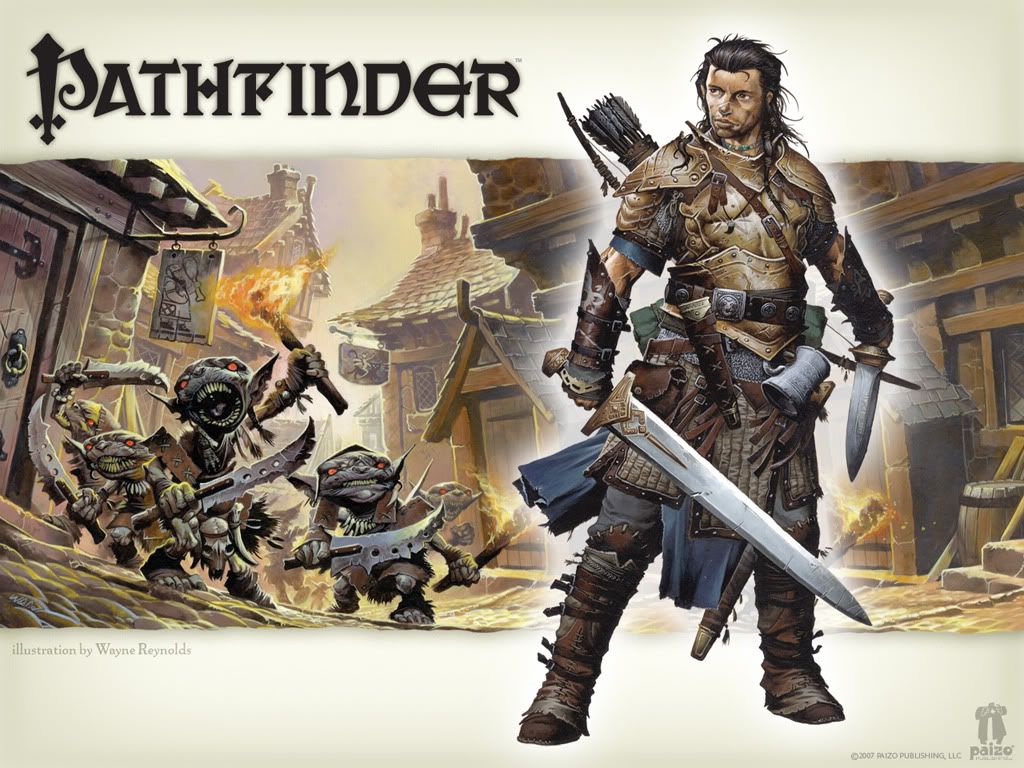
Fortunately, I lack no support as a Dungeon Master in the meantime, thanks to Paizo’s excellent Pathfinder (a.k.a. “D&D3.75”) line. Although the rules are still complex, the artwork and prose in each book about the Golarion/Inner Sea setting inspires the imagination. The Ultimate Magic and Ultimate Combat books are no exception, with numerous options for Pathfinder Player Characters of all occupational classes.
I found Ultimate Magic to be slightly more useful and better balanced than Ultimate Combat, partly because the latter introduced classes such as the Gunslinger and Ninja that I would limit in my homebrew game. Between them and the Advanced Player’s Guide, any Pathfinder player should have more than enough ways to develop and tweak characters, replacing a veritable pile of D20/Open Game License/D&D3.x splatbooks (many of which I’ve now sold).
On a related note, I recently got the Tome of Horrors Complete for Pathfinder. I was a big fan of the D20 monster book, which revived several old favorites from previous editions of D&D. It included creatures from old adventure modules and the Fiend Folio, including the gold-eating aurumvorax, the statuesque caryatid column, and the floppy flumph. The new compilation has about 800 pages of monsters, with everything from the mysterious dark creepers to Lucifer himself and numerous animals!
Even though I’ve tried to limit the number of sentient species in my “Vanished Lands” campaign setting, I and most of my gamers have enjoyed encountering new beasties in the books and scenarios. The Tome of Horrors Complete is a fantastic addition to Pathfinder‘s Bestiaries I through III.
The Pathfinder: “the Vanished Lands” teleconferencing team is still struggling to get back to its regular Sunday night schedule because we’ve had difficulty getting quorum because of travel and family obligations. I hope that the eight role-players, scattered across the U.S., will soon be able to resume Skypesessions.
As I’ve mentioned before, I’ve considered using FATE 3e Legends of Anglerre for the telecom fantasy game because I think the lighter rules set would be a good fit for that venue. Also from Cubicle 7 is The One Ring, the latest game set in J.R.R. Tolkien’s Middle Earth.
I was favorably impressed by the production value of The One Ring, which overcame some of my initial misgivings about its limited scope — it’s set in the Wilderlands during the Third Age, between the events of The Hobbit and those of The Lord of the Rings. A game with more limited starting options is a good idea for starting players, but then why not outline the character–creation process more clearly?
What if I was relatively new to the hobby and wanted to replicate a member of the horse-riding Rohirrim or an Elf from Lothlorien because I’ve seen Peter Jackson’s popular films? Just as Iron Crown Enterprise’s Middle Earth Role-Playingstuck too closely to the complicated RoleMaster system and Decipher’s Lord of the Rings RPG relied too heavily on the movies, Cubicle 7 risks confusing fans with its plan to expand its view of that world piecemeal.
That said, I liked The One Ring‘s character–developmentmechanics, which encourage altruistic play over the “kill things and take their stuff” mentality that’s all too common in D&D and various videogames. This feature is similar to what I enjoyed in Decipher’s underrated Lord of the Rings (if slightly less so in Lord of the Rings Online multiplayer computer game).
Speaking of encouraging good role-playing, the Mouse Guardboxed set is a thing of beauty. Based on an award-winning set of comics and a streamlined version of Burning Wheel, this would be the ideal way to get my animal-loving nieces into gaming. I strongly encourage fans of anthropomorphic fantasy, such as GURPS Bunnies & Burrows, Redwall, andShard, to read the collected comics and buy this game.
The boxed set includes a softcover version of the core rulebook (which I already have in hardback), character record sheets, and rules and adventure supplements. The counters are a bit funny, looking like oversized collectible erasers, but even if I don’t get to run Mouse Guard anytime soon, this game will be another rich source for sparking imagination and setting a heroic tone.
Cubicle 7‘s The One Ring is the successor to Iron Crown Enterprise’s Middle Earth Role-Playing (I’ve played MERP, which uses the RoleMaster rules) and Decipher’s movie-based Lord of the Rings. Fans of J.R.R. Tolkien’s (and Peter Jackson’s) Middle Earth wonder whether the choices of specific eras, locations, and character development options for various sourcebooks are the best approach to that epic fantasy setting. I’ll take a closer look at The One Ring in the next week or so. I’m also curious about WizKids’ Lord of the Rings HeroClix miniatures.
I liked its D&D3.0 incarnation, so I hope to eventually pick up the Tome of Horrors Completefor Pathfinder. Green Ronin has released a second boxed set for Dragon Age, another fantasy competitor to D&D4e that uses tiered advancement and is oriented at newer role-players. A few of the people in my Boston-area groups have expressed interest in it and A Song of Fire and Ice (for fans of Game of Thrones).
My Pathfinder/Skype: “the Vanished Lands” campaign has yet to resume after last month’s hiatus and various scheduling snafus, but I look forward to continuing the latest teleconferencing party’s adventures. When we left those Player Characters in the northwestern borderlands, they had returned to the haunted hamlet of Alarn, only to find that several of the knights sent there had been slaughtered…
I first ran games long-distance by “snailmail” back in the mid-1980s with friends such as David I.S. and Cheryl I.L. Later, I tried several “Vanished Lands” and “Vortex” scenarios by e-mail and play-by-post, but they tended not to last more than a few months each. I’ve had more success with the Skype telecom teams — now with members in New York, Massachusetts, North Carolina, Missouri, and Colorado — but busy parents and my own travel have acted as speed bumps lately.
Other tangential G.M.s also running fantasy include Paul J.’s Pathfinder: “Crossroads of Eternity,” Dave S.C.’s D&D4e “Attos,” Josh C.’s Pathfinder: Golarion/Inner Sea, and Bruce K.’s Conan. I haven’t had time to try any of them out, but I wish every game success! Next up — steampunk RPGs…
As part of the aforementioned spring cleaning, I’ve now sold most of my books for Dungeons & Dragons Fourth Edition. It’s the first time in nearly 30 years that I’m role-playing but not using the latest edition of that game. (I still have lots of books from prior editions.)
I’ve been an early and enthusiastic adopter of past editions of D&D, including moves from the boxed sets to AD&D1 back in high school in the early 1980s, from AD&D1 to AD&D2 in college, and from AD&D2 to D&D3.0 and 3.5 (and the D20 Open Game License in general) in the early 2000s. Each new version had clearer rules, stronger support in terms of published supplements, and a larger fan base than its predecessors. I’m surprised to now find myself sympathizing more with the grognards.
In 2009, I used D&D4e for the “Faith-Based Initiative” team in my long-running “Vanished Lands” homebrew fantasy setting. The rules set worked well enough for a time, but more than half of the eight gamers soon became disenchanted, mirroring a schism in the larger community.
Some of the problems were stylistic. As a Dungeon Master accustomed to “sandbox“-style settings, in which the Player Characters are free to pick quests and explore a world in any direction, I clashed with those who expected every encounter or challenge to be appropriately scaled to the adventuring party’s power/experience level, as D&D4e encourages.
In my previous campaigns, if low-level adventurers found a monster like a dragon, they ran or hid. In D&D4e, some would either express shock at the unfairness of such a battle or doggedly fight until all opposition (and possibly some of their own company) was dead. I’ve become stingier with treasure and prefer slower advancement than in most published modules.
It’s true that I and other people didn’t master the D&D4e’s subtleties as quickly as a few in the group, and I grew impatient with combat scenes that dragged on for nearly as long as similar scenes had in earlier editions. D&D4e’s emphasis on tactical maneuvering, collectible miniatures and cards, and balanced powers was different from games that focus on nonstatistical character development, narrative storytelling, and varying “sweet spots.”
For example, Fighters used to be more important relative to other archetypes/occupational classes at lower levels, while Wizards came into their own at higher levels. In addition, I and some other Game Masters prefer scenarios between third and eighth levels, when characters are tough enough to survive some battles but still had more gritty or realistic concerns, like keeping their horses fed, than leading armies or slaying gods.
D&D4e sought to eliminate intraparty imbalances across levels, but it also made every combat maneuver resemble “button mashing” common to multiplayer online games, with every attack from a weapon or a spell resulting in predictable outcome of some damage and a move. I’m more interested in spontaneous character interaction than crunching numbers, but other G.M.s are definitely better at providing interesting combat scenes than me.
Noncombat skills, which proliferated in AD&D2 and D&D3.x, were pared back. Sure, an ambitious character who wanted to become a warlord still could administer a fiefdom in D&D4e, but it could require creative role-playing only recently supported by the official rules, and an inexperienced gamer wouldn’t necessarily even know of an option other than striving for demigodhood at Level 30.
To be fair, D&D4e eliminated some of the “min-maxing” and numerous inconsistencies, but I think it also lost some flexibility and seemed less connected to its literary inspirations, such as the works of J.R.R. Tolkien, Jack Vance, and Fritz Lieber. The weird and unpredictable magic, bizarre creatures, and character vulnerability of early editions of D&D are in marked contrast to powers and “exception-based” rules. See the excellent Vornheimfor the retro-clone Lamentations of the Flame Princess for a return to the days when adventuring could be scary fun.
Unfortunately, a early lack of support for third-party publishers and the more restrictive Game System License, the successor to the OGL, has limited the diversity of worlds using D&D4e in comparison with D20. Just as role-players moved from AD&D2’s “code bloat” to White Wolf’s Storyteller: World of Darkness in the 1990s, so today some gamers are moving to lighter systems such as FATE rather than play D&D4e.
The D&D Essentials product line has addressed some of the confusion by compiling rules into affordable softcover books, and the D&D Insider (DDI) makes errata and character generation tools available through a digital subscription. If the DDI had provided a virtual tabletop as quickly as initially promised, I might even still be running or playing D&D4e now instead of Pathfinder and FATE. Ultimately, every role-player, Game Master, and group has to find the system that suits them best. I don’t expect debate to die down, but what works best for you?
Coming soon: More on genre TV, retro games, and current campaigns!
On Sunday, 23 August 2009, the “Holy Steel” teleconferencing team resumed, now using the Pathfindercore book, which revises the Dungeons & Dragons Edition 3.5/D20 System Reference Document. So far, despite this rule set’s complexity and the tome’s heft, I like Paizo’s iteration of the world’s most popular fantasy role-playing game more than Wizards of the Coast’s Dungeons & Dragons Fourth Edition (D&D4e)/Game System License.
Although Dexter V.H. has been too busy with family commitments to rejoin our virtual sessions as Drow Ranger “Faelonia,” Byron V.O., Beruk A., and Paul J. have
continued their exploration of the pyramid of Unas as Paladin “Ibrahim,” Rogue “Milos,” and Wizard “Derek,” respectively. Their adventuring party has fought monsters and is searching for the Book of Thoth, which it believes cultists of Set are also after.
I’ve had to cancel two weeks’ worth of D&D4e “Vanished Lands: the Faith-Based Initiative” face-to-face (F2F) games because of work. We’ll probably meet again around Labor Day. After about 50 consecutive sessions, I don’t think missing a few Monday nights will hurt the momentum of that party, which is investigating smugglers in the
Hifalendorin human capital of Hesolin. Overall, “Holy Steel” has had more interesting investigations by Player Characters (P.C.s), and the “F.B.I.” has had more action scenes. A good group has a balance of the two.
I’m still looking forward to taking a break after the “F.B.I.” winds down, although that has taken longer than I expected. On the one hand, several people prefer Pathfinder or other systems to D&D4e, and the Player Characters (P.C.s) are approaching Tenth Level, which used to be “name level” — the midrange in power that usually marks the end of my campaigns.
On the other hand, the current Boston-area P.C.s have been gaining in experience and knowledge, and some gamers are understandably interested in maximizing their abilities. I still hope to give other Game Masters a shot and to run shorter-term steampunk, superhero, and/or space opera scenarios, most likely using a D20 variant, although I’ve seen mostly favorable reviews for the rules-light and pulp-flavored Savage Worlds.
I don’t expect my F2F game to return to the “Vanished Lands” setting, probably using Pathfinder, until spring of 2010. Since I’ve been building that fictional world since 1982, I’d like to take some time to tweak it to properly challenge and entertain
another party, which won’t be easy because most of the current group is now
familiar with it.



 Gene's Worlds