Star Trek, Star Wars share skipper

One of the biggest items of genre entertainment news last week was the revelation that J.J. Abrams will direct Star Wars Episode VII, sometime soon after he finishes work on Star Trek: Into Darkness. It is surprising that one person will be helming the latest iterations of the two most popular and profitable space opera franchises.
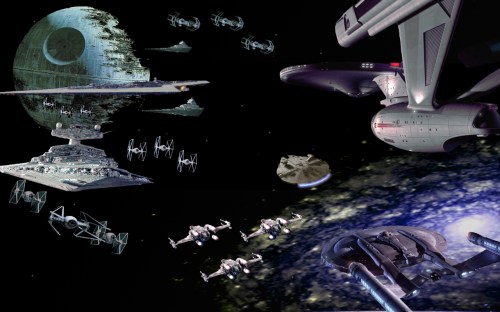
Space opera franchises meet
Universes collide!

 As I’ve noted elsewhere, Abrams does know how to handle ensemble casts and lots of action. On the other hand, I hope that his idiosyncrasies — such as lens flares and certain plot twists seen in Lost and the recently departed Fringe — don’t detract from what makes Star Trek and Star Wars great, each in its own way.  

Any incarnation of Star Trek ought to have a future that we should strive for and want to live in, following Gene Roddenberry’s idealistic vision. The best Trek depicts diplomacy, scientific exploration, and social commentary, not just a Starfleet captain fighting the existential threat of the week (or movie, even if I enjoyed Abrams’ reboot).

For Star Wars, I expect big battles between good and evil, the hero’s journey, and exotic but lived-in settings. Lucas tried to make the mythic relatable through the Skywalker clan. In contrast to Trek‘s “for the good of all mankind,” Star Wars examines the heroic and villainous potential in each person. (The animated Clone Wars has been very good lately, while Trek has yet to return to television. Both have good comic book tie-ins.)

Fortunately, there’s room in both galaxies for lots of stories and interpretations, and both show the value of friendship, altruism, and wonder. There’s a lot of speculation and unrealistic expectations online, but I’m cautiously optimistic. May the Force be with Abrams, and may we all live long and prosper!

The Force is strong with the Mouse House…

By now, genre entertainment fans may have seen the news that Disney is buying Lucasfilm for $4.05 billion. I’ve already seen lots of snarky comments online, but this purchase might be good for the franchise, and by extension, space opera.

Disney buys Lucasfilm
George Lucas and Walt Disney’s creations

I have no love for megacorporate deals, some of Lucas’ more stilted dialogue, or the “nerd rage” of many fans. Get over Jar Jar Binks already — yes, the character is unintentionally offensive, but most small children I observed loved him as previous ones loved R2-D2, Yoda, or Ewoks.

My sources have hinted that Disney has been interested in Lucasfilm for some time, for much the same reason it recently bought Marvel Comics — as intellectual property to mine for profitable ideas.

On the other hand, the fact remains that the Star Wars movies and multimedia helped rescue science fiction from obscurity in the late 1970s, and Lucas handing off his creation to the next generation of directors isn’t necessarily a bad idea.

Lucas has shown greater wisdom when collaborating with other writers than when tinkering with his earlier works, as the excellent Young Indiana Jones Chronicles and Star Wars: Clone Wars demonstrate.

The “expanded universe” of Star Wars novels, comic books, games, toys, and TV shows has generally maintained consistent quality (notwithstanding the occasional cheesy Christmas special). As much as I love other franchises from my youth, such as Doctor Who, Star Trek and Planet of the Apes, I’ve become more of a Star Wars buff.

We’ll have to wait and see if Disney’sEpisode VII” and other sequels continue the dreams born from a kid in California watching old Flash Gordon serials or whether the worst fears of hypercritical fans are again realized. May the Force be with us — always!

Gene the Christmas Jedi
As a Jedi, Christmas 2009

Science fiction games at GenCon 2011

To boldly go...
From the recent Trek MMO

Rounding out my look at some of the news around this year’s GenCon in Indianapolis, here are some observations on science fiction role-playing games. As previously noted, one recent trend is the shift of well-known licenses among game publishers, such as The One Ring for fantasy and Marvel Heroes among comic book games. The Dresden Files RPG (for which a third book may be coming) is another example of a successful tie-in across entertainment media.

Fantasy Flight Games’ announcement that it had won the Star Wars license is in keeping with this trend. There had been some speculation about which company would make the next Star Wars tabletop game, joining West End Games’ popular D6 adaptation and Wizards of the Coast’s polished D20/Saga Edition versions. FFG may look first to the youth market with miniatures, board games, and wargames, since Star Wars: Saga Edition was pretty complete and will be difficult to immediately surpass in quality or sales.

Margaret Weis Productions, whose Cortex system underlies Dragon Brigade, Leverage, and Marvel Heroes, apparently lost the Firefly/Serenity license. Mongoose, which made middling D20 splatbooks and been successful with the latest edition of Traveller, has dropped the Conan and Babylon 5 licenses, even as fans hope to revive those franchises. I’ve enjoyed the sourcebooks for all these fictional universes and look forward to seeing who gets them next.

On the other hand, Mongoose did get Star Fleet Battles and Prime Directive, which are based on the original Star Trek television series (and not its many sequels or J.J. Abrams’ parallel-universe reboot). I already have the GURPS and D20 versions of Prime Directive. I’ve been reading up on Traveller, the granddaddy of space opera RPGs, as part of preparing for my homebrew/sandbox scenarios, so a Traveller/Trek combo could be interesting. Trekkers can also look forward to a board game from WizKids, which used to make Star Wars minis for WotC.

Speaking of my FATE 3e “Vortex” campaign, I recently got Bulldogs. The pulpy SF game (previously in D20) is a good fit for my game — so much so, that I’ll probably refer to it ahead of the hard science fiction Diaspora and the thin Limitless Adventures, if not Starblazer Adventures/Mindjammer, which we used to create characters. The stunts may need tweaking, but Bulldogsrules for alien creation, equipment, combat, and starships are all clearly presented.

In other speculative fiction role-playing, the excellent Stars Without Number will be published in an expanded edition by Mongoose, but the PDF of this retro-clone, sandbox game is still free. I’d compare SwoN favorably with StarCluster 3. I’ve got my hardcopy of the comprehensive Stellar Horizons, and I’m looking forward to the science fiction/horror Ashen Stars and Cthonian Stars/Void (the latter will use its own system).

One reason I’ve enjoyed running “Vortex” is that there’s little danger of either of my face-to-face adventuring parties overlapping in storylines with the many fantasy, horror, or other games that the current Boston-area players are participating in. I’ll blog more about their sessions soon!

29 October 2009: Space opera on TV

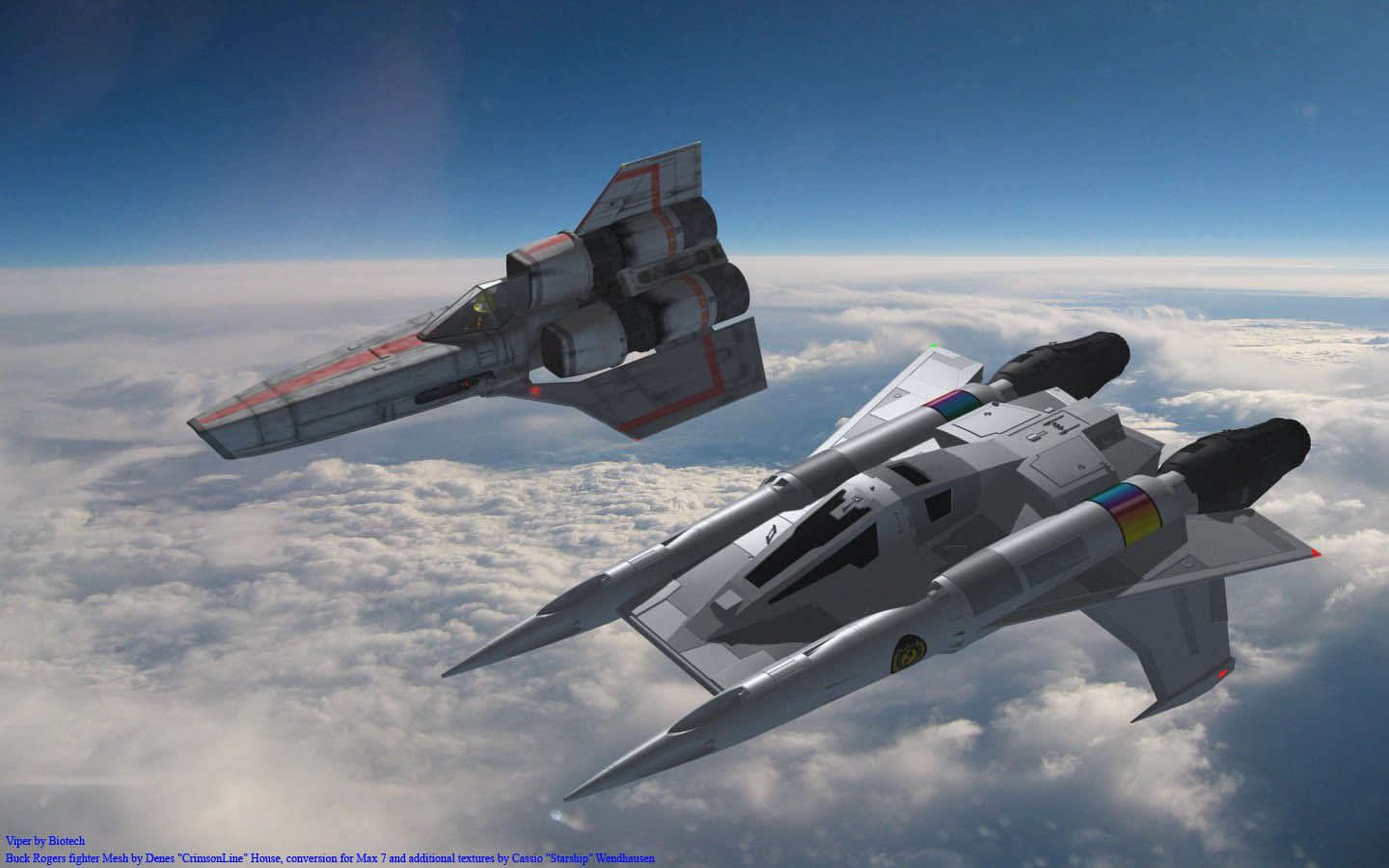
Space fighter craft

This is my fifth and last blog post (for now) looking at the new genre television season by subgenre. I’ve noted before that within speculative fiction — which starts with the question “What if?” — supernatural conspiracy shows, vampire romances, and metahuman melodramas have been more popular lately than space opera. That’s too bad, because my some of first loves in science fiction were the late-1970s TV heroes of Buck Rogers and Battlestar Galactica (see above and reruns), as well as the novels of Isaac Asimov, Robert A. Heinlein, and many others.

The recent success of Star Trek‘s cinematic reboot could be an early sign of the pendulum swinging back to rockets and ray guns. Not surprisingly, the best space opera on the air right now is the computer-animated Star Wars: Clone Wars. Loosely based on the Tartakovsky shorts that took place between Episode 2: Attack of the Clones and Episode 3: Revenge of the Sith, the pilot movie turned off some fans by focusing on young Padawan (Jedi apprentice) Ashoka Tano.

However, since then, I think that Clone Wars has done an excellent job of exploring and expanding various corners of George Lucas’ universe. It has humanized the clone troopers, showed how the Jedi knights are outmaneuvered by the cunning Sith, and demonstrated what Yoda described as the futility of war. Plus, Clone Wars has the blazing space and lightsaber battles, kid-friendly humor, and strange aliens we’ve come to expect from the Star Wars franchise.

I’m still on the fence about Stargate Universe. On the one hand, it’s part of the franchise established by the retro action movie and long-running Stargate SG1. On the other hand, the large conflict-ridden ensemble, dark and shaky cinematography, and focus on survival over heroism are more in the style of Battlestar Galactica: the Plan or Flash Forwardthan I’d prefer.

We’ll see how the major cast and crew changes coming to Doctor Who will affect that British time-travel franchise. I’ve enjoyed its mix of space opera, pseudohistorical swashbuckling, and alien horrors from the Jon Pertwee incarnation through Tom Baker and David Tennant, and I’m willing to give Matt Smith, the eleventh eponymous Time Lord, a shot. Spin-offs include the more adult-themed Torchwood,
the adolescent-aimed Sarah Jane Adventures, and the dubious reboot of K-9
and Friends
. Have a Happy Halloween!