Star Trek: Into Darkness review

On Saturday, 18 May 2013, Janice and I went with houseguest Byron V.O. to the Apple Cinema/Entertainment Cinemas Fresh Pond in Cambridge, Mass., There, we met Beruk A., Bruce K., Rich C.G., Rich’s friend Darryl, and Thomas K.Y. & Kai-Yin H. for Star Trek: Into Darkness. We all enjoyed the sequel to the reboot of the long-running space opera franchise.

Into Darkness wallpaper
J.J. Abrams’ latest space opera prequel/sequel

Story: The movie opens with the starship Enterprise saving the inhabitants of the planet Nibiru from a volcano that’s about to erupt. This violates Starfleet’s Prime Directive, which requires noninterference with societies that have yet to develop Warp (faster-than-light) capability.

Adm. Christopher Pike tells Capt. James T. Kirk that he’s relieved of duty, but terrorist attacks on Earth call the intrepid crew of the Enterprise back into action (the trailers have mostly focused on these, in an echo of 9/11 and even the recent Boston Marathon bombings). Kirk, his first officer Mr. Spock, Dr. Leonard “Bones” McCoy, and friends must overcome physical and personal challenges to save the United Federation of Planets from an internal threat.

Director J.J. Abrams and company created a parallel universe in 2009’s Star Trek to be more accessible to a generation of moviegoers not familiar with the 1960s television show and its numerous spinoffs. However, viewers who are “Trekkies” or “Trekkers” and know the rich history of Gene Roddenberry’s fictional universe will recognize many elements of Into Darkness, including Klingons, Tribbles, and references to characters such as Harry Mudd and Christine Chapel.

I had worried, based on early reviews, that Abrams and Paramount had “gone back to the well” once too often by rehashing familiar plot points, but the acting, pacing, and twists mostly made up for this, and the ending of the movie — don’t worry, I’ll avoid “spoilers” here, but be aware that the links in this review lead to some — leaves the fictional future wide open for more adventures.

Acting: I have fond memories of watching reruns of the original Star Trek TV series back in college, and the actors who first took on those roles have become pop culture icons. Still, I think that the returning cast of the new version has been well-chosen, from Chris Pine as the cocky but good-natured Kirk, Zach Quinto as the (mostly) logical Vulcan Spock, and Karl Urban as the irascible Dr. McCoy. They continue to be worthy successors to William Shatner, Leonard Nimoy, and the late De Forrest Kelley, respectively.

Just as in the original series and the first half-dozen Trek films, the supporting cast is smart and fun. Zoe Saldana is back as strong-willed communications officer (and Spock’s girlfriend) Lt. Nyota Uhura, comedian Simon Pegg is a hoot as engineer Lt.Cmdr. Montgomery “Scotty” Scott, and Anton Yelchin is Russian wunderkind Ensign Pavel Chekov.

Helmsman Lt. Hikaru Sulu, as played by John Cho, doesn’t quite ooze charisma the way George Takei does, but he does get a key scene in the captain’s chair. Bruce Greenwood is back as Adm. Pike, lending gravitas and fatherly guidance to impetuous Kirk and repressed Spock.

The latest additions to this iteration of Star Trek are just as good. The comely Alice Eve plays science officer Carol Wallace, and RoboCop and Buckaroo Banzai‘s Peter Weller is Adm. Alexander Marcus, who tasks the Enterprise with taking on mysterious torpedoes. There’s also a cameo that actually helps the story along.

As expected, Benedict Cumberbatch (the lead of the BBC/PBS Sherlock and Smaug and the Necromancer in Peter Jackson’s Hobbit adaptations) is formidable as John Harrison, the terrorist scientist of this movie. He’s both strong and clever as a foil to both Kirk and Spock and is a better villain than Romulan miner Nero in its predecessor flick.

Script: The dialogue is fast, witty, and filled with catchphrases from the ’60s series. I suspect that casual viewers or those who aren’t science fiction fans won’t find the banter as entertaining as we did, but this is a sequel that doesn’t talk down to its viewers. There is some dodgy physics, such as a “cold fusion” bomb, odd rates of acceleration and descent, and sound in space, but Trek is part of a long tradition of science in service to character-based stories rather than a lesson in realism.

While I’d prefer that a Star Trek film occasionally focus on exploration and diplomacy rather than military space opera, at least the script mentioned those concerns.

Direction: Abrams keeps up a brisk pace and gets emotive performances from the cast of Star Trek: Into Darkness. I might disagree with his addiction to lens flares and the choreography of a few fight scenes, but Abrams has injected vitality into the franchise, and I hope that Disney’s recently acquired Star Wars universe is in good hands.

Visual effects: Other than the science quibbles above, Into Darkness is spectacular, as its crew faces off against hovering aircraft, hostile Klingon vessels, and a monstrous Dreadnaught-class starship. I liked seeing more of Earth in the 23rd century, and the sleek interior of the Enterprise seems larger than any of the other renditions of the famous starship, including the NCC 1701-E of First Contact onward.

Soundtrack: The classical score, while still not as memorable as that of earlier movies, continues the themes from the ’09 Trek. My favorite part is closing credits of Into Darkness, with its peppy recap of the music from the 1960s show, despite the movie’s grim title and premise.

Ratings: At an early dinner at Bertucci’s, the consensus was about an 8 out of 10, with Rich being the most critical at a 7 and Bruce being most generous with a 10. I’d give Star Trek: Into Darkness, which is rated PG-13 for violence and unnecessary language, 8.5, a B+/A-, or four out of five stars.

As usual, there are mixed to negative reviews out there, but I’d recommend that potential fans keep their expectations in check and go in with an open mind. We were pleasantly surprised to find that Into Darkness, for all its modernizations and minor inconsistencies, still felt like classic Trek. I’d like to see Star Trek return to television, where it can focus more on idealistic social commentary rather than villain-driven fisticuffs.

Of the trailers we saw, I’m still most interested in Neil Blomkamp’s dystopian Elysium and least interested in Jerry Bruckheimer’s campy Lone Ranger. Man of Steel is the next big summer movie I’m looking forward to. In the meantime, live long and prosper!
Star Trek, Star Wars share skipper

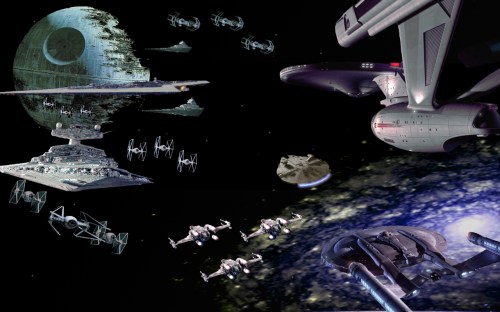
One of the biggest items of genre entertainment news last week was the revelation that J.J. Abrams will direct Star Wars Episode VII, sometime soon after he finishes work on Star Trek: Into Darkness. It is surprising that one person will be helming the latest iterations of the two most popular and profitable space opera franchises.

Space opera franchises meet
Universes collide!

 As I’ve noted elsewhere, Abrams does know how to handle ensemble casts and lots of action. On the other hand, I hope that his idiosyncrasies — such as lens flares and certain plot twists seen in Lost and the recently departed Fringe — don’t detract from what makes Star Trek and Star Wars great, each in its own way.  

Any incarnation of Star Trek ought to have a future that we should strive for and want to live in, following Gene Roddenberry’s idealistic vision. The best Trek depicts diplomacy, scientific exploration, and social commentary, not just a Starfleet captain fighting the existential threat of the week (or movie, even if I enjoyed Abrams’ reboot).

For Star Wars, I expect big battles between good and evil, the hero’s journey, and exotic but lived-in settings. Lucas tried to make the mythic relatable through the Skywalker clan. In contrast to Trek‘s “for the good of all mankind,” Star Wars examines the heroic and villainous potential in each person. (The animated Clone Wars has been very good lately, while Trek has yet to return to television. Both have good comic book tie-ins.)

Fortunately, there’s room in both galaxies for lots of stories and interpretations, and both show the value of friendship, altruism, and wonder. There’s a lot of speculation and unrealistic expectations online, but I’m cautiously optimistic. May the Force be with Abrams, and may we all live long and prosper!

Star Trek: the greatest generation

On Thursday, 29 November 2012, I met former co-worker and fellow blogger Ken G. and members of the Boston Sci-Fi Meetup for dinner, drinks, and conversation at Boston Beer Works near Fenway Park. We then went to the screening of Season 2 episodes of Star Trek: the Next Generation that have been remastered in preparation for the Blu-Ray release. I enjoyed the camaraderie, the special features, and the look back at one of the best space opera TV shows as it reached its prime 25 years ago.

Cast photo for ST:TNG Season 2
Command crew of the starship Enterprise, NCC 1701-D, as of Season 2

Q Who?” introduced the Borg, who would become one of the franchise’s greatest villains. John de Lancie’s nearly omnipotent mischief maker played off nicely against Patrick Stewart’s Capt. Jean Luc Picard and the rest of the command crew of the U.S.S. Enterprise NCC 1701-D. The remastered special effects were clean, although the colors and lighting seemed a bit too dark at times. The audio was excellent, with the starship sounds more pronounced during the opening credits and space battles.

A Measure of a Man” included 13 minutes of restored scenes from Melinda Snodgrass’ thoughtful script. Jonathan Frakes as Cmdr. William T. Riker, Stewart, and Brent Spiner as Lt.Cmdr. Data all got to shine in their roles exploring android Data’s legal rights as a sentient being in the United Federation of Planets. The episode included references to the original 1960s TV series (TOS) and held up remarkably well. I’m glad that Snodgrass’ character moments were added back in.

Both episodes showed the crew of the Enterprise growing more comfortable with one another as the storylines improved. While I disagree with the producers and many fans who wanted darker, more conflict-driven episodes in defiance of Gene Roddenberry’s wishes, I think Next Gen‘s (TNG) middle seasons did a great job of balancing character, episodic plots, and Roddenberry’s hopeful vision of the future.

The interviews with cast members, bloopers, and glimpses at the restoration process for Seasons 1 through 3 of TNG added much insight. It was nice to see the actors still joking around, learn about why Gates MacFadden was really fired (for protesting sexist scripts), and whet our appetite for remastered versions of “Yesterday’s Enterprise,” “Sins of the Father,” “Best of Both Worlds, Part 1.”

Reunion of ST:TNG cast
Reunion of the cast of Star Trek: the Next Generation

Star Trek, including The Next Generation, helped set the template for many other genre television in the decades that have followed. Like Trek, Battlestar Galactica, Stargate, and Babylon 5 had an initially successful military space opera — TOS, the 1970s show, the 1980s movie, and the 1990s TV series, respectively. The best of these showed teams of co-workers become friends as they saved humanity and the galaxy time after time.

Each was followed by a ship-based TV revival (TNG, Ron Moore’s BSG, and Stargate SG1), a darker and more intricate stationary show (Star Trek: Deep Space Nine, Caprica, and Stargate: Atlantis) and a weaker return to a ship-based action series (Voyager/Enterprise, Razor/Blood & Chrome, Stargate: Universe, and Crusade, respectively). All had episodes featuring time travel or flashbacks, shared hallucinations, foes turned friends, and many other speculative fiction tropes codified by Trek.

Even space operas that didn’t have spinoffs owe a heavy debt to Roddenberry and crew, such as Andromeda, Farscape, and Firefly/Serenity. I’ve been a fan of all of these shows, but the familial relationships of TNG and Roddenberry’s heroic idealism still resonate with me more than many of that show’s peers, spinoffs, and successors.

Now that more information is becoming available for the sequel to J.J. Abrams’ reboot, I’m still cautiously optimistic. I’d prefer a less villain-driven plot, which looks to use Benedict Cumberbatch’s Khan Noonien Singh or Gary Mitchell as an analogue for Osama Bin Laden. Star Trek‘s final frontier still beckons. Live long and prosper!

Captain’s log…

Like memes, quizzes circulate endlessly online. I’m satisfied with this result, even if I thought I’d be more like Capt. Picard….
You are James T. Kirk (Captain)

James T. Kirk (Captain)
65%
Will Riker
60%
An Expendable Character (Redshirt)
60%
Chekov
55%
Geordi LaForge
55%
Worf
55%
Deanna Troi
55%
Mr. Sulu
50%
Jean-Luc Picard
50%
Spock
49%
Leonard McCoy (Bones)
45%
Uhura
45%
Mr. Scott
40%
Data
36%
Beverly Crusher
30%
You are often exaggerated and over-the-top
in your speech and expressions.
You are a romantic at heart and a natural leader.


Click here to take the “Which Star Trek character am I?” quiz…

Gene at the Star Trek Experience
On the bridge of the U.S.S. “Enterprise” NCC 1701-D


Our continuing mission…

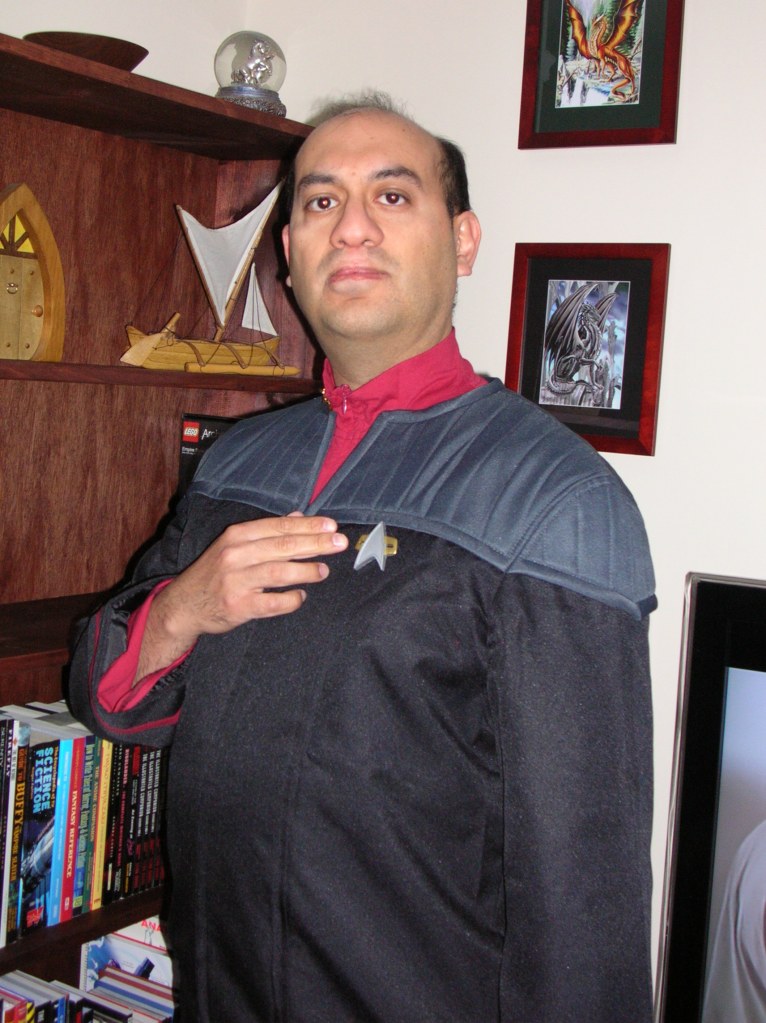
As some of you may know from my report of this past weekend’s successful steampunk festival, I collect costumes, among other things. As a longtime “Trekker/Trekkie,” I already have the boots, phaser pistol, and gold command tunics for the classic 1960s television series. In addition, I recently ordered a shirt and jacket in the style of Star Trek: Deep Space Nine/Nemesis uniforms. The space opera garb arrived from China less than two weeks after I ordered it.

Star Trek garb
These are the voyages....

The materials and stitching are good, especially for the gray yoke. I’ll have to be careful with the small zippers. I may eventually replace the red mock turtleneck with one of a heavier material and use my metal rank pips and comm badge pin rather than the plastic ones that were Velcroed or sewn on. The jacket’s sleeves are a bit short, and the cuffs are a bit wide, but that’s because of my personal proportions and can be altered by a tailor (paging Elim Garak).

Capt. Tzu Tien Lung
One to beam up!

This costume resembles my image for “Capt. Tzu Tien Lung,” the commander of the U.S.S. Tempest in a homebrew GURPS 3e Space game that Steve M.R. ran in Virginia back in the mid-1990s. Although J.J. Abrams has rebooted the movie franchise and is working on a sequel, as the Star Trek Online MMO and some tabletop campaigns have shown, many fans are interested in continuing the universe of Star Trek: The Next Generation.

Sketch of Capt. Tzu
Sketch of Capt. Tzu

While I don’t have a Blu-Ray player, I am curious about the latest remastered episodes of Star Trek. I also hope that we can recover and build on real-world human spaceflight capabilities. Live long and prosper!