If you like director Quentin Tarantino‘s other movies, you know what to expect: snappy dialogue, some satire, homages to multiple film genres, and over-the-top violence. There has been some controversy over the film’s depiction of slavery and shootouts, but I think it’s good that American audiences are queasy in the face of the “peculiar institution” and gunfights. The “N word” is used to both shock and remind modern audiences of the original sin of the U.S. and its pernicious justifications.
Django‘s story is simple — Dr. King Schultz, an itinerant German dentist and bounty hunter, frees slave Django, who helps him track down and kill wanted criminals in return for help finding his wife Brunhilde, so named by previous owners. It turns out that Brunhilde is being kept at the plantation of Calvin Candie, whose right-hand man Stephen is wary of Schultz and Django’s cover story as slave dealers.
As usual, Tarantino has an excellent cast to work with, including Golden Globe winner Christoph Waltz as Dr. Schultz, Jamie Foxx as Django, and Kerry Washington as Broomhilda. Waltz was also in Tarantino’s similar World War II vengeance fantasy Inglorious Basterds. Calvin Candie is played to slimy perfection by Inception‘s Leonardo DiCaprio, and Samuel L. Jackson shows how some people internalize oppression as the nasty Stephen.
Django Unchained‘s supporting actors are no less familiar, including almost unrecognizable appearances by Don Johnson, Franco Nero (the original Django), Tom Wopat, Russ and Amber Tamblyn, Bruce Dern, Johah Hill, and Zoe Bell. The director himself makes a cameo.
The cinematography and eclectic soundtrack show Taratino’s many influences, from classic and spaghetti westerns, to 1970s Blaxploitation, to postmodern westerns such as Unforgiven. The bloody battles and slayings have their roots in The Wild Bunch, and the scary hillbillies could have been in Deliverance or Pulp Fiction. Scenes mocking a lynch mob reminded me of Blazing Saddles and O Brother, Where Art Thou? (incidentally, two of my favorite movies).
Overall, I’d give Django Unchained, which is rated R for graphic violence, a B+, eight out of 10 stars, or three and a half out of five stars. It’s not for everyone, but those who like Tarantino’s oeuvre will find the movie satisfying. It did make me want to dust off RPGs Boot Hill or Sidewinder.
This past year was a busy one for genre television. I had meant to post my first impressions of the new fall season, but I struggled with how to organize it: short lists, or detailed analyses? By subgenre, night of the week, or network? At least a few additional months have given me perspective on the shows I like most and least.
Janice and I tend not to watch a lot of reality shows, situation comedies, crime dramas, or serialized soap operas, so you’ll have to look elsewhere for reviews of those types of shows. In live-action TV, we do watch some procedurals, with Masterpiece: Mystery and the secondseason of the modernizedBBC/PBS Sherlock as favorites.
Doctor Who and Sherlock Holmes
The competingElementary is decent, if not quiteas brilliant as its British forebears. Castle has managed to balance humor and drama, as has White Collar, even though both have occasionally veered too far into gruesome melodrama on the one hand or silly romance on the other. At the same time, I look forward to the goofy shout-outs to the 1980s and ’90s in Psych.
I’d put do-gooder capers such as the original Mission Impossible in a closely related category. This includes the recentlycanceledLeverage (whose tabletoprole-playing game is the best implementation of the Cortex system) and Hu$tle. I haven’t been following popular detective shows such as Bones and the remake of Hawaii Five-O.
In the related genre of supernatural crime fighters, I thought that the canceled Awake was decent. I preferGrimm, which has inherited some of Buffy: the Vampire Slayer and Angel‘s writers and style, to the fairy tale soap Once Upon a Time.
Fringe is in a league of its own, with the mind-bending perspectives of Farscape and the procedural style of The X-Files. I’ll miss Fringe, which is at least going out strong. I haven’t been following Supernatural.
On the slightly more realistic side, thrillers such as Homeland, Person of Interest, and Last Resort have been pretty good, but I dropped Nikita, which of course outlasted much of its competition. What have you been watching?
6. Skyfall. James Bond made a triumphant return, melding modern grit and parkour with many small homages to 50 years of films. Skyfall also served as a “soft reboot,” restoring a status quo familiar to fans of the superspy. I haven’t yet seen female-led actioners Haywire or Underworld [4]: Awakening.
5. Looper. I was initially wary of this time-travel tale, but the world-building and seasoned actors won me over. To be fair, I didn’t see MenInBlack III, which used a similar plot device for comedic effect, or the remake of mind-bender Total Recall. Dredd and IronSky were other speculative fiction flicks I missed.
4. ParaNorman. This heartfelt gothic Halloween story ended up being my favorite animated picture of the year, edging out Studio Ghibli’s Borrowers adaptation The Secret World of Arrietty, the funny The Pirates! A Band of Misfits, Disney’s beautiful Brave, and the syncretic Rise of the Guardians. I haven’t seen Hotel Transylvania, Frankenweenie, and Wreck-It Ralph, but I’m sure I’ll catch them eventually thanks to nieces and nephews.
3. John Carter. Several mainstream media critics have put this planetary romance on their “worst of 2012” lists, but I enjoyed the film, which combined the precursor to much space opera with modern visual effects and pacing. It was also less pretentious than Avatar or Prometheus. Speaking of retro sensibilities, I haven’t yet seen likely Oscar contendersArgo, Lincoln, or Django Unchained.
2. The Avengers. After years of buildup, Joss Whedon’s superhero teamup flick turned out to be perfect popcorn escapism. I preferred it to the dour Dark Knight Rises, which was well-done but less fun. I preferred the gonzo first Ghost Rider to its wan sequel Spirit of Vengeance. The Amazing Spider-Man was a decent comic book reboot, but the strong cast wasn’t enough to overcome the feelings of déjà vu.
1. The Hobbit: An Unexpected Journey. Peter Jackson’s fantasy prequel has garnered much criticism for stretching out J.R.R. Tolkien’s slender novel, but it was still satisfying to return to Middle Earth. The first part of another trilogy may not equal Lord of the Rings: Fellowship of the Ring, but it was better than Snow White and the Huntsman or Mirror, Mirror. I’ve heard mixed reviews for the mythic Wrath of the Titans.
At the movies in Boston
In 2013, I’m most looking forward to continued revival Star Trek: Into Darkness, kaiju vs. giant robots in Pacific Rim, a new Superman in Man of Steel, and The Hobbit: the Desolation of Smaug.
I don’t yet know whether fantasy flicksJack the Giant Slayer or Oz: the Great and Powerful, the postapocalyptic After Earth or Elysium, or the superheroic sequels Iron Man 3, The Wolverine, or Thor 2 will be worth the hype. So much to see, so little time!
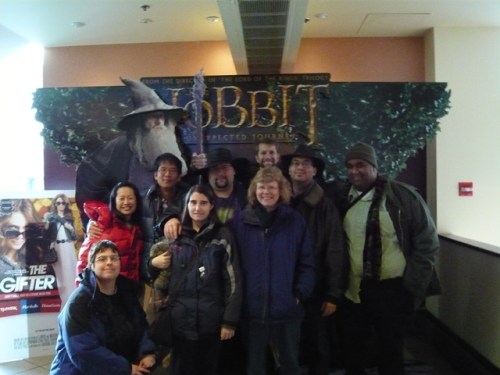
On Saturday, 15 December 2012, Janice and I met Beruk A., Thomas K.Y. & Kai-Yin H., Ken G., Josh C. & Sara F., and Robin H. at the AMC Loews Boston Common to see The Hobbit: An Unexpected Journey. We all enjoyed Peter Jackson’s latest adaptation of J.R.R. Tolkien’s classic fantasy novels.
The gang for An Unexpected Journey
I’ll try to avoid plot/script “spoilers,” but if you haven’t yet read the original book, do so! An Unexpected Journey follows eponymous Hobbit Bilbo Baggins as he evolves from a retiring country gentleman in the Shire to become an adventurer alongside 12 Dwarves and the wizard Gandalf. On the way to the Lonely Mountain, they encounter warg-riding Goblins, Elves, Trolls, and more, all harkening back to the Norse tales that Tolkien studied and loved.
Director Jackson and company fold in plot threads from the appendices of The Lord of the Rings, expanding many scenes and characters. Since Jackson filmed more than four hours’ worth of footage for each installment of the previous trilogy, it should come as no surprise that he expanded on The Hobbit. I have fond memories of a marathon screening of the first trilogy’s extended editions in New York City with cast members present, so I am perhaps the target audience.
That’s what Bilbo Baggins hates!
The tone of the prequel is close to that of “LotR,” but with a bit more humor, as in the book, and slightly less violence — but maybe still too much for young children. I was pleased to hear much of Tolkien’s language in An Unexpected Journey, including a few songs and poems (some of us still remember the Rankin-Bass animated attempt). As a longtime Tolkien fan, this helped balance out the newer additions to the story.
One of the strongest components of An Unexpected Journey was the cast. It was nice to see familiar faces again, including Ian Holm as the older Bilbo and Elijah Wood as young Frodo in a framing scene. Of course, it’s now difficult to imagine mischievous Gandalf without picturing Ian McKellen, and Hugo Weaving and Cate Blanchett are back as regal Elves Elrond and Galadriel, respectively.
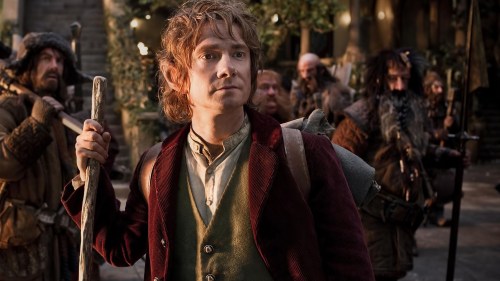
Fans of British genre television and movies should recognize many of the actors, at least by name. Martin Freeman is ever the befuddled Englishman, whether it’s in The Office, Shaun of the Dead, The Hitchhiker’s Guide to the Galaxy, Sherlock, and now as young Bilbo in The Hobbit. But as Gandalf notes, he’s more clever, hardy, and ethical than meets the eye.
Bilbo Baggins, the bravest little Hobbit of them all
Even with a three-hour runtime, we get to know only a few of the Dwarves in The Hobbit, but Robin Hood‘s Richard Armitage stands out as honorable Thorin Oakenshield, and Being Human‘s hunky Aidan Turner as young Dwarf Kili might be a rival for the affections of fans of Orlando Bloom’s Legolas. Jekyll‘s James Nesbitt has some sympathetic moments as Bofur, and Ken Stott is sagacious as older Dwarf Balin.
Far over the Misty Mountains cold….
Doctor Who‘s Sylvester McCoy is the twitter-pated (literally) wizard Radagast the Brown. Those playing the villains are just as experienced. Andy Serkis, now also second-unit director for The Hobbit, is a delight as the nasty Gollum. Comedian Barry Humphries, best known as Dame Edna, is unrecognizable as the Great Goblin, while Spartacus‘ Manu Bennet is fearsome as Orc leader Azog.
It was also nice to see familiar Middle Earth locations, such as Bilbo’s comfy estate of Bag End in Hobbiton and Elrond’s Last Homely House in Rivendell. Jackson also shows us Dwarf cities in their full glory and violent decline, a Goblin town beneath the Misty Mountains, and the depths of Mirkwood. All of the architecture, costumes, and props are again excellent.
Many critics have taken issue with the movie’s length and editing, and I agree that they could have been tighter. Still, trimming a few sequences of Bilbo and company hiking or computer-enhanced battle scenes wouldn’t make An Unexpected Journey much shorter, and I’m glad that so many character moments and scenes from the book made it into the film. The flow of the story from scene to scene could have been smoother — reminding me of both tabletop and computer role-playing games — and I hope it will improve in later chapters of this new trilogy.
Unlike practical visual effects and makeup, the storm giants and the aforementioned Azog and Goblin king do look computer-generated, unlike the expressive but still realistic Gollum or Trolls. I think that comparisons to Star Wars Episode I: The Phantom Menace, even if they’re accurate, reflect “nerd rage” more than a fair critique. I didn’t see the movie in 3-D, IMAX, or high frame rate formats, so I’ll leave that to other reviewers to describe. Howard Shore’s latest soundtrack was also good, and it alluded to the soaring themes of Lord of the Rings.
Overall, I’d give The Hobbit: An Unexpected Journey, which is rated PG-13 for violence, an 8 out of 10, four out of five stars, or a B+/A-. For me, that’s about on par with The Two Towers, if not as satisfying as The Fellowship of the Ring or Return of the King. Compared with most other fantasy films, I’d still recommend the The Hobbit and remind moviegoers that it has been a generation since we’ve had so many to choose from.
Most of the trailers we saw before The Hobbit were for science fiction flicks rather than fantasies. Both Tom Cruise’s Oblivion and Will Smith’s After Earth post-apocalyptic visions had cool hardware but seemingly predictable plots. Romantic zombie comedy (when did you think you’d see those together?) Warm Bodies looked mildly amusing.
After the movie, we went to the Rock Bottom Brewery for a late lunch. On Sunday, Janice and I attended “A Celtic Christmas Sojourn” at the Cutler Majestic Theatre in Boston. I hope that all your holidays are happy!
Rise of the Guardians follows Jack Frost, a boy who is granted supernatural abilities and meets other seasonal icons, including a sword-wielding Santa Claus, the cute Tooth Fairy, a mute but expressive Sandman, and an inexplicably Australian Easter Bunny.
These seasonal superheroes find themselves fighting the Boogeyman and his nightmares to defend the hopes and dreams of children everywhere. Sure, we’ve seen all of the elements before, but how they’re represented and mixed is a feast for the eyes. In terms of computer animation, I’d put Rise of the Guardians very close to Disney/Pixar’s Brave (its rival for awards), as well as to the How to Train Your Dragon franchise.
The voice casting is pretty good, with Star Trek‘s Chris Pine as Jack Frost, The Shadow‘s Alec Baldwin as Santa, Isla Fisher as the lead Tooth Fairy, X-Men‘s Hugh Jackman as the Easter Bunny, and Jude Law as Pitch Black, the Boogeyman.
Rise of the Guardians is based on a series of children’s books that William Joyce wrote for his late daughter. Guillermo del Toro was one of the producers, and the movie does have some of his love of the fantastical.
Dreamworks’ decidedly non-denominational film appropriates Christian and pagan iconography, most of which will go over the heads of most viewers. It reminded me of L. Frank Baum’s Life and Adventures of Santa Claus, which was one of the more eccentric adaptations done by Rankin-Bass.
While it’s no Lincoln, I’d give Rise of the Guardians, which is rated PG for some violence, about a B+, three out of five stars, or a 7.5 out of 10. Of the previews we saw, Jack the Giant Slayer looks like what I’d call a classic fantasy gamer flick. Josh, Sara, Janice, and I later enjoyed lunch at The Restaurant in Woburn, Mass. Next up: The Hobbit [Part 1 of 3]: An Unexpected Journey!






 Gene's Worlds