Birthday dinner, 2011

My birthday dinner
Hangar steak at Blue Ginger

Thanks again to all the friends and family who sent birthday wishes! Being 43 isn’t so bad — so far. I didn’t go to my high school reunion in Westchester, New York, this past weekend because only a few of the people I was friends with 25+ years ago were attending (we’ll arrange an informal gathering in spring of 2012). On Saturday, 15 October 2011, Janice and I browsed among the shops in Wellesley, Massachusetts, including the Wellesley Booksmith and Wasik’s Cheese Shop.

We then met Thomas K.Y. & Kai-Yin H. for dinner at Blue Ginger, the restaurant of celebrity chef Ming Tsai. We had talked about eating there for years, and we finally managed to get a reservation a week in advance. The Asian fusion cuisine was very good, and the open kitchen was a nice touch. (I’ve posted versions of this review to Yelp and Zagat‘s Web sites.)

For appetizers, we had the tender salmon and beef carpaccio, attractive charcuterie plate, and shiitake-leek spring rolls. For entrees, we ordered tasty hangar steak, nicely spiced Vindaloo-glazed lamb, and flaky Alaskan butterfish.

For dessert, we ate a sorbet trio with a ginger kick, spiced buttermilk donuts, a sweet petit four plate, and foie gras-shiitake shumai. (Janice also baked me a chocolate cake at home.) The dishes were all an interesting blend of flavors, if a bit rich and pricey. The service was prompt and efficient. I’d definitely recommend Blue Ginger for special occasions.

Thomas asked an interesting question: How would I compare Blue Ginger with Tango and Smith & Wollensky, where we’ve dined together previously? Although the cuisines are different, we’ve ordered steak at all three. I thought that Smith & Wollensky, at which Beruk A. and I joined Thomas, Stuart C.G., and Stuart’s son in Boston a few years ago, was the best but also the most expensive.

Tango, an Argentinean steakhouse in Arlington, Mass., had a somewhat more limited menu, but I’d rate it slightly higher than Blue Ginger, whose dining room was a bit noisy. We also discussed our busy schedules, travel, and other eateries to try, such as Summer Shack in Dedham, Texas Roadhouse in Walpole, and Petit Robert Bistro and Rice Barn in Needham. Of course, if money and time were no object, I’d happily eat at any of these places.

Coming soon: More genre TV roundups, New York Comic-Con announcements, gaming updates, and more…
Autumn 2011 genre TV, Part 2

Thrillers and superspies
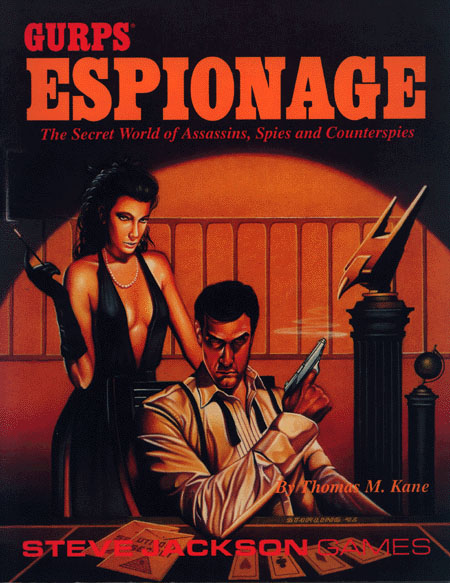
RPG sourcebook related to midweek genre TV

Continuing my look at the new television season, on Tuesdays, Janice and I have been watching Top Shot on the History Channel. We like the use of a range of archaic weapons, if not the cutthroat competitiveness of some participants.

In addition to catching up on genre shows recorded on Sundays and Mondays, I look forward to the eventual return of the sleuths on White Collar and Memphis Beat. Janice is taking a yoga class this fall.

I haven’t added comedies such as The New Girl or Two Broke Girls to my viewing schedule, but I liked what little I saw of them more than the Mad Men-inspired Pan Am or even the already canceled The Playboy Club.

On Wednesdays, most of the shows I’ve watched in the past few seasons are not returning: Reaper, Eastwick, and Human Target, to name a few. I still occasionally watch food TV such as Diners, Drive-ins, and Dives and Man vs. Food NationBitchin’ Kitchen is my current favorite.

The goofy sleuths on Psych return tonight. If you liked David Lynch’s surrealistic Twin Peaks (whose cast had a reunion on Psych) or the psychosexual horror of some of True Blood, you’ll probably like FX’s American Horror Story. It’s a bit dark for my tastes, but it’s better than most of the schlocky “reality” programming on SyFy or the History Channel.

On Thursdays, I’ve dropped spy show Nikita, which of course then got renewed. Also last season, I watched Undercovers, which got canceled, but not Covert Affairs, which also got renewed. I wasn’t impressed by the latest version of Charlie’s Angels, whose actresses are less jiggly, glamorous, or interesting than their predecessors and who are hampered by weak scripts.

I have picked up Person of Interest, created by Jonathan Nolan, brother of The Dark Knight director Chris Nolan. Like that movie, it explores the implications of ubiquitous surveillance, and it’s a paranoid post-9/11 technothriller similar to the aforementioned Homeland. The distrustful team of a computer genius and a former commando inserting themselves into the lives of people who need help reminds me of The Prisoner, The Pretender, and Human Target.

I’ll save Friday, which is the most crowded night of the week for genre TV fans, for an upcoming post. What are you watching?

Latest Comics Wednesday lists

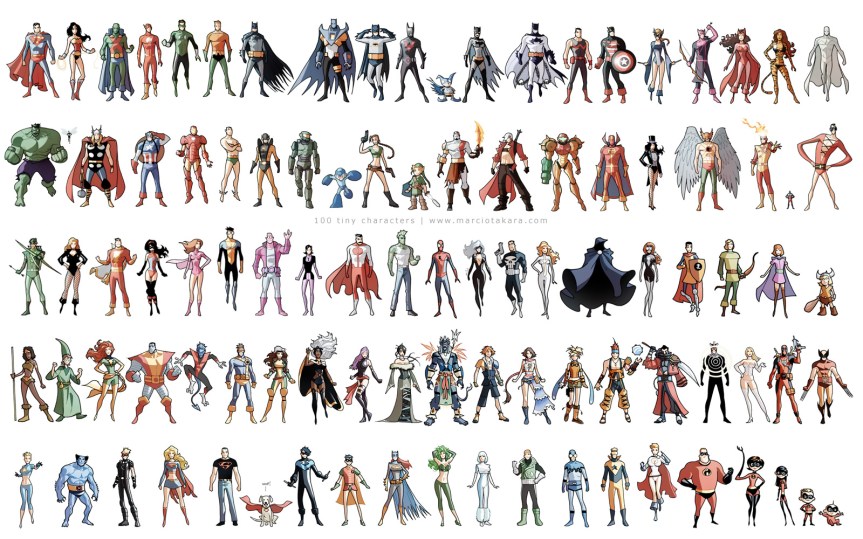
From DeviantArt.net
100 comic book characters

Since today is when many comic book fans visit their local shops to get the latest issues of their favorite titles — and I’m still catching up on work and gaming notes — here’s a quick rundown of what I’m currently subscribing to.

In particular, as DC Comics’ renumbering/reboot continues, the initial reviews have been mostly positive. So far, I think the experiment has been a success at getting print and digital issues out on time, increasing awareness in the wider public, shaking up continuity, and reviving characters such as Aquaman. We’ll see whether DC can keep up its sales numbers.

Yes, several of the costume redesigns aren’t especially good (Teen Titans and Birds of Prey), there’s an emphasis on horror (Justice League Dark) over all-ages superheroes. While DC’s reboot includes a few well-written female characters (Batwoman), other titles feature blatant pandering and sexism (Red Hood and the Outlaws). Overall, however, I’m still buying and reading more DC than Marvel.

Good, already subscribed to Issue 2 and beyond:

Batfamily: Batgirl, Batman and the Brave and the Bold (animated), Batman and Robin, Batwoman, Birds of Prey, Detective Comics

Other DC Universe: Action Comics (young Superman!), Aquaman, Green Arrow, Justice League, Wonder Woman, Young Justice

OK, might keep buying:

Batfamily: Catwoman, Batman, The Dark Knight, Huntress, Nightwing

Other DC Universe: Static Shock, Superman, Teen Titans, Zatanna

Dropped: Red Hood and the Outlaws

-David I.S. getting: All-Star Western, DC Universe Presents, Mr. Terrific, Resurrection Man

Not getting (doesn’t include Vertigo): Animal Man, Batman Beyond, Batwing, Blackhawks, Blue Beetle, Captain Atom, Deathstroke, Demon Knights, Flash, Frankenstein: Agent of SHADE, Fury of Firestorm, Green Lantern, Green Lantern Corps, Green Lanterns: New Guardians, Grifter, Hawk and Dove, I Vampire, JLA Beyond, Justice League Dark, Justice League International, Legion of Superheroes, Legion Lost, My Greatest Adventure, OMAC, Red Lanterns, Savage Hawkman, Sgt. Rock and the Men of War, The Shade, Stormwatch, Suicide Squad, Superboy, Supergirl, Swamp Thing. Voodoo

Marvel: Avengers: Earth’s Mightiest Heroes, Captain America, Mystic

Other publishers: Conan, Doctor Who, Flash Gordon, Godzilla, Guns & Dinos, Jim Butcher’s Dresden Files, Liberty Meadows, Red Sonja, Rocketeer Adventures, The Shadow?, Sherlock Holmes, Star Trek, Star Wars: Old Republic, Steampunk Fairy Tales/Women of Steampunk, Teenage Mutant Ninja Turtles, Warlord of Mars, Zorro Rides Again

Done/dropped: Aladdin/Sinbad, Buck Rogers, 50 Girls 50, Green Hornet, Jungle Girl, Magnus Robot Fighter, New/Mighty/Secret Avengers, Ruse, Thor, Turf, Umbrella Academy

To borrow from David I.S.: Angel & Faith/Buffy: the Vampire Slayer, Domino Lady, Echo, Farscape, Firefly/Serenity, Ghostbusters, Knights of the Dinner Table, Mystery Society

Trades only: Age of Bronze, Astro City, Girl Genius, League of Extraordinary Gentlemen, Mouse Guard, Powers, Wizard of Oz

What are you reading, and why?

Role-playing roundup: Science fiction, fall 2011 edition

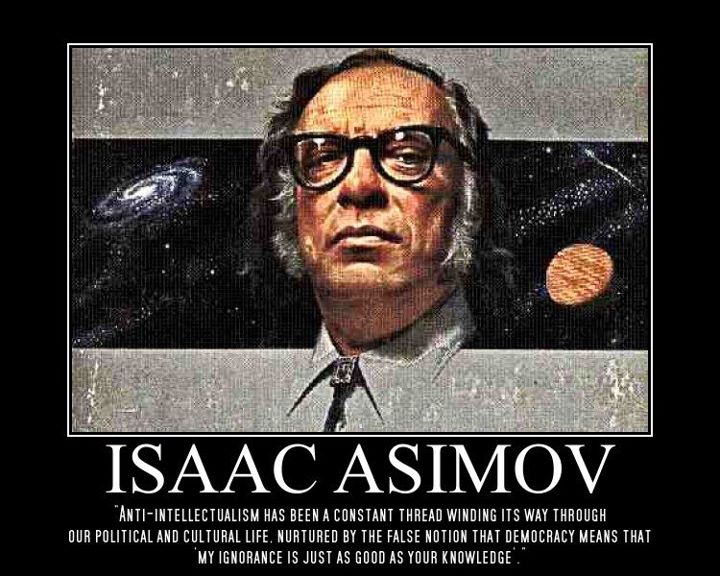
My favorite author
Favorite author Isaac Asimov

Continuing my look at recent role-playing supplements such as The One Ring, I’ve managed to squeeze in reading some sourcebooks in between work, travel, and running games. Fantasy may be the primary genre in which I’ve played — and superheroes, steampunk, and time/dimension travel have yielded many memorable characters — but science fiction is still my first literary love.

As I’ve mentioned before in describing my “Vortex” game, my sandbox setting is largely inspired by classic space opera such as the novels of Isaac Asimov, Robert A. Heinlein, and David Brin. It’s no surprise, then, that I liked the PDFs of Star Frontiers Remastered, StarCluster 3, and Stars Without Number so much that I ordered hardcopies. Stars Without Number is about to get a revised printing from Mongoose, publisher of the latest incarnation of Traveller.

The detailed “future history” of games such as Stellar Horizons and Ashen Stars is similar to that of “Vortex.” (I took a class on the topic back in college.) In these settings, humanity has colonized the Sol system and beyond but faces new threats such as alien horrors, as well as old ones like infighting. I like the political and technical extrapolations of Stellar Horizons and the idea of Player Characters as interplanetary troubleshooters in Ashen Stars.

At the same time, I’ve incorporated elements of more recent cyberpunk and transhumanist fiction in my campaigns. I’ve already used ideas from Panopticon, a supplement for the excellent Eclipse Phase, in recent sessions. I also still regularly refer to GURPS Terradyne, Blue Planet, and Jovian Chronicles for megacorporations, genetically engineered species, and descriptions of colonial life, respectively.

Speaking of mixing genres, the fantasy/cyberpunk Shadowrun has endured even as fashions have changed in the past few decades. I played and ran the game briefly in college. The Fourth Edition and the 20th Anniversary Edition — even though Shadowrun has been around for longer than that — are slick and straightforward, with solid rules (point-buy character creation, dice pools using D6s). I would have preferred more thorough location and faction descriptions rather than “flavor-text” fiction, but that was the style of games from the late 1980s and most of the ’90s.

Similar to Ashen Stars in time period is Chthonian Stars/Void, which has a strong horror bent. I haven’t yet gotten it, and Cubicle 7 did reply to my query about supplements for Starblazer Adventures/Mindjammer and Legends of Anglerre. They’re delayed, but I look forward to eventually using them for “Vortex.” I’m also enjoying the lean FATE version of Bulldogs in the meantime.

After grabbing nearly every star map published for RPGs in the past 30 years, I recently ordered the excellent poster maps from Project Rho Productions. I’ll eventually need every human-habitable system within 100 parsecs, but this is a great start!

Role-playing roundup: Fantasy, fall 2011 edition

Wallpaper for Mouse Guard RPG
Mouse Guard!

In the past few months, I’ve enjoyed reading through some of the role-playing games displayed at this year’s GenCon. During recent visits to game shops and on various message boards, I’ve heard and seen speculation about a fifth edition of Dungeons & Dragons, prompted in part by the return of designer Monte Cook to publisher Wizards of the Coast.

I still feel strangely detached from these discussions because I’m not running or buying D&D4e supplements. Even if I’m not a hardcore grognard as some in the old-school Renaissance, I’ve come to prefer simpler rules, lower-powered scenarios, and heroic role-playing over combat simulation. If D&D5e addresses those preferences as well as some retro-clones do, I might yet return to the popular tabletop fantasy RPG brand.

Fortunately, I lack no support as a Dungeon Master in the meantime, thanks to Paizo’s excellent Pathfinder (a.k.a. “D&D3.75”) line. Although the rules are still complex, the artwork and prose in each book about the Golarion/Inner Sea setting inspires the imagination. The Ultimate Magic and Ultimate Combat books are no exception, with numerous options for Pathfinder Player Characters of all occupational classes.

I found Ultimate Magic to be slightly more useful and better balanced than Ultimate Combat, partly because the latter introduced classes such as the Gunslinger and Ninja that I would limit in my homebrew game. Between them and the Advanced Player’s Guide, any Pathfinder player should have more than enough ways to develop and tweak characters, replacing a veritable pile of D20/Open Game License/D&D3.x splatbooks (many of which I’ve now sold).

On a related note, I recently got the Tome of Horrors Complete for Pathfinder. I was a big fan of the D20 monster book, which revived several old favorites from previous editions of D&D. It included creatures from old adventure modules and the Fiend Folio, including the gold-eating aurumvorax, the statuesque caryatid column, and the floppy flumph. The new compilation has about 800 pages of monsters, with everything from the mysterious dark creepers to Lucifer himself and numerous animals!

Even though I’ve tried to limit the number of sentient species in my “Vanished Lands” campaign setting, I and most of my gamers have enjoyed encountering new beasties in the books and scenarios. The Tome of Horrors Complete is a fantastic addition to Pathfinder‘s Bestiaries I through III.

The Pathfinder: “the Vanished Lands” teleconferencing team is still struggling to get back to its regular Sunday night schedule because we’ve had difficulty getting quorum because of travel and family obligations. I hope that the eight role-players, scattered across the U.S., will soon be able to resume Skype sessions.

As I’ve mentioned before, I’ve considered using FATE 3e Legends of Anglerre for the telecom fantasy game because I think the lighter rules set would be a good fit for that venue. Also from Cubicle 7 is The One Ring, the latest game set in J.R.R. Tolkien’s Middle Earth.

I was favorably impressed by the production value of The One Ring, which overcame some of my initial misgivings about its limited scope — it’s set in the Wilderlands during the Third Age, between the events of The Hobbit and those of The Lord of the Rings. A game with more limited starting options is a good idea for starting players, but then why not outline the charactercreation process more clearly?

What if I was relatively new to the hobby and wanted to replicate a member of the horse-riding Rohirrim or an Elf from Lothlorien because I’ve seen Peter Jackson’s popular films? Just as Iron Crown Enterprise’s Middle Earth Role-Playing stuck too closely to the complicated RoleMaster system and Decipher’s Lord of the Rings RPG relied too heavily on the movies, Cubicle 7 risks confusing fans with its plan to expand its view of that world piecemeal.

That said, I liked The One Ring‘s characterdevelopment mechanics, which encourage altruistic play over the “kill things and take their stuff” mentality that’s all too common in D&D and various videogames. This feature is similar to what I enjoyed in Decipher’s underrated Lord of the Rings (if slightly less so in Lord of the Rings Online multiplayer computer game).

Speaking of encouraging good role-playing, the Mouse Guard boxed set is a thing of beauty. Based on an award-winning set of comics and a streamlined version of Burning Wheel, this would be the ideal way to get my animal-loving nieces into gaming. I strongly encourage fans of anthropomorphic fantasy, such as GURPS Bunnies & Burrows, Redwall, and Shard, to read the collected comics and buy this game.

The boxed set includes a softcover version of the core rulebook (which I already have in hardback), character record sheets, and rules and adventure supplements. The counters are a bit funny, looking like oversized collectible erasers, but even if I don’t get to run Mouse Guard anytime soon, this game will be another rich source for sparking imagination and setting a heroic tone.

I’ve been swamped again with work and travel, but I plan to post about science fiction RPGs, the new TV season, and more as soon as I’m able!