Ray Bradbury, one of my favorite science fiction and fantasy authors, has died. Along with Isaac Asimov, Arthur C. Clarke, and Robert A. Heinlein, he enlightened and entertained me in my youth.
Late author Ray Bradbury
More poetic than many of his Golden Age peers, Bradbury‘s many stories featured a mix of speculation, wonder, and hope for humanity. Here are some of my favorites of Bradbury‘s tales:
Bradbury‘s Something Wicked This Way Comes was the first time I became aware of the potential for horror in Americana, with its sinister carnival. Even memories of the Disney adaptation, starring Jonathan Pryce, send shivers up my spine. Stephen King and HBO’s Carnivale would later develop that theme.
Fahrenheit 451 is a political “What if?” on par with 1984 or Brave New World as a cautionary tale and source of controversy. In the “real world,” paper books are threatened by electronic media, which are just as prone, of not more so, to censorship and invasions of privacy. Bradbury will be missed, but his works live on.
I’ve fallen behind in blogging again, but here’s the first in what I hope will be a series of posts to catch up on what I’ve been up to as spring slides into summer. Now that the genre television season has wound down, let’s look back at some shows that I liked.
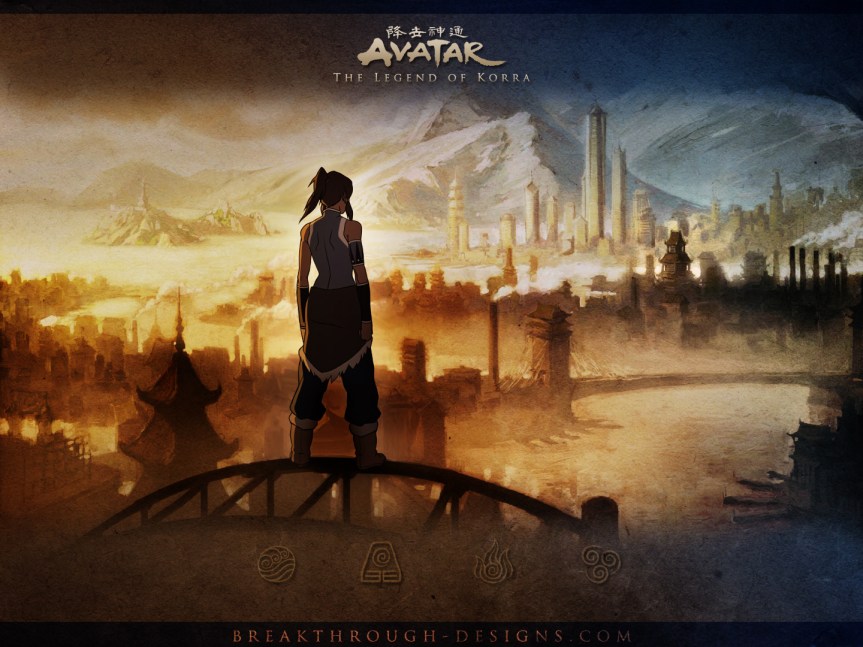
As fellow blogger Thomas K.Y. has noted, Korra‘s adolescent characters are a bit harder to sympathize with than Avatar‘s wandering children. However, the setting and story more than make up for that to me. Republic City resembles a dieselpunk/fantasy China of the early 20th century, and the conflict between people who can “bend” or control the elements (air, earth, wind, and fire) and those who can’t has led to some tense moments.
I’ve also been impressed with the first episode of Disney’s Tron: Uprising, which may join the Cartoon Network’s Star Wars: Clone Wars in using computer animation to flesh out a cinematic sequel that initially underwhelmed critics. In contrast, Kung-Fu Panda: Legends of Awesomeness, Transformers: Prime, and G.I. Joe: Renegadesare entertaining, but they’re not as memorable as additions to their respective franchises.
Cartoon’s Green Lantern: the Animated Series started out slowly with simplistic designs based on Bruce Timm’s, but it has steadily incorporated elements of recent comic book storylines, including the proliferation of cosmic factions based on different colors and emotions. How to Train Your Dragon: the Series will joining a competitive field.
In more traditional animation, the Cartoon Networks’ Thundercatsrevival has also mixed retro nostalgia with more modern animation and world-building to good effect. It’s friendlier to younger audiences than Korra or Tron, but I’ve enjoyed the reboot so far. I hope that the next Teenaged Mutant Ninja Turtles can do the same.
Cartoon Network’s “DC Nation” animation block of programming on Saturday mornings — Green Lantern and Young Justice (followed by Korra on Nickelodeon) — includes very funny shorts with “Super Best Friends Forever” and Aardman stop motion, as well as glimpses of past favorites such as the Teen Titans Go!
Disney Channel’s “Marvel Universe” block on Sundays (Avengers and Spidey) does give some nice glimpses into the art and characters of its shows, plus how real-world athletes can approach comic book moves. I don’t particularly like the “Marvel Mash-ups,” which dub modern jokes over weakly animated scenes from the 1960s through early 1980s. I may be in the minority of people who prefer the gags of The Looney Tunes Show or Metalocalypse on weeknights to most of Fox’s Sunday night programs.
Coming soon: Police procedurals, supernatural series, and movie reviews!
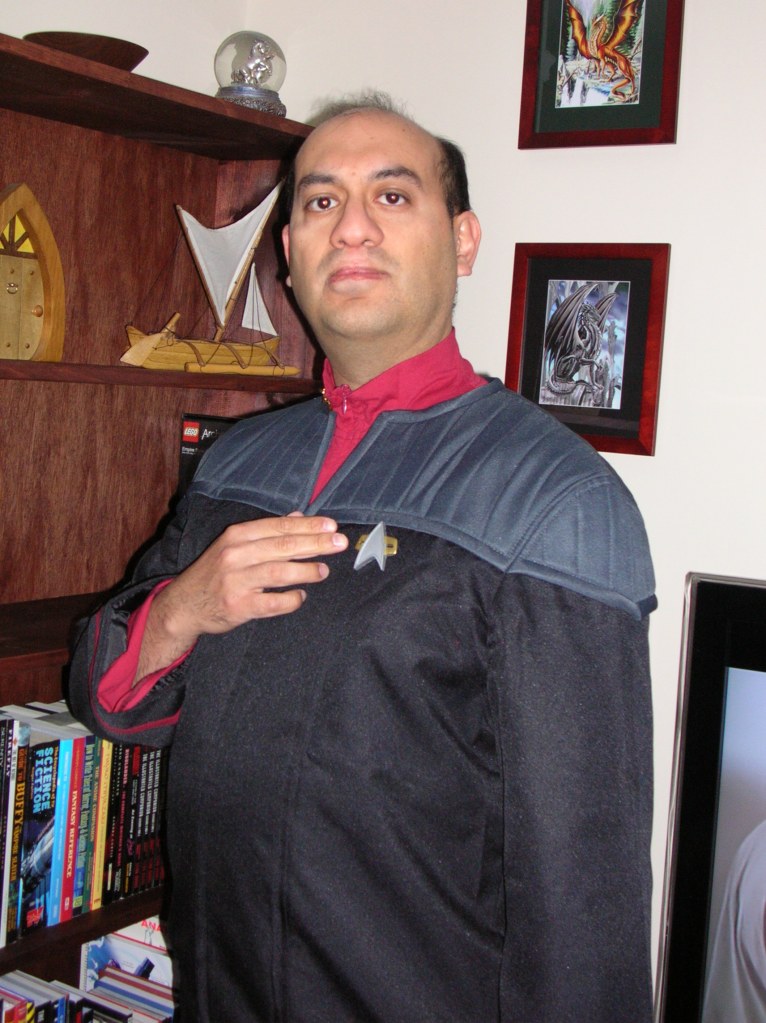
As some of you may know from my report of this past weekend’s successful steampunkfestival, I collect costumes, among other things. As a longtime “Trekker/Trekkie,” I already have the boots, phaser pistol, and gold command tunics for the classic 1960s television series. In addition, I recently ordered a shirt and jacket in the style of Star Trek: Deep Space Nine/Nemesis uniforms. The space opera garb arrived from China less than two weeks after I ordered it.
These are the voyages....
The materials and stitching are good, especially for the gray yoke. I’ll have to be careful with the small zippers. I may eventually replace the red mock turtleneck with one of a heavier material and use my metal rank pips and comm badge pin rather than the plastic ones that were Velcroed or sewn on. The jacket’s sleeves are a bit short, and the cuffs are a bit wide, but that’s because of my personal proportions and can be altered by a tailor (paging Elim Garak).
It is a period of incredible progress and terrible destruction. Communications and transportation grow ever faster, but they also hasten the spread of wars and disease. Old tribal rivalries and nascent social consciousness challenge vast aristocratic and mercantile empires, and urbanization and industrialization make life easier for millions but condemn millions more to seemingly inescapable poverty. The arts blossom as alliances tighten and harden, leading to what many believe will be a “war to end all wars.” It is the Victorian era, the setting for most steampunk.
Gears and gadgets
Steampunk is a style of speculative fiction that has been growing in popularity in the past few years. It has literary roots, readily incorporates elements of other subgenres, and is well-represented across media.
–Steampunk is alternate history. Much steampunk starts with the premise of “What if everything that authors Jules Verne, Edgar Rice Burroughs, and Arthur Conan Doylewrote about was true?” From a North America where the Union didn’t win, to humans hunting dinosaurs (and vice versa), to trips through the ether to a verdant Mars, steampunk combines their wildest dreams.
-Steampunk is romance. The novel, classical and revived folk music (the opera, waltz, and polka), Pre-Raphaelite and Impressionist painting, and modern theater all took shape during the 18th and 19th centuries. The swashbuckling stories of Walter Scott and Alexandre Dumas reflect this era as much as the ones they were set in, as does the “noble savage” described by James Fenimore Cooper or Rudyard Kipling. International cuisine, celebrity fashion, and travel for pleasure (and the first amusement parks) are all things we now take for granted that started during that period.
-Steampunk is science fiction. Just as its sibling cyberpunk examines the relationship of humanity with technology (specifically cybernetics, artificial intelligence, genetic engineering, and nanotechnology), steampunk looks at how the Industrial Revolution reshaped the world. The railroad and the telegraph are only the beginning, with anachronistic conveniences such as personal computers, televisions, and jet packs weighed down by clockwork gears, levers, and dials. Real-world advances in engineering are exaggerated for dramatic effect. Getting there is half the fun, with dirigibles the signature conveyance of the genre.
-Steampunk is fantasy. Like its sibling gothic horror — another product of this era — steampunk often includes elements of the supernatural, just as spiritualism (the forerunner of the modern New Age movement), religious revivals, and utopian experiments were part of the real-world reaction to scientific advancement. Edgar Allen Poe, Lord Dunsanay, L. Frank Baum, and Lewis Carroll inspired J.R.R. Tolkien, Robert E. Howard, and other seminal fantasy authors. Lost civilizations still seemed possible.
-Steampunk is socially conscious. Labor unions, waves of migration, the long struggle for civil rights including women’s sufferage, and the polemics of Charles Dickens and Karl Marx are parts of the wrenching social change underlying steampunk. Unlike the real world, where racism and sexism were at their peak, people of color and women are often found among steampunk‘s protagonists.
-Steampunk is idealistic. Like its cousins space opera, pulp cliffhangers, and comic book superheroes, steampunk roots for the little guy to become the big hero. The American West is full of legends and antiheroes. It’s all about attitude. Anyone can put on a pair of goggles, a bowler hat, and suspenders and attend a steampunk convention. Anyone can be a mad scientist, brave archaeologist, laconic gunslinger, or alluring spy. It’s a century and a half ago as many authors and we wish it could have been.
-Steampunk is multimedia. In the actual 19th century, wide literacy made possible the rise of newspapers and “penny dreadfuls,” the forerunners of pulps, current mass-market paperbacks, and online fan fiction. Steampunk has taken advantage of modern media, as demonstrated by numerous Web sites, games, sculptures, and graphic novels.
Examples:Rasputina (musical band); Arcanum: Of Steamworks and Magick Obscura (video game); GURPS Steampunk (RPG)
-Steampunk is punk. Like cyberpunk, which looks at the disenfranchised in dystopian near futures, steampunk celebrates individualism and defiance of the established order. The 1960s weren’t the first or last time a bohemian counterculture was fueled by artistic license, sexual experimentation, and drug addiction. The chaotic mashup of genres, a loose approach to history and science, and an emphasis on fun have attracted numerous fans. Many goth enthusiasts have also embraced the retro styles of steampunk. The apparent contradictions or ambivalence reflected in the idealist/punk or fantasy/science fiction strains are just fine in this genre.
-Steampunk is (pre)apocalyptic. The steampunk era roughly coincides with the growth of the U.S. after the Louisiana Purchase to the outbreak of World War I. The so-called Manifest Destiny, the growth of democracy, and the “Gilded Age” would all come to a close as Europe’s dynasties and colonial domination came crashing down after Archduke Franz Ferdinand’s assassination. War machines loom on the horizon.
Just as we today look back at the Cold War or the 1990s with a nostalgia born of post-9/11 fears of terrorism, recession, and ecological catastrophe (floods, epidemics, earthquakes; with the attendant resurgence of zombies and other horror monsters), so too does steampunk look back at the 1800s through rosy lenses. In the 20th century, steampunk gives way to the pulps, noir, and dieselpunk. Who knows what else the 21st century will bring?
I’ve participated in conversations on EnWorld.org and elsewhere about what television shows we’re currently watching. Before I discuss this season’s best programs, here’s an overview of the schedule.
Note that in some cases, shows that are in the same time slot may not be on during the same months because of cable station counterprogramming. Still, my DVR keeps busy!
And Josh C.’s Spelljammer: “the Show Must Go On” (space fantasy miniseries, using Skype/Google+, an online dice roller, and FATE 3e Legends of Anglerre)
–Canceled/dropped: Heroes, The Cape, Lost Girl (metahuman melodramas, **), Terra Nova (time travel, **)
Tuesday
-8:00 p.m., Cartoon: The Looney Tunes Show (animated comedy) ***
-9:00 p.m., USA: White Collar (sleuth/caper) ***
-10:00 p.m., History: Top Shot (marksmanship) **
–Canceled/dropped: No Ordinary Family (metahuman melodrama, **), V (alien conspiracy reboot, **), Memphis Beat (sleuth, ***), Homeland (thriller, ***), Kung-Fu Panda: the Series (animated martial arts comedy, ***)
Wednesday
-7:30 to 8:30 p.m. (not including travel): historical weapons classes at Guard Up!
–Canceled/dropped: Chuck (espionage comedy ***), Batman and the Brave and the Bold (***), Fantastic Four,Wolverine and the X-Men, and Iron Man: Armored Adventures (animated superheroes, *), Stargate Universe (space opera, **), Merlin/Camelot (Arthurian, **), Smallville (metahuman melodrama; ***), Pillars of the Earth (historical miniseries; ***), Sym-Bionic Titan (animated kaiju; ***), Torchwood (speculative conspiracy **), A Gifted Man (supernatural drama),Magic City(Miami noir **)
Saturday
-9:30 a.m., Cartoon: Thundercats (animated) ****
-10:00 a.m., Cartoon: Green Lantern (animated superhero) **
-10:30 a.m., Cartoon: Young Justice(animated superheroes) ***
-10:30 a.m., CW: Phantom Gourmet/NECN: TV Diner (local food) ***
-9:00 p.m., BBC America: Doctor Who (time travel) ****
-10:00 p.m., BBC America: The Graham Norton Show (talk) **
-11:00 p.m., VH1 Classic: That Metal Show (talk) ***
–Canceled/dropped: Legend of the Seeker (syndicated fantasy, **), Robin Hood (historical action, **), The Super Hero Squad Show(Marvel heroes, **), Being Human (BBC/NBC supernatural melodrama ***)
–Coming soon: Teenaged Mutant Ninja Turtles, How to Train Your Dragon: the Series





 Gene's Worlds