I’ve already blogged about how I would approach DC’s “Big Three” — Wonder Woman, Superman, and Batman — with a mix of reverence to their 70 years of shared history and an attempt to keep them young and relevant for new audiences across serialized media.
As I’ve portrayed the Justice League in my “Societe de Justice Internationale” role-playing scenarios (using GURPS Supers and Mutants & Masterminds), that group of superheroes is the “national team,” similar in theme and power levels to Marvel’s Avengers. It has international branches, but it is based in the U.S. and focuses on threats such as natural disasters, alien invasions, and supervillains that no single superhero can handle alone.
The “major leagues” include the Justice Society, which is composed of “legacy” heroes — semiretired costumed vigilantes and their children and grandchildren. Marvel has its Invaders. The Justice Society, which began in World War II, disbanded during the Cold War (in a parallel to the censorship of comics) and served as mentors and inspiration to the Justice League.
The experienced metahumans of the Justice Society and Justice League have a few offshoots, such as Justice League International, the covert Outsiders, the futuristic Legion of Superheroes, and the street-level Birdsof Prey. I’d put Marvel’s X-Men and Fantastic Four at this level.
The “minor leagues” include the young adults of the (formerly Teen) Titans and the up and coming Young Justice. Marvel’s equivalents include the New Mutants, Runaways, and Young Avengers. Some of the people on these supergroups are the protégés of older heroes. Just as the Justice League has its Legion of Doom, so do the sidekicks have their own foes, such as the Brotherhood of Evil.
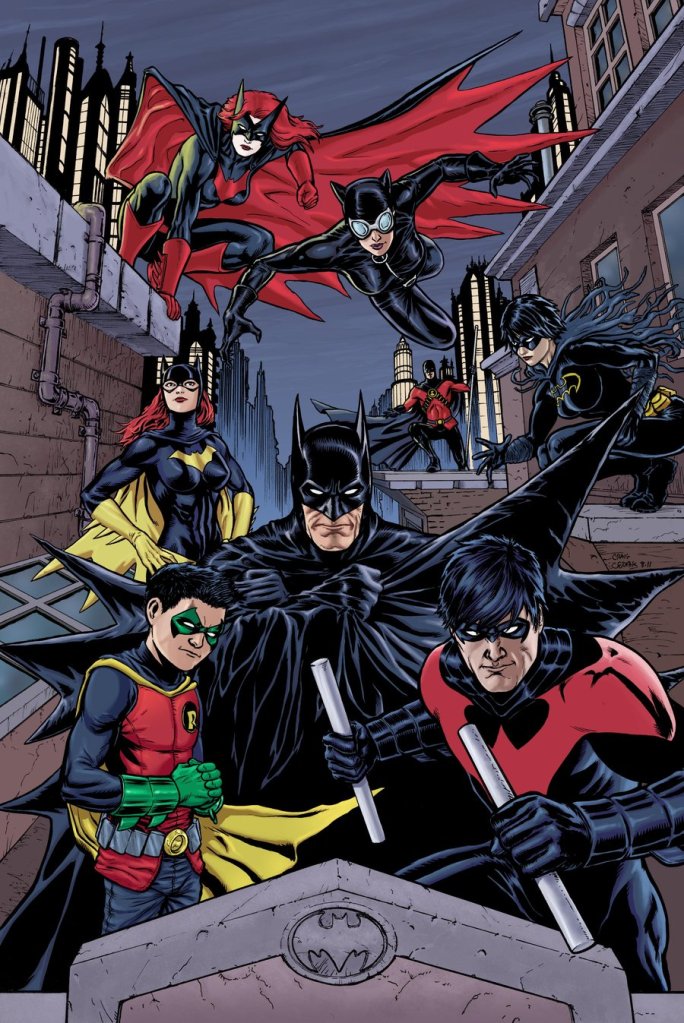
I like this generational aspect and would try to keep it. See my previous blog posts on how relative ages should work out. For example, the Justice Society’s Nite Owl is the protégé of the Golden Age hero of the same name, and Batman (about age 30) is the dark vigilante of the night in the Justice League. In turn, Batman’s former sidekick Nightwing (about 20) leads the Titans, and Red Robin (age 17) is on Young Justice.
Mieville helps attune our senses to a city reminiscent of Dickensian London, with fantastic, horror, and steampunk elements. New Crobuzon is squalid and crowded, with bits of glitter and glory surrounded by strange ruins, nonhuman ghettos, ornate industry, and quasi-organic growths. It is dangerous, maddening, and impressive in scope and scale.
If you don’t mind gothic prose, occasional sex and gore, and truly horrific monsters, you’ll enjoy Mieville’s descriptions of peoples suffering from crime and oppression and a scientist whose discoveries threaten to unhinge reality. Mieville takes fantasy tropes — the band of adventurers, the magical aid, the obstacles to enlightenment — and he adds enough suspense and sacrifice for a rewarding page-turner.
~30 years ago: Bruce Wayne is born to Thomas and Martha Wayne, wealthy physicians in Gotham City. The family fortune is a combination of old real estate (including Wayne Manor), savvy early biotech investments, and occasional shady dealings. The Waynes are also noted philanthropists, eventually running afoul of some of the megalopolis’ underworld.
~22 years ago: After attending a screening of the classic Zorro, Thomas and Martha are gunned down in a random mugging by Joe Chill in front of their son. Bruce is raised by family butler and head of security Alfred Pennyworth — a former street urchin, British intelligence officer, and thespian. Dr. Leslie Tomkins, another friend of the family, offers condolences. Bruce swears vengeance against all criminals (not merely Chill, who he’ll encounter later but comes to a bad end on his own). He also vows never to use guns or take a life.
~10 years ago: A prodigy, Bruce Wayne graduates from university with degrees in business, engineering, and criminology. He travels the world, honing his skills for his private war on crime, which continues to fester and grow in Gotham. He has a revelation that “criminals are a cowardly, superstitious lot” and takes on a bat totem (whether it’s a utilitarian disguise; inspired by Zorro, The Scarlet Pimpernel, and Die Fledermaus; or from a bat crashing through a study window can be left open to individual interpretations). Bruce also meets Zatanna, daughter of a famous stage magician who was friends with his father.
~9 years ago: The urban myth known as the Batman has begun stalking Gotham’s streets, working his way up the food chain from street thugs, drug dealers, and pimps to various gang leaders. Even as other costumed vigilantes are inspired by Superman, garish villains begin to arise in Gotham and elsewhere. A few thrill seekers, like Selina Kyle/Catwoman, toe the line between altruistic hero and selfish villain. Even as Bruce dons the guise of a billionaire playboy, he supports worthy causes, such as a clinic run by Tomkins in what’s become known as “Crime Alley.” Lucius Fox, head of Wayne Enterprises, learns of Bruce’s dual life and initially helps him acquire or develop his many “toys.”
~8 years ago: Partly inspired by the Justice Society, Batman, Superman, and Wonder Woman form the Justice League to handle global crises and provide a community for superheroes. (DC’s new official continuity puts this only five years ago or less, rather than eight — or 50 — years ago.) Meanwhile, 12-year-old Dick Grayson loses his parents, the Flying Graysons, when mobster Tony Zucco makes good on extortion threats to Haley’s Circus. With wary approval from Lt. James Gordon, whose daughter Barbara is about the same age, Bruce adopts Dick (and soon begins training him as Robin I). Barbara soon joins them as Batgirl I. While dealing with Middle Eastern intrigue, Bruce unknowingly fathers a child, Damian, with Talia al-Ghul.
~5 years ago: After co-founding the Teen Titans, Robin I eventually becomes Nightwing. Fourteen-year-old Jason Todd, who tried to steal the wheels from the Batmobile, becomes Robin II. Batman trains the Outsiders for covert missions that the Justice League can’t or won’t handle. Villains become more vicious, and Todd is apparently murdered by the Joker. Soon after, Gotham suffers from plagues, cultists, and an earthquake, and Bruce’s back is broken by Bane.
~4 years ago: Bruce works hard to recover and takes back the cape and cowl from religious zealot Azrael. Gotham City rebuilds, but corruption quickly returns as well. Thirteen-year-old Tim Drake, who has figured out Bruce and Dick’s secret identities on his own, is taken in as Robin III and joins Young Justice, which includes understudies to the (now-young adult) Titans, the revived Justice Society, and the Justice League. Like their mentor, the various Robins are able to hold their own, even when surrounded by metahumans, by virtue of training and wits.
~2 years ago: Dick and Barbara graduate from college, and Barbara becomes Oracle after being shot by the Joker in psychological torture against Commissioner Gordon. Oracle leads the Birds of Prey, including Huntress, Black Canary, and successive Batgirls Cassandra Cain and Stephanie Brown (who was also Spoiler and briefly Robin IV).
~1 year ago: Tim becomes Red Robin, and Damian becomes Robin V. During a lengthy absence by Bruce (out of time, technically, but offworld or abroad is also fine), Dick fills in again as Batman. Jason returns, but now as Red Hood, eschewing Bruce’s vow of nonlethal measures. Kate Kane, a 25-year-old relative of Bruce and former U.S. Marine, puts on a new uniform as Batwoman.
~Present day: Bruce Wayne/Batman is about 30 years old, at the peak of his abilities. He is obsessive but not obsessed, clinical but compassionate, and indomitable. He is the scourge of supervillains and an inspiration to numerous street-level masked crimefighters. Dick Grayson/Nightwing is about 20 and a talented acrobat and team leader. Barbara Gordon/Oracle is a master hacker, strategist, and support for the Justice League, “Batfamily,” and Birds of Prey.
Detective Tim Drake/Red Robin is 17 and leads Young Justice. The bratty Damian is 8 (going on 18) and trying to live up to his father’s legacy while avoiding his grandfather and mother’s preferred destiny as an assassin. Martial artist Cassandra Cain is Batman’s covert agent on the West Coast and in Asia, and Stephanie Brown is still debating whether to be Spoiler or Batgirl.
Yes, most of this somewhat simplified and rearranged Batfamily timeline follows the recently ended continuity more closely than “pre-Crisis” history or the current “DCnU.” It compresses events from the past 70 years without setting Gotham in any specific period. I tried to fit each character into a consistent setting.
In fact, this is the background I’d use for my “Societe de Justice Internationale” superhero scenarios with DC Adventures/Mutants & Masterminds 3rd Ed. From it, I can extrapolate the ages, rosters, and relationships of the rest of the DC universe. What do you think?
As for individual titles, I’d have Batman focus on Bruce Wayne’s dual life in Gotham City and with the Justice League (the first DCnU issuethat’s out), Tales of the Dark Knight on out-of-continuity stories (horror/sci-fi Elseworlds, alternate futures such as Batman Beyond, etc.), and Batman and Robin on Bruce and his protégés.
Detective should focus on solving mysteries rather than punching supervillains. Related DCnU Batfamily titles include Batgirl, Batman Beyond, Batwing, Batwoman, Birds of Prey, Catwoman, Huntress, Justice League, Nightwing, Red Hood and the Outlaws, Teen Titans/Young Justice, and Zatanna. I expect DC Comics to take a different direction, but I look forward to checking at least the first issues of each of these titles. Batman lives!
A few months ago, the editorial management at DC Comics announced plans to renumber or relaunch — but not “reboot” — its fictional universe. Characters would be de-aged, costumes redesigned, and relationships shaken up. Most of the initial reactions from fans, competitors, and the mainstream news media were negative, but I want to wait and see if DC’s moves can renew interest in its iconic superheroes or if the changes are costly missteps in entertainment’s ongoing migration online.
The cornerstone of the DC universe has always been Superman. DC has had to react to lawsuitsfrom the heirs of creators Siegel and Shuster, who were among the numerous writers and graphic artists who were poorly treated by the companies that made billions of dollars from their creations.
I understand the desire of Warner Brothers and Disney to hang onto profitable intellectual properties, but it’s a shame that popular characters Batman, Mickey Mouse, and SherlockHolmes can’t enter the public domain.
On the other hand, given the serial nature of comic books (and television and movies), periodically “hitting the reset button” makes sense. Despite the popularity of The Dark Knight Returns and Batman Beyond, I generally don’t want to read about the adventures of an old Bruce Wayne or his protégés, so keeping our heroes forever young requires tinkering with continuity. Here’s how I’d handle Superman:
-Kryptonians age differently. What if Kal-El had arrived in during the Great Depression? Clark Kent could have learned traditional values in Smallville, Kansas, observed World War II as a youth, and participated in the civil rights struggles of the 1960s. What would Superman have done during the U.S. troop deployments in Southeast Asia or in the Middle East?
If he’s still at the height of his powers, Superman could help found the Justice Societyand the Justice League, plus marry Lois Lane, anytime in the past few decades. In DC’s Multiverse, similar Supermen existed in the Earth 2 of Crisis on Infinite Earths and the Elseworlds such as Kingdom Come. However, this doesn’t help determine evergreen timelines for anyone else.
-Always the present: Marvel Comics has been fairly successful with this sliding timeline. For example, Tony Stark is a wealthy industrialist who turned from producing weapons to being an armored vigilante as Iron Man. Did the ambush and injuries that awakened his altruism happen in Vietnam or Afghanistan? When did he help create the Avengers — the 1960s or the 2010s? Whenever suits the current readership. This had the advantage of keeping past storylines in the vague backstories, but the buildup of history can be like barnacles on a boat, dragging down creativity and making stories less accessible to new readers. Hence Marvel’s Ultimates line and DC’s “soft” reboots.
-Fathers and sons: I find this idea somewhat intriguing, because it reflects the multiple generations of readers, fans, and characters. Instead of beginning his career or being born in 1938, what if Superman’s father and stepfather were both born that year? Jonathan and Martha Kent could be of the generation that remembers the Great Depression and World War II, as well as the U.S.’s supposed halcyon days of the 1950s before societal turmoil in the 1960s and ’70s.
Disclaimer: My parents were born in the 1930s, so I can identify with this as a reader and writer, but I also think this possible timeline can help ground Superman’s values. Speaking of values, I’d want the tone of Superman to be lighter than for Batman or the X-Men, and more grounded than the Fantastic Four. Thor or Captain America (or a good Spider-Man) are closer in mood.
If Jor-El was also born in 1938, and he and Lara had Kal-El around the age of 40, the destruction of Krypton could have happened in 1978, the year of Christopher Reeve’s seminal cinematic portrayal. For the kindly Kents to be middle-aged and wanting but unable to have children, putting them in their 40s makes sense.
Clark would have grown up during the 1980s and 1990s, a solid product of the Midwest even as smaller family farms became endangered. Around 2000, he would have finished college, traveled the world, begun mastering his abilities, and moved to Metropolis to work at the Daily Planet in the last gasp of print newspaper popularity. This is similar to Birthright in the comics and Lois and Clark and Smallvilleon television.
In the past decade, Superman would have become aware of technocratic nemesis Lex Luthor, helped found the Justice League, and inspired many other heroes — and villains — to don colorful costumes (perhaps inspired by the Justice Society of many decades prior). At 33 in 2011, he would be reaching the prime of his powers, like an NFL quarterback.
Pa Kent would have died of a heart attack around the age of 65 — long enough to have guided his son to adulthood, but early enough to be traumatic. I’d make Lois Lane about the same age as Clark but impatient, accomplished, worldly, and ready for a relationship, even if she wouldn’t admit it. Clark’s secret identity should be at least a little believable. In the end, I’d recommend a balance between the revised timeline and the timeless approach. The revised official continuity, or “DCnU,” states that Superman has been active for only five years.
While I don’t think that Superman’s origin story should be endlessly rehashed, a universal starting point is helpful to new writers and fans. As Marvel has often done, I’d start each new issue, TV show, or movie with a concise retelling a la Grant Morrison’sAll-Star Superman: “Doomed planet. Desperate scientists. Last hope. Kindly couple.” New stories could start from that timeless point.
As for costume and abilities, I’d try to keep them simple. The new movie and relaunched comics use an overly textured, militaristic look, but I prefer the blue-collar (but not dumb) hero of the 1940s. I’m not a fan of the “ribbed for your pleasure” look that started with Raimi’s Spider-Man and has continued through Superman Returns and the Star Trek reboot to this past summer’s Green Lantern and Captain America. (The black leathers of the Matrix, X-Men, and Batman Begins — and the upcoming Catwoman — have alsobecome just as clichéd as the bright, ill-fitting spandex of previous live-action attempts.)
The red briefs on the outside (nowomitted) may resemble those of a circus strongman or a professional wrestler, but that’s kind of the point — Superman is powerful and direct, not an ironically cool or an angsty poseur. Kal-El is an alien who has taken it upon himself to defend humanity, not someone who needs armor, intimidation, or shadows to cloak his role as a beacon of hope.
Superman should be “faster than a speeding bullet, stronger than a locomotive, and able to leap tall buildings in a single bound,” but he doesn’t need to be able to erase minds with a kiss, reverse the Earth’s orbit and time, or be strong enough to lift entire cities or the moon.
Kal-El can have “cousins” such as Kara Kent/Supergirl and Karen Starr/Power Girl and a clone in Connor Kent/Superboy, but he should still be the last direct survivor of Krypton as well as the alien who eventually most identifies with humanity (in contrast, say, to J’onn J’onzz, the Martian Manhunter, or others).
The man of tomorrow should be smart enough to deal with weird science but not afraid to roll up his sleeves to smack down supercriminals, common thugs, corrupt politicians and businessmen, dictators, mad scientists, metahuman menaces, and alien horrors.
Kryptonite, magic, and his human heart should remain vulnerabilities. Many of Superman‘s villains are humans twisted by greed, ambition, belligerence, and selfishness, the opposites of his virtues and manifestations of our own darker sides.
Superman should still be the benchmark against which we measure all other superheroes, not just for powers, but also for their dedication to the “never-ending struggle for truth, justice, and the American way.” Let’s hope that those working on the DCComics and Warner Bros. refreshes remember, don’t mess with the S!
Margaret Weiss Productions, which already had tie-ins for Buffy: the Vampire Slayer/Angel, Smallville, Battlestar Galactica, Serenity/Firefly, Supernatural, and Leverage, will use its Cortex Plus system for the similarly themed swashbuckling Dragon Brigade. It might not be Dragonlance, and although the densely packed introductory “Opening Salvo” might intimidate newer gamers, Dragon Brigade could be fun.
Lady Blackbirdis a better model of concise presentation in this mashup subgenre. As much as I like such games, after seeing numerous steampunky sky pirates at conventions in the past year or so, I wonder if they’re are all scrambling for the same audience rather than there being a few rules sets that can capture and build upon it.
They, Josh C., and Dave S.C. have also run various horror one-shots. I haven’t played in a longer-term supernatural campaign since Hans C.H.’s Storyteller: World of Darkness-Vampire: the Masquerade in the late 1990s in Virginia, but FATEis oneof themore popularsystems right now in my groups. Like Wizards of the Coast, White Wolfis moving from strictly pen-and-paper games to multimedia entertainment.




 Gene's Worlds