The Amazing Spider-Man belated review

Between trying to complete a big project at work, bad news of serious illness and unemployment among family and friends, and last weekend’s visit to Upstate New York, I’ve again fallen behind in blogging. At least I won’t run out of movies, television, and games to review anytime soon.

On Sunday, 8 July 2012, I met Thomas K.Y. & Kai-Yin H. and Sara F. & Josh C. for The Amazing Spider-Man. Sony’s superhero reboot was more fun than some of its predecessors, if not as memorable.

The Amazing Spider-Man
Spidey gets new threads from Marc Webb

The good: I thought that the cast of The Amazing Spider-Man was strong, with lanky, wisecracking Andrew Garfield taking on the role of Peter Parker/Spidey from the mopey Tobey Maguire. The chemistry between Garfield and Emma Stone‘s Gwen Stacy was palpable, and I found Stone more appealing than Kirsten Dunst’s Mary Jane Watson.

Cliff Robertson is ably replaced as Peter’s honorable Uncle Ben by Martin Sheen (who knows a thing or two in real life about troubled children). Sally Field is a long way from Gidget as Aunt May, and Denis Leary is Gwen’s tough father, NYPD Capt. Stacy. Speaking of parental figures, Rhys Ifans, who was charismatic in the SyFy Channel’s Neverland, brings proper pride and pathos to Dr. Curt Connors.

I also liked that The Amazing Spider-Man‘s webslinging seemed to rely more on stuntmen in costumes rather than computer-generated imagery. Of course, visual effects have no doubt improved in the past decade or so.

The bad: One of my main complaints is that, in its attempt to keep the movie rights from reverting back to Disney/Marvel, Sony rehashed Spider-Man’s origin story barely a decade after Sam Raimi did a good job of adapting it to the silver screen. Garfield spends most of his screen time out of costume or unmasked, and the subplot of his missing (scientist or spy) parents is teased but mercifully dropped.

The advertising for The Amazing Spider-Man gave away the identity of the Lizard as the main villain. He’s formidable and has ties to Peter and to Oscorp (which played a major role in the Raimi/Maguire version). Still, he’s not as fearsome as Willem Dafoe’s Green Goblin or Alfred Molina’s Doctor Octopus.

The ugly: As glad as I am to see Peter’s ingenuity return with mechanical web shooters rather than organic ones, I’m not a fan of Spidey’s skaterboi racing suit in The Amazing Spider-Man. I prefer the classic red-and-blue costume over the “ribbed for your pleasure” hyper-textured look that has been popular in everything from J.J. Abrams’ Star Trek reboot to Zach Snyder’s upcoming Man of Steel.

Even though the plot element of Peter’s missing parents is dropped, aptly named director Marc Webb suggests that it was somehow his destiny to be bitten by a mutant spider and that his subsequent heroics are less a matter of personal ethical choice and more one of heredity. This undermines Uncle Ben’s “with great power comes great responsibility” mantra and echoes some of the missteps of the “Bring on the Dark” Broadway musical. Peter’s hero’s journey doesn’t need those complications.

I also noticed that a scene with Spider-Man fighting reptilian mutated police was truncated, but that was for the best. Otherwise, it would have been like the slugfest between Ang Lee’s Hulk and giant dogs. It’s also too bad that other New York-based superheroes, such as the Fantastic Four, Daredevil, or the Avengers, couldn’t be shown in the background because different studios hold the rights.

The verdict: Overall, I enjoyed The Amazing Spider-Man more than I expected to. The cast made up for some plot weaknesses, and my onetime hometown New York City looked as good as ever. I’d put it just after Raimi’s first two superhero flicks, but I definitely liked it more than his third one.

I enjoyed The Avengers more, but The Amazing Spider-Man is a more family-friendly comic book adaptation than The Dark Knight Rises (which I’ll try to belatedly review soon). I’d give The Amazing Spider-Man, which is rated PG-13 for violence, about a 7 out of 10, three out of five stars, or a solid B.
Catching up: San Diego Comic-Con 2012 reflections

Superheroes and villains have been in the news a lot lately. My heart goes out to the families of the victims of this past weekend’s shooting tragedy in Colorado. Let’s look back for a moment to happier times.

San Diego Comic-Con 2012 included the usual movie and television previews, toys and games, large numbers of brave fans in costume (also known as cosplay), and even some comic book announcements. Although I missed Spike TV’s coverage a few weeks ago, I caught much of G4’s programming, including its three-hour block on Saturday, 14 July 2012.

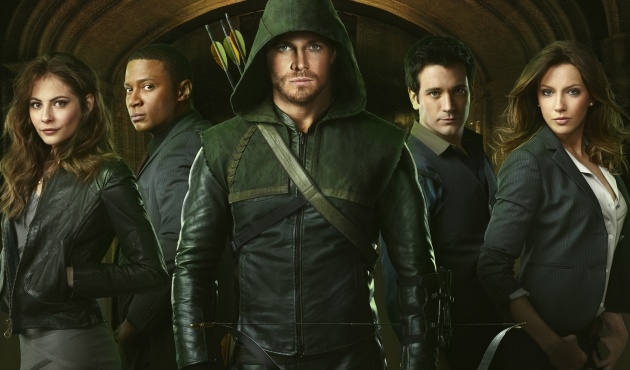
The CW's upcoming "Arrow" TV series
The CW’s upcoming “Arrow” TV series

Movies

Of the movies previewed, I’ve become more interested in the science fiction remakes Total Recall and Dredd, as well as animated comedies ParaNorman, Hotel Transylvania, and Rise of the Guardians. A few other flicks caught my eye, including Django Unchained, Looper, Elysium, and Pacific Rim.

Of course, there are the obligatory prequels and sequels, including James Bond in Skyfall, comic book superheroes Iron Man 3 and Thor 2, Star Trek 2, and last but not least The Hobbit: An Unexpected Journey and The Hobbit: There and Back Again.

Live-action TV

With the recent genre TV season ended, it was bittersweet to look back at departed or soon-to-end series such as Awake, Fringe, and Spartacus. Fortunately, there are lots of new shows to look forward to this fall, including supernatural melodrama 666 Park Ave. and postapocalyptic Revolution.

I’m a longtime fan of DC Comics’ Green Arrow, so I’ll definitely try the CW’s Arrow, which gives Oliver Queen the Batman Begins/Smallville treatment. I hope that it can focus more on Ollie’s awakening as a champion of social justice and archery prowess and less on the soap opera aspects, but the trailers are a mixed bag.

Of course, there’s lots to watch in the meantime, like midsummer cable shows such as Leverage, Warehouse 13, Alphas, and White Collar. As a longtime “Whovian,” it’s nice to see the cast of Doctor Who (and Torchwood) treated as returning heroes. We’ll see whether CBS’s Elementary will be a worthy companion to the BBC and PBS’s Sherlock and Masterpiece: Mystery.

Beyond the speculative fiction of Fringe, other procedurals with twists that I recommend include Castle (fanboy shippers), Person of Interest (domestic espionage), and Grimm (modernized fairy tales).

Cartoons

I’m disappointed that Batman and the Brave and the Bold and Avengers: Earth’s Mightiest Heroes are being replaced so soon, but at least Young Justice and Green Lantern: the Animated Series will be joined by new lighthearted Teen Titans Go! episodes. As I’ve mentioned before, Star Wars: the Clone Wars is carrying the torch for space opera on TV and continuing to expand George Lucas’ universe.

I’ve enjoyed the worldbuilding of Avatar: the Legend of Korra and the underrated Tron: Legacy. I suspect that the next animated Teenaged Mutant Ninja Turtles will be better than the live-action revision would have been.

Comic books

In comic books discussed around Comic-Con, I’m amused that Marvel is also doing a “soft reboot” with its “Marvel Now” after the much-criticizedDCnU” of the past year. I’ll be sorry to see Ed Brubaker leave Captain America, which he presented as a technothriller, and I hope that Marvel can rein in its proliferating Avengers and X-Men titles.

I’m still sifting through various “Batfamily” issues, but I’ve enjoyed some of DC Comics’ series after its continuity revision. Superman and Wonder Woman have benefited most from de-aging and new creative teams, and (some) Green Lantern and the Flash have changed the least. DC’s treatment of its female characters and younger teams still leaves something to be desired, however.

Of the comics from publishers other than the “big two,” I’ve enjoyed the Star Trek: the Next Generation/Doctor Who — Assimilation crossover, the similarly retro Steed and Mrs. Peel, and Brian Wood and Becky Cloonan’s atmospheric adaptation of Conan the Barbarian: Queen of the Black Coast.

I’ve been busy with work, games, and summer activities, but I hope to post my belated reviews of The Amazing Spider-Man and The Dark Knight Rises soon!

R.I.P., Ray Bradbury

Ray Bradbury, one of my favorite science fiction and fantasy authors, has died. Along with Isaac Asimov, Arthur C. Clarke, and Robert A. Heinlein, he enlightened and entertained me in my youth.

SF author Ray Bradbury
Late author Ray Bradbury

More poetic than many of his Golden Age peers, Bradbury‘s many stories featured a mix of speculation, wonder, and hope for humanity. Here are some of my favorites of Bradbury‘s tales:

The Illustrated Man is an intoxicating collection of surreal tales, both clever and introspective. I Sing the Body Electric (and I now have the Rush song in my head) is a robot story the equal of most of Asimov’s.

Bradbury‘s Something Wicked This Way Comes was the first time I became aware of the potential for horror in Americana, with its sinister carnival. Even memories of the Disney adaptation, starring Jonathan Pryce, send shivers up my spine. Stephen King and HBO’s Carnivale would later develop that theme.

In The Martian Chronicles, Bradbury depicts a planet that’s not as exotic as Edgar Rice Burroughs’ Barsoom or as desolate as the world we know today. Instead, it’s a dusty frontier, with whispered memories of its original inhabitants and lonely explorers and homesteaders.

Fahrenheit 451 is a political “What if?” on par with 1984 or Brave New World as a cautionary tale and source of controversy. In the “real world,” paper books are threatened by electronic media, which are just as prone, of not more so, to censorship and invasions of privacy. Bradbury will be missed, but his works live on.

Game changes

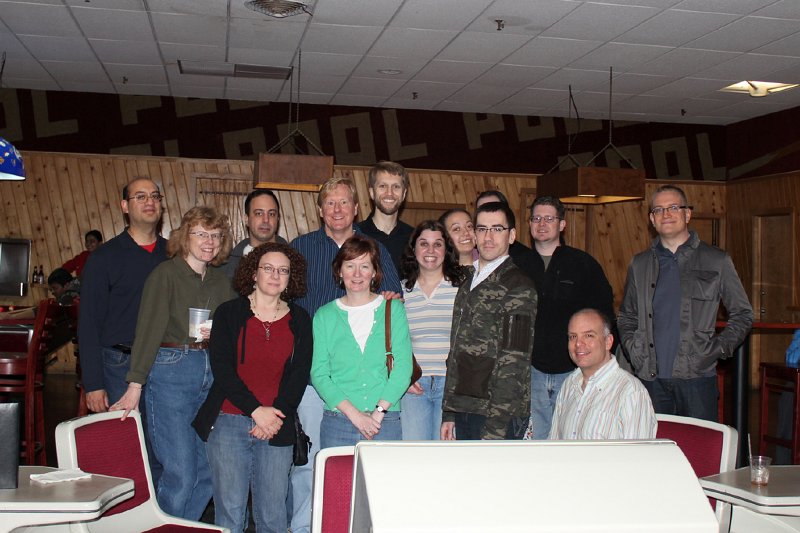
A few weeks ago, between Free Comic Book Day and seeing The Avengers, Janice and I went to Lanes & Games in Cambridge, Massachusetts, for fellow blogger and former co-worker Ken G.‘s annual Cinco de Mayo party.

Ken G.'s party at Lanes & Games
Cinco de Mayo 2012

We met other IDG/CW alumni Michele L.D. and Bob R. and their respective spouses Paul D. and Sheila K.R. Just a month before, I had dinner with Ken, Michele, and Bob at the Met Bar & Grill in the Natick Mall for “The Escapists” book club. We discussed Michael Chabon’s Pulitzer Prize winner, The Amazing Adventures of Kavalier and Clay, which we mostly enjoyed. As a longtime comic book fan and onetime New Yorker, I found the novel very evocative.

We played a few rounds of billiards/pool as munchies and Ken’s other friends arrived, including a few I remembered from previous shindigs. None of the friends I’ve introduced Ken to made it. We then tried candlepin bowling, which both Bob and Ken were good at. I lobbed gutter ball after gutter ball (I’m not as bad with regular bowling or its Wii equivalent). Janice’s game improved significantly, though.

I did slightly better with air hockey, which I won a tournament in back in the early 1990s in Queens, New York. Overall, we had a good time, and it was nice to have an excuse to socialize. I get along well with most of my current co-workers, but the copy desk crew had a decade for its chemistry to develop.

In other games, my role-playing groups are in transition. On Monday nights, I have been running my “Vortexspace opera for two face-to-face teams of about six people each, using FATE 3e Starblazer Adventures/Mindjammer and Bulldogs. I haven’t heard from Team 2 (the grifters on the Appomattox) since my recent move from Needham to Waltham, Mass. I know those guys are busy with other things, including Greg D.C.’s FATE 3e Dresden Files modern supernatural game.

Vortex” Team 1 (the explorers aboard the Blackbird, for which I owe an update) has chosen to take a break for Jason E.R.‘s “Glassworks” superhero miniseries. The fictional city of Hamilton, Delaware, is the same setting that Jason ran with his DarkPages noir one-shot, but we’ll be using the Marvel Heroic Roleplaying system.

So far, these Cortex-based rules have gotten mixed reviews (I do like the Leverage adaptation). Marvel Heroic Roleplaying‘s dice-pool mechanic reminds some of us of the “FASERIP” Marvel Super Heroes, and its Power Points are similar to FATE, but the core book’s organization could be better. A good alternative might be D20/OGL Mutants & Masterminds 3rd Ed./DC Adventures or Icons. I trust that Jason will come up with interesting scenarios for our street-level vigilantes.

On the weeks when Jason isn’t running, we’re looking at various ideas, including Bruce K.’s Pathfinder: Conan” and Rich C.G.’s fantasy and horror proposals. Brian W. has graciously offered to host the Monday games. I don’t mind the break from Game Mastering, but I’m sure I’ll want to be back behind the screen soon enough.

On Sunday nights, my “Vanished Lands: the Uncommon Companions” fantasy campaign (using Pathfinder, Skype, and an online dice roller) is again on hiatus because of scheduling conflicts for half of that teleconferencing group. So in the meantime, Josh C. has been running his “Spelljammer: the Show Must Go Onspace fantasy miniseries (using FATE 3e Legends of Anglerre and Google+/Tabletop Forge).

Last for now, but not least, my historical weapons class at Guard Up! in Burlington, Mass., has continued to be interesting. Each Wednesday night, I and about 10 other students spend half an hour practicing our moves with wooden or resin weapons and half an hour sparring with foam ones. It’s good exercise.

Our instructor, Karl, has shown us the basics of the quarterstaff, longsword, and warhammer. We’re currently learning about the naginata (a Japanese pole arm) and will eventually get to the great sword and fencing.

Blast from the past: What is steampunk?

In preparation for this coming weekend’s third annual Watch City Festival, here’s a look back at a post that didn’t get transferred from my previous blogs. Janice and I enjoyed last year’s International Steampunk City in downtown Waltham, Massachusetts, and we plan to check out this year’s events with friends.

It is a period of incredible progress and terrible destruction. Communications and transportation grow ever faster, but they also hasten the spread of wars and disease. Old tribal rivalries and nascent social consciousness challenge vast aristocratic and mercantile empires, and urbanization and industrialization make life easier for millions but condemn millions more to seemingly inescapable poverty. The arts blossom as alliances tighten and harden, leading to what many believe will be a “war to end all wars.” It is the Victorian era, the setting for most steampunk.

MVS-Whitby-3-Wallpaper800
Gears and gadgets

Steampunk is a style of speculative fiction that has been growing in popularity in the past few years. It has literary roots, readily incorporates elements of other subgenres, and is well-represented across media.

Steampunk is alternate history. Much steampunk starts with the premise of “What if everything that authors Jules Verne, Edgar Rice Burroughs, and Arthur Conan Doyle wrote about was true?” From a North America where the Union didn’t win, to humans hunting dinosaurs (and vice versa), to trips through the ether to a verdant Mars, steampunk combines their wildest dreams.

Examples: The League of Extraordinary Gentlemen, graphic novels by Alan Moore and Kevin O’Neill; Deadlands (role-playing game)

-Steampunk is romance. The novel, classical and revived folk music (the opera, waltz, and polka), Pre-Raphaelite and Impressionist painting, and modern theater all took shape during the 18th and 19th centuries. The swashbuckling stories of Walter Scott and Alexandre Dumas reflect this era as much as the ones they were set in, as does the “noble savage” described by James Fenimore Cooper or Rudyard Kipling. International cuisine, celebrity fashion, and travel for pleasure (and the first amusement parks) are all things we now take for granted that started during that period.

Examples: Diamond Age, novel by Neal Stephenson; Castle Falkenstein and Lady Blackbird (RPGs)

-Steampunk is science fiction. Just as its sibling cyberpunk examines the relationship of humanity with technology (specifically cybernetics, artificial intelligence, genetic engineering, and nanotechnology), steampunk looks at how the Industrial Revolution reshaped the world. The railroad and the telegraph are only the beginning, with anachronistic conveniences such as personal computers, televisions, and jet packs weighed down by clockwork gears, levers, and dials. Real-world advances in engineering are exaggerated for dramatic effect. Getting there is half the fun, with dirigibles the signature conveyance of the genre.

Examples: The Difference Engine, a novel by William Gibson and Bruce Sterling; Etherscope (RPG)

-Steampunk is fantasy. Like its sibling gothic horror — another product of this era — steampunk often includes elements of the supernatural, just as spiritualism (the forerunner of the modern New Age movement), religious revivals, and utopian experiments were part of the real-world reaction to scientific advancement. Edgar Allen Poe, Lord Dunsanay, L. Frank Baum, and Lewis Carroll inspired J.R.R. Tolkien, Robert E. Howard, and other seminal fantasy authors. Lost civilizations still seemed possible.

Examples: Nausicaa of the Valley of the Wind, anime by Hayao Miyazaki; D20 Ravenloft: Masque of the Red Death (RPG)

-Steampunk is socially conscious. Labor unions, waves of migration, the long struggle for civil rights including women’s sufferage, and the polemics of Charles Dickens and Karl Marx are parts of the wrenching social change underlying steampunk. Unlike the real world, where racism and sexism were at their peak, people of color and women are often found among steampunk‘s protagonists.

Examples: Girl Genius, graphic novels by Phil Foglio et al.; Victoriana (RPG)

-Steampunk is idealistic. Like its cousins space opera, pulp cliffhangers, and comic book superheroes, steampunk roots for the little guy to become the big hero. The American West is full of legends and antiheroes. It’s all about attitude. Anyone can put on a pair of goggles, a bowler hat, and suspenders and attend a steampunk convention. Anyone can be a mad scientist, brave archaeologist, laconic gunslinger, or alluring spy. It’s a century and a half ago as many authors and we wish it could have been.

Examples: The Adventures of Brisco County Jr. (television show); Space 1889 (RPG)

-Steampunk is multimedia. In the actual 19th century, wide literacy made possible the rise of newspapers and “penny dreadfuls,” the forerunners of pulps, current mass-market paperbacks, and online fan fiction. Steampunk has taken advantage of modern media, as demonstrated by numerous Web sites, games, sculptures, and graphic novels.

Examples: Rasputina (musical band); Arcanum: Of Steamworks and Magick Obscura (video game); GURPS Steampunk (RPG)

-Steampunk is punk. Like cyberpunk, which looks at the disenfranchised in dystopian near futures, steampunk celebrates individualism and defiance of the established order. The 1960s weren’t the first or last time a bohemian counterculture was fueled by artistic license, sexual experimentation, and drug addiction. The chaotic mashup of genres, a loose approach to history and science, and an emphasis on fun have attracted numerous fans. Many goth enthusiasts have also embraced the retro styles of steampunk. The apparent contradictions or ambivalence reflected in the idealist/punk or fantasy/science fiction strains are just fine in this genre.

Examples: Wild, Wild West (TV show), D&D4e Eberron (RPG)

-Steampunk is (pre)apocalyptic. The steampunk era roughly coincides with the growth of the U.S. after the Louisiana Purchase to the outbreak of World War I. The so-called Manifest Destiny, the growth of democracy, and the “Gilded Age” would all come to a close as Europe’s dynasties and colonial domination came crashing down after Archduke Franz Ferdinand’s assassination. War machines loom on the horizon.

Just as we today look back at the Cold War or the 1990s with a nostalgia born of post-9/11 fears of terrorism, recession, and ecological catastrophe (floods, epidemics, earthquakes; with the attendant resurgence of zombies and other horror monsters), so too does steampunk look back at the 1800s through rosy lenses. In the 20th century, steampunk gives way to the pulps, noir, and dieselpunk. Who knows what else the 21st century will bring?

Examples: Sherlock Holmes (2009 Guy Ritchie/Robert Downey Jr. films); Forgotten Futures (RPG)

Note: This post originally ran on the “Vanished Lands” Yahoo/eGroup Web club in preparation for the Boston-area group‘s return to my “Gaslight Grimoire” steampunk/fantasy campaign.