By now, genre entertainment fans may have seen the news that Disney is buying Lucasfilm for $4.05 billion. I’ve already seen lots of snarky comments online, but this purchase might be good for the franchise, and by extension, space opera.
George Lucas and Walt Disney’s creations
I have no love for megacorporatedeals, some of Lucas’ more stilted dialogue, or the “nerd rage” of manyfans. Get over Jar Jar Binks already — yes, the character is unintentionally offensive, but most small children I observed loved him as previous ones loved R2-D2, Yoda, or Ewoks.
On the other hand, the fact remains that the Star Wars movies and multimedia helped rescue science fiction from obscurity in the late 1970s, and Lucas handing off his creation to the next generation of directors isn’t necessarily a bad idea.
The “expanded universe” of Star Wars novels, comic books, games, toys, and TV shows has generally maintained consistent quality (notwithstanding the occasional cheesy Christmas special). As much as I love other franchises from my youth, such as Doctor Who, Star Trek and Planet of the Apes, I’ve become more of a Star Wars buff.
On Sunday, 30 September 2012, I met Beruk A., Thomas K.Y. & Kai-Yin H. for Looper at the AMC Burlington 10 cineplex. We enjoyed the time-travel drama, which was one of the better genre movies I’ve seen in the theaters so far this year.
Looper
We liked one of director Rian Johnson‘s previous films, Brick, which was a noirish thriller set in a high school. Joseph Gordon-Leavitt, who was also in Brick, plays Joe, an assassin hired by criminals from the future who is confronted with closing his own loop.
Gordon-Leavitt endured makeup and altered his mannerisms to match Bruce Willis (12 Monkeys) as the older version of Joe, who goes on the lam to try to fix history. Of course, with gun-toting thugs, telekinesis, and a dystopian world, nothing goes as planned for any of Looper‘s characters.
The rest of the supporting cast is strong, including Piper Perabo as a dancer, Jeff Daniels as a crimelord, Paul Dano and Garrett Dillahunt (Terminator: the Sarah Connor Chronicles) as fellow “loopers,” Emily Blunt as a secretive farmer, and young Kamden Beauchamp as a creepy child.
Looper alludes to previoustime-travelfilms such as those mentioned above, and it does a decent job of bringing up the questions of paradoxes, free will vs. predestination, and “If you could go back in time and kill Hitler as a child, would you?” Looperdoesn’t resolve all these, but the character development and action scenes keep the story moving.
Overall, I’d give Looper, which is rated R for strong violence, an 8.5 out of 10, four out of five stars, or a B+/A-. I’d put Looper close to the much-maligned John Carter, the blockbuster Avengers, and darkly whimsical ParaNorman and would recommend it to other science fiction fans.
I’ve missed other recent dystopian movies, including Total Recall and Dredd, and I don’t know if I’ll see animated Halloween flicks Hotel Transylvania or Frankenweenie. Before Looper, we sat through numerous previews, and only Argo and Lincoln looked promising. I’m looking forward more to James Bond in Skyfall, Rise of the Guardians, and of course, The Hobbit [1]: An Unexpected Journey!
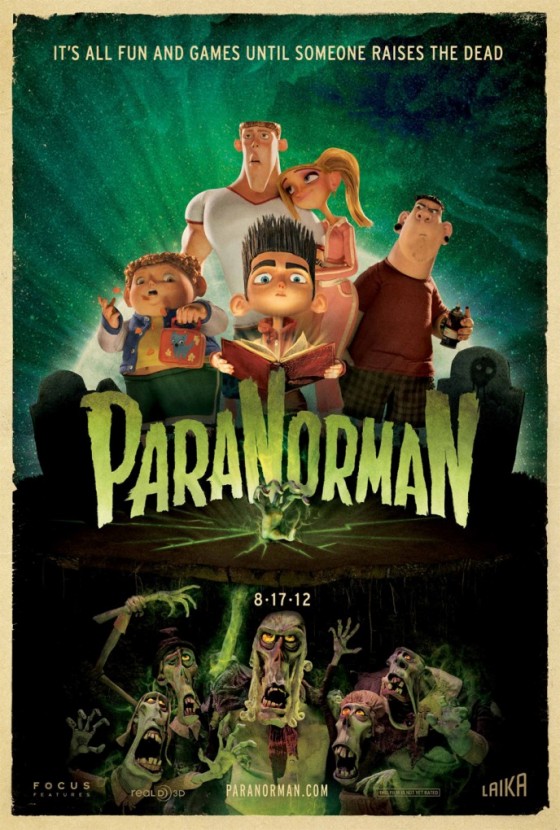
On Sunday, 26 August 2012, Janice and I screened ParaNorman. We enjoyed the stop-motion-animated horror/comedy. Like Coraline, the movie uses familiar archetypes and genre tropes but has a better-than-average script, clever allusions, and a decent emotional heft.
Good Undead fun
ParaNorman’s all-star voice cast is unobtrusive, and the zombies may be a bit intense for younger viewers. The writers were clearly familiar with the Salem witch trials and how the town has become a tourist destination in Massachusetts.
Without giving away any “spoilers,” I liked some of ParaNorman‘s role reversals and the revelation of the witch’s identity. I could also easily see the story as an RPG scenario using School Daze. I’d give ParaNorman, which is rated PG, an 8 out of 10, three out of five stars, or a B+.
This coming weekend, I look forward to joining Thomas K.Y. & Kai-Yin H., college chum Stuart C.G., and Stu’s family during his visit to the Boston area.
Cast:Bale is a decent Bruce Wayne, a tortured soul masquerading as a billionaire playboy. He’s not as fun as Adam West (who once called me “chum”), as slick as Val Kilmer or George Clooney, or as initially odd a choice as Michael Keaton was for the costumed vigilante.
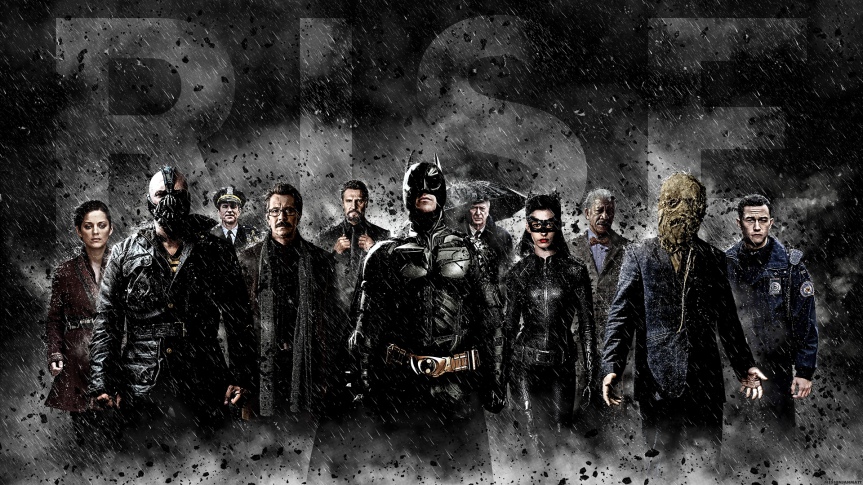
Bale is again ably supported by older character actors in The Dark Knight Rises. Michael Caine is Wayne’s cockney and concerned butler Alfred, Morgan Freeman adds mischievous gravitas as technologist Lucius Fox, and chameleon Gary Oldman is the embattled Commissioner James Gordon.
Newcomers to this cinematic version of Gotham City include Marion Cotillard as mysterious executive Miranda Tate, Tom Hardy as brutal assassin Bane, and Joseph Gordon-Leavitt as idealistic police officer John Blake. Blake becomes the audience surrogate in hoping for things to improve, even as the police as a whole are outmaneuvered.
They all did well in their roles — even if Hardy was sometimes hard to understand through his face mask — but Anne Hathaway deserves special mention for her performance as Selina Kyle/Catwoman.
I had some doubts about the young actress, but Hathaway was properly slinky and cunning as the (never-named) cat burglar and con artist. She was believable in navigating Gotham’s seamy underbelly and its glittering galas, and she brought much-needed femininity and light to Nolan’s grim and gritty universe.
Plot:Batman Begins showed how an orphan could become an anonymous champion of justice, and The Dark Knight depicted Batman fighting grotesque villains (Aaron Eckhart’s Two-Face and the late Heath Ledger’s unparalleled Joker). The Dark Knight Risesexpands on both those themes and is Wagnerian in showing Batman fighting Bane and a conspiracy for the very survival of Gotham City.
Nolan tries to make the plot a complicated puzzle, but even the trailers for the movie telegraphed some of the resolution. Anyone who has read the comic bookstorylines of Batman: Year One, The Killing Joke, Son of the Demon, Cataclysm, No Man’s Land, and Nightfall knows what to expect.
I appreciate Nolan and Bale’s somewhat more realistic approach to Batman’s world and motivations, but the pendulum has swung very farfrom the cheerful camp of West’s 1960s superhero. Even the direct-to-video adaptations of DC Comics are moving to Frank Miller’s The Dark Knight Returns, another obvious inspiration.
Rich felt that Nolan’s Batman isn’t as majestic or as much of a loner as he prefers, but I agree that the amount of time that passes for the desperate citizens of Gotham (and the audience) is on the long side.
I thought that The Dark Knight Rises‘ political subtext was muddled. Following Joseph Campbell’s hero pattern, the aristocratic hero must wander, reject his father figure, be humbled, triumph over his dark reflection, and then walk away or die. Other than a bus full of orphans, we see very few of the 12 million ordinary citizens whom Batman is supposedly fighting to protect.
On the other hand, there’s a populist “99%” strain to Bane’s Robespierre-style demagoguery — even if he’s just a tool of the League of Shadows. The military and police are shown as impotent, implicitly endorsing vigilantism. Granted, dressing upas a bat to fight crime doesn’t always make sense, but why bring up those points if you’re not going to fully show both sides?
Visual effects: From the opening scene of a daring aerial hijacking, The Dark Knight Rises‘ set-piece scenes were clearly inspired by the James Bond movies, which Nolan also paid tribute to in Inception. The battles of The Avengers were more cosmic and colorful, but Batman’s gadgetry and vehicles are still impressive.
Like some comic book writers and fans, Nolan’s Dark Knight is more of an urban warrior than a stealthy detective or martial artist. Perhaps this leaves room for the next set of filmmakers to interpret and develop different aspects of Batman. Even though I miss the Batman: the Animated Series of the 1990s and even the recent campy Batman and theBrave and the Bold, I look forward to the upcoming animatedBewarethe Batman on TV.
Soundtrack: Hans Zimmer’s score is appropriately operatic, if not especially memorable. Unlike the Marvel Universe, whose movies include relatively recent popular music, it seems fitting that DC’s iconic heroes such as Batman stick with classical.
Spoilers and ratings: Note that some of the articles I’ve linked to contain “spoilers” about the plot, but I’ll try to avoid giving anything away directly here. I can see a few ways for how Nolan’s version could have continued, but I’m also content with his conclusion to Bruce Wayne’s story.
I’d give The Dark Knight Rises, which was rated PG-13 for violence, three out of five stars, a B+, or a 7.5 out of 10. The only upcoming movie that’s gettingbuzz and I’m excited about is Peter Jackson’splannedtrilogyadapting J.R.R. Tolkien’s TheHobbit. In the meantime, keep tuning in, same Bat time, same Bat channel!
Between trying to complete a big project at work, bad news of serious illness and unemployment among family and friends, and last weekend’s visit to Upstate New York, I’ve again fallen behind in blogging. At least I won’t run out of movies, television, and games to review anytime soon.
The good: I thought that the cast of The Amazing Spider-Man was strong, with lanky, wisecracking Andrew Garfield taking on the role of Peter Parker/Spidey from the mopey Tobey Maguire. The chemistry between Garfield and Emma Stone‘s Gwen Stacy was palpable, and I found Stone more appealing than Kirsten Dunst’s Mary Jane Watson.
Cliff Robertson is ably replaced as Peter’s honorable Uncle Ben by Martin Sheen (who knows a thing or two in real life about troubled children). Sally Field is a long way from Gidget as Aunt May, and Denis Leary is Gwen’s tough father, NYPD Capt. Stacy. Speaking of parental figures, Rhys Ifans, who was charismatic in the SyFy Channel’s Neverland, brings proper pride and pathos to Dr. Curt Connors.
I also liked that The Amazing Spider-Man‘s webslinging seemed to rely more on stuntmen in costumes rather than computer-generated imagery. Of course, visual effects have no doubt improved in the past decade or so.
The bad: One of my main complaints is that, in its attempt to keep the movie rights from reverting back to Disney/Marvel, Sony rehashed Spider-Man’s origin story barely a decade after Sam Raimi did a good job of adapting it to the silver screen. Garfield spends most of his screen time out of costume or unmasked, and the subplot of his missing (scientist or spy) parents is teased but mercifully dropped.
The advertising for The Amazing Spider-Man gave away the identity of the Lizard as the main villain. He’s formidable and has ties to Peter and to Oscorp (which played a major role in the Raimi/Maguire version). Still, he’s not as fearsome as Willem Dafoe’s Green Goblin or Alfred Molina’s Doctor Octopus.
The ugly: As glad as I am to see Peter’s ingenuity return with mechanical web shooters rather than organic ones, I’m not a fan of Spidey’s skaterboi racing suit in The Amazing Spider-Man. I prefer the classic red-and-blue costume over the “ribbed for your pleasure” hyper-textured look that has been popular in everything from J.J. Abrams’ Star Trek reboot to Zach Snyder’s upcoming Man of Steel.
Even though the plot element of Peter’s missing parents is dropped, aptly named director Marc Webb suggests that it was somehow his destiny to be bitten by a mutant spider and that his subsequent heroics are less a matter of personal ethical choice and more one of heredity. This undermines Uncle Ben’s “with great power comes great responsibility” mantra and echoes some of the missteps of the “Bring on the Dark” Broadway musical. Peter’s hero’s journey doesn’t need those complications.
I also noticed that a scene with Spider-Man fighting reptilian mutated police was truncated, but that was for the best. Otherwise, it would have been like the slugfest between Ang Lee’s Hulk and giant dogs. It’s also too bad that other New York-based superheroes, such as the Fantastic Four, Daredevil, or the Avengers, couldn’t be shown in the background because different studios hold the rights.
The verdict: Overall, I enjoyed The Amazing Spider-Man more than I expected to. The cast made up for some plot weaknesses, and my onetime hometown New York City looked as good as ever. I’d put it just after Raimi’s first two superhero flicks, but I definitely liked it more than his third one.
I enjoyed The Avengers more, but The Amazing Spider-Man is a more family-friendly comic book adaptation than The Dark Knight Rises (which I’ll try to belatedly review soon). I’d give The Amazing Spider-Man, which is rated PG-13 for violence, about a 7 out of 10, three out of five stars, or a solid B.




 Gene's Worlds