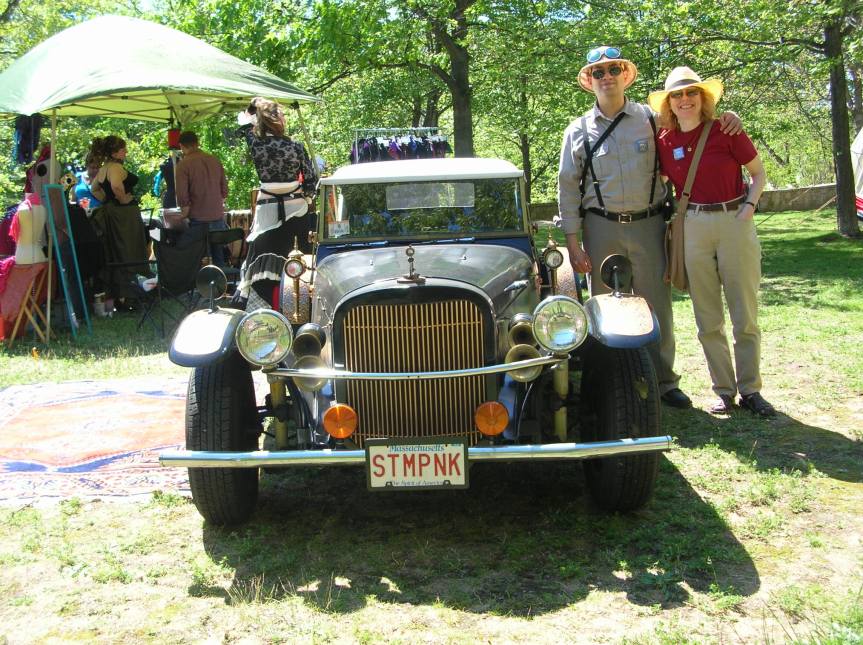
Janice and I went to last year’s International Steampunk City, and we were glad to see strong attendance, including many young people. We didn’t get to any of the panel discussions, but I did get to chat with some authors and artists in a variety of media.
It is a period of incredible progress and terrible destruction. Communications and transportation grow ever faster, but they also hasten the spread of wars and disease. Old tribal rivalries and nascent social consciousness challenge vast aristocratic and mercantile empires, and urbanization and industrialization make life easier for millions but condemn millions more to seemingly inescapable poverty. The arts blossom as alliances tighten and harden, leading to what many believe will be a “war to end all wars.” It is the Victorian era, the setting for most steampunk.
Gears and gadgets
Steampunk is a style of speculative fiction that has been growing in popularity in the past few years. It has literary roots, readily incorporates elements of other subgenres, and is well-represented across media.
–Steampunk is alternate history. Much steampunk starts with the premise of “What if everything that authors Jules Verne, Edgar Rice Burroughs, and Arthur Conan Doylewrote about was true?” From a North America where the Union didn’t win, to humans hunting dinosaurs (and vice versa), to trips through the ether to a verdant Mars, steampunk combines their wildest dreams.
-Steampunk is romance. The novel, classical and revived folk music (the opera, waltz, and polka), Pre-Raphaelite and Impressionist painting, and modern theater all took shape during the 18th and 19th centuries. The swashbuckling stories of Walter Scott and Alexandre Dumas reflect this era as much as the ones they were set in, as does the “noble savage” described by James Fenimore Cooper or Rudyard Kipling. International cuisine, celebrity fashion, and travel for pleasure (and the first amusement parks) are all things we now take for granted that started during that period.
-Steampunk is science fiction. Just as its sibling cyberpunk examines the relationship of humanity with technology (specifically cybernetics, artificial intelligence, genetic engineering, and nanotechnology), steampunk looks at how the Industrial Revolution reshaped the world. The railroad and the telegraph are only the beginning, with anachronistic conveniences such as personal computers, televisions, and jet packs weighed down by clockwork gears, levers, and dials. Real-world advances in engineering are exaggerated for dramatic effect. Getting there is half the fun, with dirigibles the signature conveyance of the genre.
-Steampunk is fantasy. Like its sibling gothic horror — another product of this era — steampunk often includes elements of the supernatural, just as spiritualism (the forerunner of the modern New Age movement), religious revivals, and utopian experiments were part of the real-world reaction to scientific advancement. Edgar Allen Poe, Lord Dunsanay, L. Frank Baum, and Lewis Carroll inspired J.R.R. Tolkien, Robert E. Howard, and other seminal fantasy authors. Lost civilizations still seemed possible.
-Steampunk is socially conscious. Labor unions, waves of migration, the long struggle for civil rights including women’s sufferage, and the polemics of Charles Dickens and Karl Marx are parts of the wrenching social change underlying steampunk. Unlike the real world, where racism and sexism were at their peak, people of color and women are often found among steampunk‘s protagonists.
-Steampunk is idealistic. Like its cousins space opera, pulp cliffhangers, and comic book superheroes, steampunk roots for the little guy to become the big hero. The American West is full of legends and antiheroes. It’s all about attitude. Anyone can put on a pair of goggles, a bowler hat, and suspenders and attend a steampunk convention. Anyone can be a mad scientist, brave archaeologist, laconic gunslinger, or alluring spy. It’s a century and a half ago as many authors and we wish it could have been.
-Steampunk is multimedia. In the actual 19th century, wide literacy made possible the rise of newspapers and “penny dreadfuls,” the forerunners of pulps, current mass-market paperbacks, and online fan fiction. Steampunk has taken advantage of modern media, as demonstrated by numerous Web sites, games, sculptures, and graphic novels.
Examples:Rasputina (musical band); Arcanum: Of Steamworks and Magick Obscura (video game); GURPS Steampunk (RPG)
-Steampunk is punk. Like cyberpunk, which looks at the disenfranchised in dystopian near futures, steampunk celebrates individualism and defiance of the established order. The 1960s weren’t the first or last time a bohemian counterculture was fueled by artistic license, sexual experimentation, and drug addiction. The chaotic mashup of genres, a loose approach to history and science, and an emphasis on fun have attracted numerous fans. Many goth enthusiasts have also embraced the retro styles of steampunk. The apparent contradictions or ambivalence reflected in the idealist/punk or fantasy/science fiction strains are just fine in this genre.
-Steampunk is (pre)apocalyptic. The steampunk era roughly coincides with the growth of the U.S. after the Louisiana Purchase to the outbreak of World War I. The so-called Manifest Destiny, the growth of democracy, and the “Gilded Age” would all come to a close as Europe’s dynasties and colonial domination came crashing down after Archduke Franz Ferdinand’s assassination. War machines loom on the horizon.
Just as we today look back at the Cold War or the 1990s with a nostalgia born of post-9/11 fears of terrorism, recession, and ecological catastrophe (floods, epidemics, earthquakes; with the attendant resurgence of zombies and other horror monsters), so too does steampunk look back at the 1800s through rosy lenses. In the 20th century, steampunk gives way to the pulps, noir, and dieselpunk. Who knows what else the 21st century will bring?
I’ve participated in conversations on EnWorld.org and elsewhere about what television shows we’re currently watching. Before I discuss this season’s best programs, here’s an overview of the schedule.
Note that in some cases, shows that are in the same time slot may not be on during the same months because of cable station counterprogramming. Still, my DVR keeps busy!
And Josh C.’s Spelljammer: “the Show Must Go On” (space fantasy miniseries, using Skype/Google+, an online dice roller, and FATE 3e Legends of Anglerre)
–Canceled/dropped: Heroes, The Cape, Lost Girl (metahuman melodramas, **), Terra Nova (time travel, **)
Tuesday
-8:00 p.m., Cartoon: The Looney Tunes Show (animated comedy) ***
-9:00 p.m., USA: White Collar (sleuth/caper) ***
-10:00 p.m., History: Top Shot (marksmanship) **
–Canceled/dropped: No Ordinary Family (metahuman melodrama, **), V (alien conspiracy reboot, **), Memphis Beat (sleuth, ***), Homeland (thriller, ***), Kung-Fu Panda: the Series (animated martial arts comedy, ***)
Wednesday
-7:30 to 8:30 p.m. (not including travel): historical weapons classes at Guard Up!
–Canceled/dropped: Chuck (espionage comedy ***), Batman and the Brave and the Bold (***), Fantastic Four,Wolverine and the X-Men, and Iron Man: Armored Adventures (animated superheroes, *), Stargate Universe (space opera, **), Merlin/Camelot (Arthurian, **), Smallville (metahuman melodrama; ***), Pillars of the Earth (historical miniseries; ***), Sym-Bionic Titan (animated kaiju; ***), Torchwood (speculative conspiracy **), A Gifted Man (supernatural drama),Magic City(Miami noir **)
Saturday
-9:30 a.m., Cartoon: Thundercats (animated) ****
-10:00 a.m., Cartoon: Green Lantern (animated superhero) **
-10:30 a.m., Cartoon: Young Justice(animated superheroes) ***
-10:30 a.m., CW: Phantom Gourmet/NECN: TV Diner (local food) ***
-9:00 p.m., BBC America: Doctor Who (time travel) ****
-10:00 p.m., BBC America: The Graham Norton Show (talk) **
-11:00 p.m., VH1 Classic: That Metal Show (talk) ***
–Canceled/dropped: Legend of the Seeker (syndicated fantasy, **), Robin Hood (historical action, **), The Super Hero Squad Show(Marvel heroes, **), Being Human (BBC/NBC supernatural melodrama ***)
–Coming soon: Teenaged Mutant Ninja Turtles, How to Train Your Dragon: the Series
On Saturday, 28 April 2012, Janice and I went to Gore Place in Waltham, Massachusetts, for the 25th annual Sheepshearing Festival. I was impressed by the size of the event and the number of attendees. We enjoyed the herding dog demonstration, fair food, craft tents, and bluegrass music. Janice and I also took a brief tour of the early 19th century home of one of Massachusetts’ governors.
We caught a matinee of The Pirates! A Band of Misfits, the latest comedy from Aardman Animation, the studio responsible for Wallace & Gromit, among other things. We enjoyed the movie, which follows a hapless pirate captain (named “Pirate Captain” and voiced by Hugh Grant) in his quest to win the “Pirate of the Year Award.”
The Pirates!
Along the way, Pirate Captain and his eccentric crew — even for pirates — meet Charles Darwin (voiced by Martin Freeman, also known as Arthur Dent, Dr. Watson, and Bilbo Baggins) and an entirely unamused Queen Victoria (Imelda Staunton). Also important to the plot are a dodo, a dirigible, and Darwin’s monkey butler.
If this sounds delightfully chaotic, it is. The Pirates! has a lively Anglo-American voice cast, sight gags too numerous to catch in a single viewing, and good use of modern music (the Clash’s “London Calling” is most memorable). The movie, which combines stop-motion and computer animation, also alludes to real-world literature and science of the 19th century.
I enjoyed The Pirates! more than the past few Pirates of the Caribbean flicks, and I recommend the movie to anyone who likes animation, comedy, or swashbuckling and steampunk. The Pirates! is rated PG for some crude humor and slapstick violence, but most of the adult jokes will sail right over children’s heads. I’d give The Pirates! A Band of Misfits an 8.5 out of 10, a B+/A-, or four stars. This coming weekend is the opening of the much-anticipated Avengers live-action movie….
The next morning, Janice, her parents, and I met Janice’s middle sister Shelly and her children Laura and David for breakfast at the Denny’s across from our motel. Janice and I then visited high school chum Damon F.P. at his apartment in Yorktown Heights, N.Y. We got to meet his cat Caesar, and we watched a little of That Metal Show, before going to check in at the Courtyard Tarrytown Greenburgh, where we have stayed before.
The highlight of the weekend for me was an informal reunion that Damon and I have been planning for a few months. Since we didn’t attend Archbishop Stepinac High School‘s official 25th anniversary reunion last year, we organized a gathering with some of our longtime friends in White Plains, N.Y.
Sean F., Frank J.D., Brian D.H., Carlo R., Damon F.P., and Steve M.
Carlo R., who was two years ahead of the Class of 1986, joined us, as did Frank J.D. We hadn’t seen Frank, who was also my first roommate at the State University of New York at Binghamton, in many years, so we were excited to catch up. After checking out the lacrosse game on a field that was much nicer than the one we remembered, we walked the halls of our alma mater.
Janice was patient as we recounted various adolescent misadventures, including a bus riot, assorted teachers who scared us or whom we drove to tears, and the pranks of our classmates. I was thrilled to reconnect with Frank, who was from Yonkers like me and now lives with his family in Connecticut.
We perused old yearbooks together. It’s hard to believe that it has been nearly 30 years since we first met! Carlo reminded me of our shared interest in DoctorWho and our space opera screenplay for “The Zarkonian Bomb,” which later evolved into the short stories of “The Adventures of Jason Delmar” and the “Vortex” role-playing game setting. We also noted the passing of our collaborators Bill B. and Ray C., among others.
Damon and I once sparred over politics, and we’ve been in regular contact — I’ve served as best man at his weddings, and we met other friends at a 40th birthday bash a few years ago. His impressions of our former teachers, including several priests, were hilarious. Frank was just as interested in sports, cuisine, and good times as I remember, and it was like finding a long-lost brother.
From Stepinac, we went to Executive Billiards, where we met classmates Steve M. and Sean F., as well as Brian D.H., who knew Frank at SUNY-B. and was my housemate right after college when we worked at NYPIRG in Queens. Hockey goalie and painter Steve lives near Frank in Connecticut, and Sean, whom we hadn’t seen since high school, lives and works in White Plains. I’ve been away for long enough to find that city’s growth is impressive.
I saw Brian and several other college friends in Manhattanlast summer, but it was nice to catch up with him and everyone over friendly games of pool with beer and munchies. Damon, Frank, and I had tracked down a few other Stepinac alumni, but they couldn’t make it. Maybe next time.
All of us but Sean had a late dinner at Hacienda Azteca, a nice Mexican restaurant near the pool hall. Were it not for family obligations and travel plans, we could have talked even later into the evening. We may have matured somewhat, but I was pleased to find that our bonds have changed little. Unlike the promises scrawled into our yearbooks, I expect to stay in touch as our friendships are renewed as adults.
The next morning, Janice and I met Damon, Carlo, and Ron J.K. for brunch. Ron is another Binghamton alumnus and a core member of the “Westchester crew.” Unfortunately, we couldn’t eat at the City Limits Diner as planned because it had suffered a kitchen fire just as we arrived! Fortunately, we found Highridge Bagels 2 nearby.



 Gene's Worlds