Catching up: Raiders, Halloween, and the Rhode Island Comic Con

On Sunday, 28 October 2012, Janice and I went to the Brattle Theater in Harvard Square, Cambridge, to screen a remastered print of Raiders of the Lost Ark. I broke out my fedora and leather bomber jacket (but not my whip) for the occasion.

The cliffhanger movie has held up well after 30 years, and it was great to see Harrison Ford again as the charming scoundrel, John Rhys-Davies and Denholm Elliott as Indy’s pals, and most of all, Karen Allen as the spunky Marion Ravenwood, who’s every bit the equal of the adventuresome archaeologist and his Nazi nemeses.

Janice and I also browsed among our usual bookshops and had a good meal at Grendel’s Den. Unfortunately, former co-worker and fellow blogger Ken G. wasn’t able to join us because his return flight from Peru had been delayed.

For Halloween, I dressed in full chain armor for my weekly historical weapons class. It was fun to practice our moves with metal weapons for once.

At GuardUp!
Dueling in Norman-style chain armor

On Saturday, Nov. 3, I drove down to Providence, R.I., for the first Rhode Island Comic Con. The genre entertainment convention was a success, with strong attendance, numerous dealers and artists, and several celebrities, including (but not limited to) the following:

  • Star Trek: John De Lancie, Robert Picardo, Gary Graham
  • Star Wars: Peter Mayhew, Tom Kane
  • Buffy: the Vampire Slayer: Nicholas Brendon
  • Buck Rogers in the 25th Century: Gil Gerard, Felix Silla

And last, but not least, from the original Battlestar Galactica:

  • Richard Hatch (Cmdr. Apollo and Tom Zarek)
  • Dirk Benedict (Lt. Starbuck)
  • Herbert Jefferson Jr. (Lt. Boomer)
  • Jack Stauffer (Capt. Bojay)
  • Sarah Rush (Cpl. Rigel)
  • Noah Hathaway (Boxey)

As a child of the 1970s, I was excited to meet more actors from one of my favorite military space operas of all time. While I was disappointed that Laurette Spang (Cassiopeia) and Anne Lockhart (Lt. Sheba) couldn’t make it, it was still cool to see so many classic BSG actors together.

The actors still resemble their characters, almost 35 years later. Hatch was as gracious and philosophical as I remember from our previous meeting, and Jefferson still has his military bearing and is down to earth. Rush was perky as ever, and during the BSG panel discussion, ailing Stauffer talked about giving back to the acting community.

Benedict was as roguish as ever, soft-spoken one on one but sarcastic and funny during the panel. Hathaway, who was also Bastian in The Neverending Story, has grown into a tattooed, wiry guy with an attitude closer to that of Starbuck than adoptive father Apollo.

Everyone spoke highly of the professionalism and courtesy of the late Lorne Greene, a.k.a. Adm. Adama. They acknowledged classic Galactica‘s debt of inspiration to Star Wars, as well as the problems with producing a grand space adventure in the face of TV network opposition to its budget and tone. The cast even mentioned the derivative Galactica 1980 and Ron Moore’s grim BSG reboots, as well as plans to return the Galactica franchise to movie theaters.

Among other people, I enjoyed chatting about Buck Rogers with Gil Gerard (I had met Erin Gray at a previous event) and about Alien Nation with Gary Graham. I was pleased to find both actors approachable and good-humored about their respective television careers.

It was also nice to chat with artists Bob Eggleton and Craig Rousseau, whose works I’ve followed and whom I’ve met at past conventions. I also talked with Star Wars reference book author Ryder Windham, who agreed with me in being optimistic about Disney’s purchase of Lucasfilm and plans for more films in the saga.

In addition, there were many creative and confident cosplayers at RICC, and I was impressed when a zombie flash mob broke into dance to Michael Jackson’s “Thriller.” I didn’t have time to participate in any of the games that were being played in one ballroom.

I’d definitely consider attending the Rhode Island Comic Con if it is held again next year. Sure, the organizers could have done a better job of handling the crowds for certain panels, but I hope that the event was profitable enough that it can join the Boston Comic Con and this coming weekend’s annual Super MegaFest.

World War Z review

World War Z: An Oral History of the Zombie WarWorld War Z: An Oral History of the Zombie War by Max Brooks

My rating: 2 of 5 stars

Traditional monsters always reflect both our primal fears and the time in which a particular story is told. Just as vampires represent perennial concerns about lust and death, so do zombies embody loathing of disease and dread about the hordes of nameless others that threaten to overwhelm us — communists in the 1950s, race riots in the 1960s, and terrorists in the early 2000s.

Max Brooks, son of Mel Brooks, takes a Ken Burns-like approach to zombies in World War Z. His conceit of a onetime U.N. observer traveling around to get firsthand accounts 15 years after the outbreak of the living dead does convey the global nature of the conflict. However, it also drains the narrative of a single protagonist and the suspense needed for a good zombie tale.

The upcoming movie adaptation, starring Brad Pitt, diverges significantly from the source material, with “only one man can save the world” and fighting against fast, free-running zombies rather than the typical shambling undead.

Brooks effectively evokes pop culture portrayals as he shows the gory struggle to survive the zombie apocalypse. On the other hand, he uses too much military jargon, many characters sound too much alike, and more characters should have been tied together sooner.

I’d give World War Z a B-, and my book club gave it a C-. I’d recommend the novel to anyone who’s a fan of horror literature and movies and doesn’t mind stock characters.

View all my reviews

Campaign 2012: Living with disappointment

After watching the latest U.S. presidential debate, I still think that few minds were changed and that the race is too close to call. The 5% or so of the electorate that hasn’t made up its mind is less important than the Electoral College and whose partisans turn out to vote. I’ve made no secret of my political preferences here and on various social media. However, I keep hoping that both parties will do better.

Gov. Romney and Pres. Obama point fingers
Presidential candidates point fingers

Following the lead of Vice President Joe Biden in his debate with Rep. Paul Ryan, President Barack Obama was much more forceful in his arguments in the second debate. I still think that he could have defended the liberal and Democrat points of view even more strongly.

I would have liked Obama to clearly and unapologetically state the need for government leadership in protecting health care, the environment, and civil rights. Sure, both candidates paid lip service to the importance of education, veterans, and care for the elderly, but neither proposed significant reforms beyond alternative payment schemes. Neither candidate called for sacrifice, patience, or experimentation in dealing with a recession that’s beyond the president’s direct control.

Instead of bickering over dubious statistics, sticking to their campaign platforms rather than directly address questions, and wrestling over oratorical procedure, the candidates could have laid out their visions for the next four years — not the past four or more, nor some nebulous nirvana a decade from now, when neither would be in office.

Former Massachusetts Gov. Mitt Romney also missed opportunities to lay out a compelling set of Republican alternatives. Fiscal conservatives want to cut taxes, government regulations, and federal and trade deficits — all worthy goals — but they haven’t really explained how they’d make up the revenue or continue to properly safeguard the public good. If liberals shouldn’t pick winners and losers in industry, neither should conservatives.

Social conservatives want to restrict abortion, promote individual initiative and responsibility, and eliminate programs they don’t like, but many Americans are more concerned with jobs and the social safety net. I’m in favor of renewing the assault weapons ban, continuing to reform health care, and allowing anyone to be married, regardless of race, creed, or sexual preference. The so-called culture wars have wasted as much energy as the well-intentioned but misguided and costly wars on poverty and drugs.

On foreign policy, where I can claim more expertise than in economics, the U.S. should devise a better strategy for the current and evolving state of global affairs. Both Democrats and Republicans have coddled dictators, misjudged security threats, and needlessly rattled sabers.

Why is it that the U.S., which spends more on its military than the rest of the world combined and is the No. 1 arms seller, has lost its credibility as a peacemaker? How can we help break the nuclear standoff between Israel and Iran without escalation? How can we encourage democracy without getting embroiled in civil wars in Libya and Syria, continue to engage European and Asian allies amid their own economic turmoil, and contain the threat posed by states such as North Korea?

There are no easy answers, but bad-mouthing our creditor, commercial supplier, and geopolitical rival China doesn’t strike me as particularly productive. We missed opportunities to encourage reform and stability in Eastern Europe after the Cold War, and I believe we’re missing our window of influence on the emerging Asian century.

Both Obama and Romney agree on the need to eventually withdraw from Afghanistan, despite the deplorable acts of the Taliban there and in Pakistan. I hope they’ll do more than mention human rights (if at all) in their final debate. Both men say they want the U.S. to become self-reliant for its energy needs, even if they differ on the means and on the need for global standards and environmental protection.

I hope my fellow citizens will try to be informed and get out and vote. Our neighbors, allies, and foes will all be watching. We may have stumbled, but the U.S. still has considerable natural and human resources, traditions of idealism and innovation, and the ability to serve as a positive example of representative democracy. I hope we choose wisely!

The Dark Knight Rises, a belated review

On Sunday, 22 July 2012, I met Beruk A. and James B. at the AMC Loews Boston Common for a matinee of The Dark Knight Rises. Sadly, the superhero sequel was overshadowed by the tragic shootings in Colorado.

We enjoyed the film, which neatly wrapped up director Christopher Nolan and lead actor Christian Bale’s take on Batman. I liked The Dark Knight Rises a little more than The Amazing Spider-Man, if not as much as the four-color The Avengers.

Wallpaper 6
Nolan and Bale’s Batman comes to a conclusion

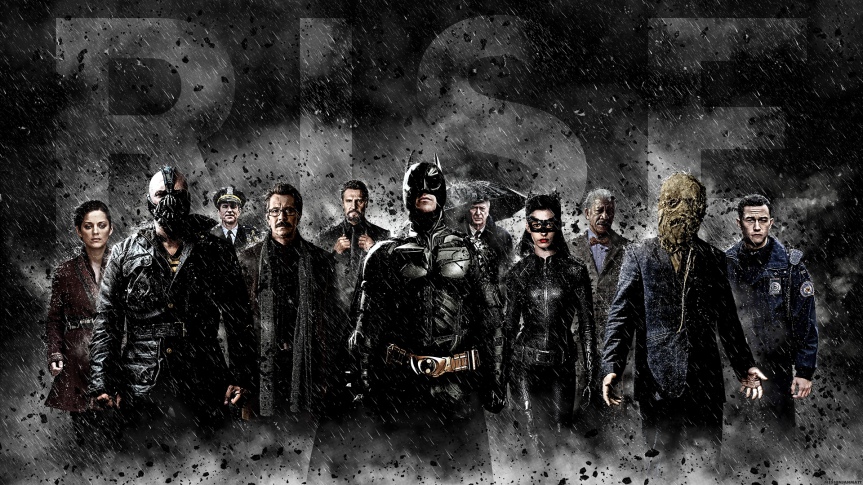
Cast: Bale is a decent Bruce Wayne, a tortured soul masquerading as a billionaire playboy. He’s not as fun as Adam West (who once called me “chum”), as slick as Val Kilmer or George Clooney, or as initially odd a choice as Michael Keaton was for the costumed vigilante.

Bale is again ably supported by older character actors in The Dark Knight Rises. Michael Caine is Wayne’s cockney and concerned butler Alfred, Morgan Freeman adds mischievous gravitas as technologist Lucius Fox, and chameleon Gary Oldman is the embattled Commissioner James Gordon.

Newcomers to this cinematic version of Gotham City include Marion Cotillard as mysterious executive Miranda Tate, Tom Hardy as brutal assassin Bane, and Joseph Gordon-Leavitt as idealistic police officer John Blake. Blake becomes the audience surrogate in hoping for things to improve, even as the police as a whole are outmaneuvered.

They all did well in their roles — even if Hardy was sometimes hard to understand through his face mask — but Anne Hathaway deserves special mention for her performance as Selina Kyle/Catwoman.

I had some doubts about the young actress, but Hathaway was properly slinky and cunning as the (never-named) cat burglar and con artist. She was believable in navigating Gotham’s seamy underbelly and its glittering galas, and she brought much-needed femininity and light to Nolan’s grim and gritty universe.

Plot: Batman Begins showed how an orphan could become an anonymous champion of justice, and The Dark Knight depicted Batman fighting grotesque villains (Aaron Eckhart’s Two-Face and the late Heath Ledger’s unparalleled Joker). The Dark Knight Rises expands on both those themes and is Wagnerian in showing Batman fighting Bane and a conspiracy for the very survival of Gotham City.

Nolan tries to make the plot a complicated puzzle, but even the trailers for the movie telegraphed some of the resolution. Anyone who has read the comic book storylines of Batman: Year One, The Killing Joke, Son of the Demon, Cataclysm, No Man’s Land, and Nightfall knows what to expect.

I appreciate Nolan and Bale’s somewhat more realistic approach to Batman’s world and motivations, but the pendulum has swung very far from the cheerful camp of West’s 1960s superhero. Even the direct-to-video adaptations of DC Comics are moving to Frank Miller’s The Dark Knight Returns, another obvious inspiration.

Rich felt that Nolan’s Batman isn’t as majestic or as much of a loner as he prefers, but I agree that the amount of time that passes for the desperate citizens of Gotham (and the audience) is on the long side.

I thought that The Dark Knight Rises‘ political subtext was muddled. Following Joseph Campbell’s hero pattern, the aristocratic hero must wander, reject his father figure, be humbled, triumph over his dark reflection, and then walk away or die. Other than a bus full of orphans, we see very few of the 12 million ordinary citizens whom Batman is supposedly fighting to protect.

On the other hand, there’s a populist “99%” strain to Bane’s Robespierre-style demagoguery — even if he’s just a tool of the League of Shadows. The military and police are shown as impotent, implicitly endorsing vigilantism. Granted, dressing up as a bat to fight crime doesn’t always make sense, but why bring up those points if you’re not going to fully show both sides?

Visual effects: From the opening scene of a daring aerial hijacking, The Dark Knight Rises‘ set-piece scenes were clearly inspired by the James Bond movies, which Nolan also paid tribute to in Inception. The battles of The Avengers were more cosmic and colorful, but Batman’s gadgetry and vehicles are still impressive.

Like some comic book writers and fans, Nolan’s Dark Knight is more of an urban warrior than a stealthy detective or martial artist. Perhaps this leaves room for the next set of filmmakers to interpret and develop different aspects of Batman. Even though I miss the Batman: the Animated Series of the 1990s and even the recent campy Batman and the Brave and the Bold, I look forward to the upcoming animated Beware the Batman on TV.

Soundtrack: Hans Zimmer’s score is appropriately operatic, if not especially memorable. Unlike the Marvel Universe, whose movies include relatively recent popular music, it seems fitting that DC’s iconic heroes such as Batman stick with classical.

Spoilers and ratings: Note that some of the articles I’ve linked to contain “spoilers” about the plot, but I’ll try to avoid giving anything away directly here. I can see a few ways for how Nolan’s version could have continued, but I’m also content with his conclusion to Bruce Wayne’s story.

Since Batman is the single most profitable superhero film franchise, there’s little doubt that Warner Brothers/DC Comics will reboot the movies as soon as possible, not unlike various Marvel remakes. I do wonder if they’ll be able to maintain the quality amid stylistic and cast changes. I’m cautiously optimistic about the Superman reboot Man of Steel, as well as early plans for a Justice League film (for which I’ll have to write up my own ideas). I just hope they’re fun and well-done.

I’d give The Dark Knight Rises, which was rated PG-13 for violence, three out of five stars, a B+, or a 7.5 out of 10. The only upcoming movie that’s getting buzz and I’m excited about is Peter Jackson’s planned trilogy adapting J.R.R. Tolkien’s The Hobbit. In the meantime, keep tuning in, same Bat time, same Bat channel!

P.S.: Here are my Batfilm ratings:

  • 1943: Batman serials — yet to watch
  • 1965: Batman ***/B+
  • 1989: Batman **/B
  • 1992: Batman Returns **/B-
  • 1993: Batman: Mask of the Phantasm (animated) ****/A
  • 1995: Batman Forever ***/B+
  • 1997: Batman & Robin */C
  • 1998: Batman & Mr. Freeze: SubZero (animated) ***/B+
  • 2000: Batman Beyond: Return of the Joker (animated) **/B-
  • 2003: Batman: Mystery of the Batwoman (animated) ***/B+
  • 2005: The Batman vs. Dracula (animated) **/B, Batman Begins ***/A-
  • 2008: Justice League: the New Frontier (animated) ***/B+, The Dark Knight ***/B+
  • 2009: Batman: Gotham Knight ****/A-, Superman/Batman: Public Enemies **/B (animated)
  • 2010: Justice League: Crisis on Two Earths ***/B+, Batman: Under the Red Hood ***/B+, Superman/Batman: Apocalypse **/B (animated)
  • 2011: Batman: Year One (animated) ***/B+
  • 2012: Justice League: Doom (animated) **/B, The Dark Knight Rises ***/B+, The Dark Knight Returns (animated) coming soon

R.I.P., Ray Bradbury

Ray Bradbury, one of my favorite science fiction and fantasy authors, has died. Along with Isaac Asimov, Arthur C. Clarke, and Robert A. Heinlein, he enlightened and entertained me in my youth.

SF author Ray Bradbury
Late author Ray Bradbury

More poetic than many of his Golden Age peers, Bradbury‘s many stories featured a mix of speculation, wonder, and hope for humanity. Here are some of my favorites of Bradbury‘s tales:

The Illustrated Man is an intoxicating collection of surreal tales, both clever and introspective. I Sing the Body Electric (and I now have the Rush song in my head) is a robot story the equal of most of Asimov’s.

Bradbury‘s Something Wicked This Way Comes was the first time I became aware of the potential for horror in Americana, with its sinister carnival. Even memories of the Disney adaptation, starring Jonathan Pryce, send shivers up my spine. Stephen King and HBO’s Carnivale would later develop that theme.

In The Martian Chronicles, Bradbury depicts a planet that’s not as exotic as Edgar Rice Burroughs’ Barsoom or as desolate as the world we know today. Instead, it’s a dusty frontier, with whispered memories of its original inhabitants and lonely explorers and homesteaders.

Fahrenheit 451 is a political “What if?” on par with 1984 or Brave New World as a cautionary tale and source of controversy. In the “real world,” paper books are threatened by electronic media, which are just as prone, of not more so, to censorship and invasions of privacy. Bradbury will be missed, but his works live on.