4 August 2010: “Vortex” Player Character concepts

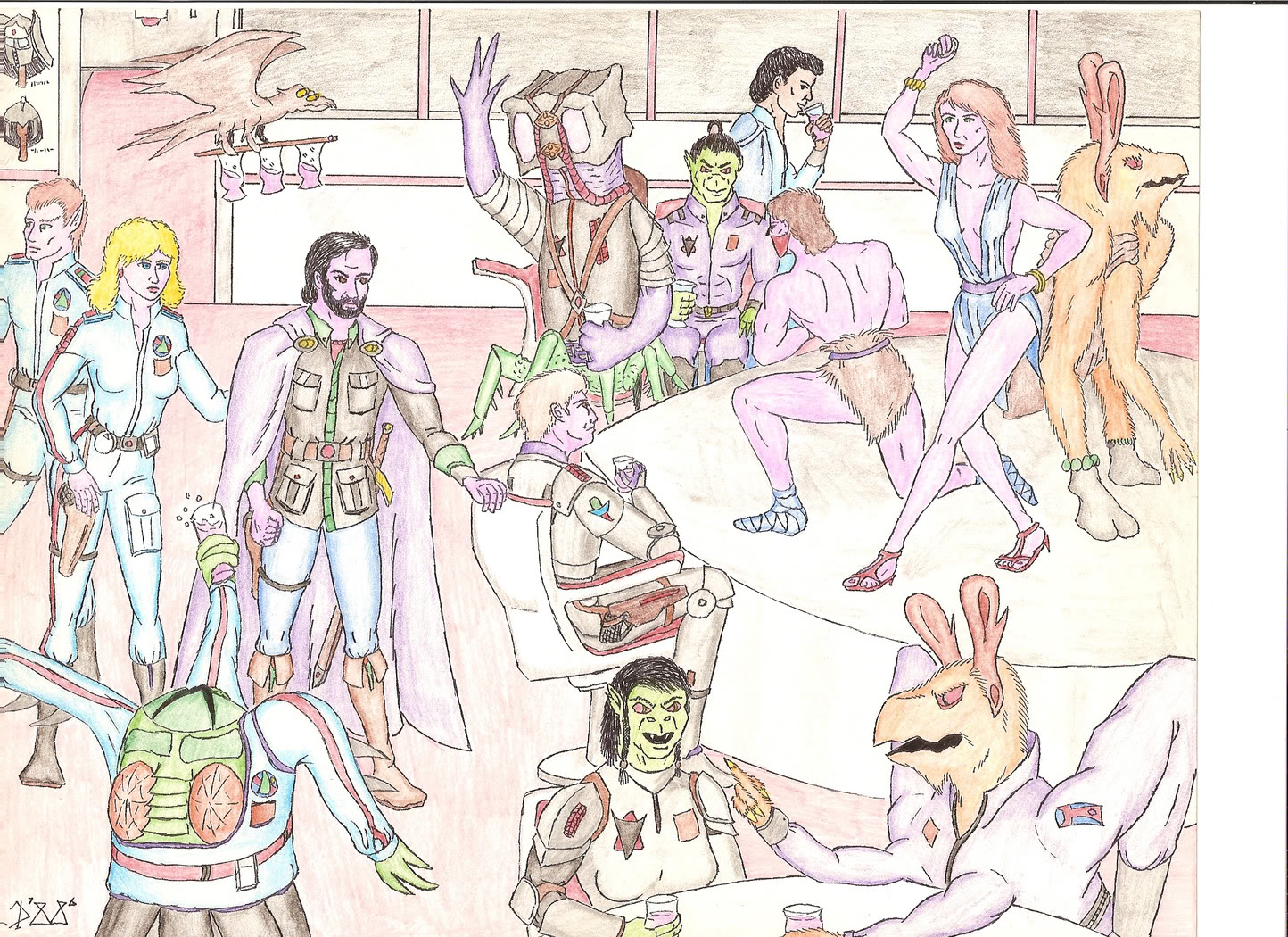
Vortex PC party

In one future, humanity has colonized the Sol system but still struggles with population pressures, competition for resources, and ideological differences. Open and official First Contact with galactic societies, themselves at war, raises the stakes even as frontiers broaden and beckon. Who will rise to the challenge?

Fellow role-players, here are 10 steps to take as we begin considering Player Characters, a new party, and the setting for my upcoming “Vortex” space opera campaign!

1. What species is your Player Character? Human, near-human, gennie/synth, or alien? How close are you to the norm?

2. Where does your character come from? What’s his/her/its homeworld? What is the P.C.’s nationality? What was your family and educational background? How old is your P.C.?

3. What’s your current occupation? I’ve used classes based on Star Wars: Saga Edition as examples: Diplomat, Explorer, Mystic, Trader, Warrior, but you can also think of things like spy, engineer, martial artist, and space marine.

4. What are your ethics? Does your P.C. have a personal code of honor, allegiances, or duties? The more specific, the better.

5. What’s your motivation? Why is your character adventuring, and why would it be part of a mixed team? What are your shorter- and longer-term goals? We’ll also be discussing party tone and objectives.

6. Who are your associates? As I mentioned previously, what affiliations does your P.C. have with other people and organizations? What are your attitudes toward things such as other species, governments and megacorporations, or various regions or factions? This is related to our setting conversations, and as with the Pathfinder teleconferencing team, we may have group generation of supporting characters.

7. What are your other interests? Does your character have any distinguishing features? What are your hobbies or personality traits? Are there any strong likes or dislikes? Signature items or style? How will others first see you?

8. Share your initial concepts. The “Vanished Lands” Yahoo/eGroup and “Holy Steel” Google Group message boards can help us coordinate. So far, this is what I’ve heard (and feel free to elaborate here):

Paul J.: male near-human Mystic with exotic weapons

Beruk A.: male human Trader with a mysterious past, possibly a former government agent

Brian W.: Trinoid (trilateral amphibious alien) Explorer, xenobiologist

Sara F.: female alien (species and occupation to be determined)

Josh C.: male Terran human Warrior, sniper with a strong code of honor

9. Write it up. Pick two of the rules sets we’re consideringBASH, FATE, GURPS, and Saga — and see how your concept looks. I can help with nonhumans and setting notes.

10. Bring it! Be ready to discuss concepts, rules, and themes in the next week or two! Nothing’s written in stone yet, but I look forward to tightening up our ideas and role-playing! -Gene

3 August 2010: “Vortex” — why rules matter

12lys

Fellow role-players, here is my last major post before we get into the specifics of group setting, Player Character, and party creation! Why does our choice of game system matter? Wouldn’t any set of generic or science fiction rules work for my upcoming “Vortex” space opera campaign?

Well, yes and no. As with my other settings — the “Vanished Lands” for fantasy, “Gaslight Grimoire” for steampunk, the superhero/espionage world of the “S.J.I.,” and the shared time/dimensional travel of “Voyagers II” — I’ve been running 5,000+ years of continuity through different editions of various games, most notably Dungeons & Dragons.

On the other hand, some games are more generic than others, which bundle specific worlds, genres, and rules. For example, Shadowrun Fourth Edition combines aspects of traditional fantasy (demihumans and magic) with one dystopian cyberpunk future and dice pools. It might work well for steampunk, but probably less so for lower-powered settings, optimistic superheroes, or certain types of horror.

I want to find rules sets that are easy to learn and teach, offer room for character development and player creativity, and provide support for basic space opera tropes — species, technologies, and environments. After looking at dozens of games over the past several months, I’ve narrowed down our options to the following:

>>GURPS 4e Lite/Space

Pros: I used the third edition of Steve Jackson Games’ Generic Universal Role-Playing System for several campaigns back in Virginia in the 1990s, including “Vortex,” so my background notes would need less conversion effort. Character creation is point-based and granular. GURPS set the standard for well-written reference books about different genres and real-world history. GURPS Lite can be downloaded for free.

Cons: The full fourth edition of GURPS isn’t user-friendly to newcomers, and advanced character options are spread across several books. The rules are moderately “crunchy” and less cinematic than some of the others listed here.

Related GURPS 3e/4e sourcebooks: Aliens, Bio-Tech, Blue Planet, Cyberpunk, Cyberworld, Espionage, Lensman, Magic, Mars, Martial Arts, Mecha, Powers, Prime Directive, Psionics, Robots, Space, Terradyne, Thaumatology, Transhuman Space/Changing Times, Traveller, Ultra-Tech, Uplift, War Against the Cthorr

>>D20 Star Wars: Saga Edition

Pros: Most of the current Boston-area groups are familiar with the D20 Open Game License and system reference documents based on it. Along with Mutants & Masterminds, Saga Edition is arguably one of the most streamlined implementations of D20 and is compatible with numerous other D20 science fiction games that I own. Character creation is fairly simple, and most classes need little modification. George Lucas’ updating of space opera from the serials of the 1930s and 1940s to the 1970s and 1980s is obviously a major inspiration for “Vortex,” so it’s close in tone.

Cons: Wizards of the Coast has dropped the Star Wars license, and the “e20” generic system being written using the D20 OGL isn’t complete yet. Players familiar with “A long, long time ago, in a galaxy far, far away,” will have to set aside their preconceptions for the futuristic setting of “Vortex,” and the Jedi in particular would need rework for the Mystic occupation.

Related D20 games:

Babylon 5/Babylon Project

Big Eyes, Small Mouth/Centauri Knights (also in Tri-Stat edition)

Blood & Space/Bulldogs

Core Command/Jovian Chronicles/Heavy Gear/Mecha Compendium (also SilCore) *

e20: System Evolved Project

Farscape

-D20 “Lite” (see recent “Gaslight Grimore” steampunk fantasy)

Mars/WARS

-D20 Modern: Future/Alternity

Mutants & Masterminds 2e: Mecha & Manga

Prime Directive (“Star Trek,” also in GURPS edition)

Spycraft: Stargate SG1Star Wars (West End Games D6 edition)

Traveller (“T20” and “T20 Lite”; also in GURPS and other editions)

True20: Reign of Discordia

>>FATE 3e Diaspora/Starblazer Adventures/Mindjammer

Pros: Fellow Game Master Brian W. has demonstrated Fantastic Adventures in Tabletop Entertainment in his “Spirit of the Caribbean” and “Fierce Frontier” one-shots, and he has been successfully running fantasy using the Legends of Anglerre variant. FATE has gotten good support (including the Icons superhero game) and allows for collaborative storytelling and world building.
Cons: There is a learning curve because FATE is conceptually different from most class/level-based systems. Starblazer Adventures, which is based on 1980s British comics, is a heavyweight tome and not as clearly organized as other books. It also requires Mindjammer for transhumanist and psionic elements, while Diaspora is Traveller-style hard-SF rather than space opera. (Here are more comparisons between Starblazer Adventures and Diaspora.)

Other games:

Icons: Ion Guard

Dresden Files RPG

Savage Worlds: Slipstream

>>BASH Sci-Fi Edition

Pros: This representative of the rules-light and retro-clone movements has the slimmest and cheapest core rulebook. Basic Action Super Heroes! is a point-based system with a d6 mechanic, and the Sci-Fi Edition is meant to be a simple but complete game.

Cons: Some players may prefer the D6 rules, the anime-flavored Big Eyes, Small Mouth, or one of the third-party systems below. BASH doesn’t have the support of multiple splatbooks, a large user base, or years of playtesting.

Other games:

Aeon/Trinity (White Wolf’s “Storyteller” system)

Cyberpunk 2020Doctor Who: Adventures in Time and Space (and FASA, other editions)

Dune (Last Unicorn, D20, GURPS editions; PDFs only)

Eclipse Phase (transhumanist science fiction) *

Fspace

Iridium/Sleeping Imperium/Thousand Suns Revised (PDFs only) 

Serenity (Cortex, Firefly)

Shadowrun 4e

Space Opera RPG

SpaceMaster (Hero System 4th/5th Ed.)

Star Frontiers (“remastered” retrofuturist PDFs) *

Star Trek (GURPS, FASA, Last Unicorn, and Decipher editions; see also Prime Directive) –StarSiege: Event Horizon

X-Plorers

So how do we pick one game to use? Josh and others have come up with a good recommendation: Each role-player who plans to participate in the upcoming Boston-area face-to-face campaign should create a character using two rules systems. You should pick the two you’re most interested in and be prepared to critique them. Next Monday, 9 August 2010, we’ll start comparing notes and discuss your “VortexPlayer Characters and group party/setting creation in more detail! My next posts will lay out some steps to help with this. Have a good week, -Gene

25 July 2010: “Vortex” occupations and affiliation

Vortex occupations

Adventurers wanted! From the teeming megalopoli of Terra and the Sol system’s far-flung colonies to the vast reaches of interstellar space, humanity needs brave explorers and warriors, wise diplomats and mystics, and canny traders. Some aliens offer assistance, but others provide new dangers. Can you be a hero?

Fellow role-players, as my “Vortex” space opera approaches, here is more information for your Player Characters. While the D20 Star Wars: Saga Edition role-playing game is only one of the rules sets we’re considering (along with FATE Starblazer Adventures/Mindjammer/Diaspora, BASH Sci-Fi Edition, and GURPS 4e Lite/Space), its occupational classes are similar to those I’ve used in past versions of my homebrew campaign setting.

Diplomat (Noble): These people are interested in facilitating relationships among factions ranging from tribes to interplanetary alliances. Around the time of First Contact, diplomats can use their social talents as spies, peacemakers, or journalists. They tend to work best in the upper echelons of society.

Explorer (Scout): Just as humanity is colonizing the Sol system and encountering extraterrestrials, so too are aliens investigating Terra and numerous uncharted worlds. Scientific and survival skills are at a premium in hostile environments.

Mystic (Jedi): Terrans have just rediscovered abilities loosely classified into ecomancy (healing), elementalism (ergokinesis), probability control (luck), technomancy (machine control), telekinesis, and telepathy (drawn in part from GURPS Psionics). Unlike the Jedi knights, Mystics are secretive, specialized, and not necessarily militant. Still, their unusual abilities are much sought after.

Trader (Scoundrel): Freelance “fixers” work in gray markets, privateers and pirates ply the space lanes and cyberspace, and interstellar guilds try to control the threads of commerce linking worlds. Traders put a high priority on profit, but knowing when — and when not — to haggle is key, and they often work best
in the shadows.

Warrior (Soldier): Times of chaos increase the demand for the protection or aggression. Bodyguards, mercenaries, and members of regular militaries fight on land, under the seas, in the air, and in deep space. Martial artists and professional athletes entertain others with their feats of prowess, while Marshals enforce
frontier law.

So now you have a range of species and occupations to choose from. (If we use Saga Edition, there would be talent trees for further customization; there are similar mechanics in other systems.) What about alignment? When “Vortex” was more closely tied to AD&D2, I devised the following ethics:

-Justice (Lawful Good)

-Altruism (Neutral Good)

-Freedom (Chaotic Good)

-Order (Lawful Neutral)

-Balance (True Neutral)

-Anarchy (Chaotic Neutral)

-Might (Lawful Evil)

-Selfishness (Chaotic Neutral)

-Void (Chaotic Evil)

Those guidelines are still valid for individual beliefs, but for those gamers who prefer more nuance or flexibility, I recommend thinking about affiliations instead. Does your Player Character have a personal code of honor, and are there things he or she won’t do? How do species, personal history, occupation, group memberships, and socioeconomic status affect your P.C.’s outlook?

Returning to GURPS or FATE for a moment, each character should build ties to the “Vortex” setting through a web of associations with the following:

-Allies (peers such as fellow party members)

-Contacts (who can provide information)

-Dependents/followers (who need you for support)

-Enemies/rivals (not necessarily bad guys)

-Patrons (who can provide missions and material support)

These affiliations can be with individuals, groups of similar species/occupations (like a band of smugglers), or larger organizations such as megacorporations or militaries. I don’t expect everyone to have identical motivations or associates, but I hope they can at least be in parallel.

For example, “Miriam Accolon” is an Olvar Mystic stationed on Earth just after First Contact. Unlike her predecessors, who were spies disguised as Gennies or Synths, she operates openly as a Technomancer advising the United Ecumenical Movement on behalf of the Kharvamid Alliance.

I would previously have described Miriam as Altruistic, but now I’d say that her connections to the Kharvamids and U.E.M. show that she is firmly aligned with the “good guys.” That’s not to say our heroine is incapable of chaotic actions (she is Olvar, after all) or of evil, but she’ll likely use violence only in self-defense, try to help those weaker than herself, and behave in a rational fashion.

By contrast, “Adam Reutan” is a Terran human serving as a gunner in the North American Aerospace Marine Corps. He’ll follow the military code of honor only when necessary and is always “looking for an edge,” whether it’s against someone playing cards, a girl in a spaceport bar, a competitor for a mech suit assignment, or an enemy vessel. This Warrior isn’t malicious, just a bit self-absorbed, so I designated his ethics as Freedom in the past and would note that his orders are sometimes outweighed by his impulsiveness.

Regardless of the rules set we ultimately use, I plan to have some group character creation and discussion of party goals, and I’d also like your help developing relevant N.P.C.s and groups — Jim J.D’B. and Byron V.O. have already offered ideas.

I hope these examples are helpful, and I’ll post soon on why our choice of rules matters! -Gene

7 July 2010: “Vortex” alien species

Vortex aliens

In one future, humanity has begun to colonize the Sol system, but strife over resources and ideology persists. Open and official First Contact with galactic societies, themselves at war, thrusts Terrans onto a larger stage, but can they survive?

Fellow role-players, here is my latest post about my upcoming “Vortexspace opera campaign. I recently outlined the options for humans and “nearhumans,” and here is information about extraterrestrial species that interact with humans and that can be used for Player Characters.

Any sentient species within 300 light years of the Sol system is aware of humanity, but most of them have their own methods of communication and had little interest in one of several noisy backwaters, until recently….

Gustrall — flightless avian warriors

These bipeds evolved on the temperate plains of Irioth, the seventh moon of gas giant Birkomax, which orbits Firneq. They resemble flightless birds or raptors, with large beaks and muscular legs. However, they have hooves, orange fur, and antlers (actually breathing tubes), as well as small, double-jointed arms under
the “shoulders” of their legs.

The Gustrall (singular and plural are the same) have a long history of warfare, not unlike Terrans, and they had conquered all nearby solar systems before their greatest strategist, Kroac, became a pacifist. Gustrall tend to be reserved, honorable, and stubborn. They are only slightly more technologically advanced than the Sol system and can eat all Terran foods.

Nethians — insectoid scientists

The vegetarian Nethians evolved in the highlands of Oromekl 6 (which has a bit less gravity than Earth), and these explorers have named each planet they’ve settled since a supernova destroyed their homeworld thousands of years ago “Oromekl.” Each Nethian has six legs, all ending in three-clawed hands. They tend to walk on the rear two sets, have four eye/ear/nose stalks, and are covered in a smooth, gray exoskeleton. Nethians breathe through breathing holes along their thoraxes and have foldable wings for gliding. They are
excellent climbers but poor swimmers.

Nethians have an extremely hierarchical culture, but they do not have a hive mind and no longer enslave other species. In fact, these sentients enjoy public debate, and unlike many aliens, they discovered interstellar Transit on their own in vast, mazelike ships. Nethians are longtime allies of the Trinoids and appreciate
Terran inventiveness but are at a loss when faced with Gustrall tempers, Olvar humor, or human diversity.

Olvar — mammal-like mystics and pranksters

Of all the aliens that humans first encounter, they’re predisposed to liking the Olvar, which resemble primates or felines with tails, pointed ears, and multicolored short fur. (Yes, they’re similar to Elves or James Cameron’s Na’vi, but they were created years ago.) The Olvar evolved in the forests and mountains of Velthis Major, also known as Thurbast 3b. They can eat some human foods, and like chocolate, which is intoxicating to them.

The Olvar are known for their artistic sense, tribal organization, and sense of humor, and they are fond of ever-shifting Terran popular culture. In fact, generations ago, gray-suited Olvar adolescents were responsible for some human folklore of extraterrestrial visitors! Of the species presented here, the Olvar are most likely to study mysticism, and they are serious about recording and preserving history.

Ru’ulok — heavy-G reptilian pirates

The Ru’ulok are bipeds from Ru’okkal/Cralari 5 but are shorter and stockier than Terrans. They’re covered in small green scales and have gills where human ears would be, and their faces look somewhat simian. Although Ru’ulok internal organs are arranged in much the same way as human organs, these carnivores’ biochemistry isn’t compatible.

After generations of an oppressive caste system, the Ru’ulok distrust organization, such as those of the Nethians and Trinoids, and they don’t like the wealth disparities among humans. Although they communally share booty, the Ru’ulok compete to see who can get the best deals, find the most valued artwork or trade goods, or impress the most of their peers.

Trinoids — trilateral amphibious terraformers

The least humanoid of the aliens listed here, Trinoids evolved in the shallow areas of their “Home Sea,” or Hydronicus 2. They resemble Terran anemones or squid and have a barrel-shaped body, six stubby legs/feet, and three flexible arms ending in two spikes and three tapered fingers each. Trinoids have three sensory organs around a beaked mouth at the top of their blue-green torsos, but they communicate subsonically from ventral gills.

Trinoids have slowly but patiently expanded into the Orion Arm and are the founders of the Kharvamid Alliance to respond to the approaching Zarkonian Armada. Humans have difficulty understanding Trinoid society, which is based on the “Six Legs” — budding, food and photosynthesis, ethics, technology, strategy,
and Galactic commerce — with no clear divisions between the individual and government or corporate and religious affairs. However, Trinoids do have individual personalities, and they enjoy interacting with other species.

Some other aliens:

Cestolar — short, hairy clients of the Olvar

Laransans (created by Erik B.L.) — telepathic humanoid guardians

Ma’ari (created by Jenna P.) — diminutive wanderers

Meorr (created by David F.R-B.) — blue-furred lion-like berserkers

The aliens of “Vortex” are intended to be different, relatable, and worthwhile alternatives to human Player Characters. Interstellar travelers communicate via robotic translators, telepathy, or approximations via “Galactic standard” languages. While most of you are probably thinking of Star Trek or Star Wars, I’d also recommend looking at Star Frontiers, David Brin’s Uplift novels, or Farscape.

Coming soon: Occupations, factions, and rules!

30 June 2010: “Vortex” species — humanoids

Berkeley art

Fellow role-players, by now, you’ve probably seen my descriptions of the development of my upcomingVortexspace opera and the “future history” and tone of the homebrew campaign setting. As we get closer to beginning the game, here are some notes on available Player Character species.

In one future, humanity has begun to colonize the Sol system, but struggles for scarce resources persist. Open and official First Contact with alien societies, themselves at war, opens a wider galaxy to explore — if Terrans survive.

Humans and “near” humans

As I’ve noted previously, about 200 years from now, our solar system is home to nearly 20 billion people, most of whom are “normal” humans living on Earth. They’re still the baseline for whatever rules set we ultimately choose (the top contenders are D20 Star Wars: Saga Edition, FATE Diaspora/Starblazer Adventures, GURPS 4e Lite/Space,” and BASH Sci-Fi Edition).

In the “Vortex” universe, as in many space operas, humans are adaptable, corruptible, and lower-tech than their new galactic acquaintances. Still, the upstart children of Terra have great potential.

Also known as “metahumans,” “parahumans,” “posthumans,” and “transhumans,” the broad category of “near” humans includes mutants, genetically modified humans, and cyborgs. About one in 5 million people is born with a random but significant (and mostly helpful) mutation, and during the era of the Societe de Justice Internationale and the “Drake’s Seven,” many were costumed vigilantes or supervillains.

“Gennies” include humans born in the low-gravity environments of the Lunar Free State, the Mars Confederation, or some outer colonies (but not the orbital cities, which have mostly normal inhabitants).
Some people have been enhanced as entertainers or soldiers, while others have engaged in dangerous recreational splicing. As mentioned previously, some cloning exists, but it’s expensive and heavily regulated.

Cyborgs may not seem as high-tech as their genetically modified kin, but they can be nearly indistinguishable from normal humans (in contrast to many gennies, who often flaunt their differences and supposed superiority). Many modifications are to repair injuries, to interface with machines, or to have swappable functions.

“Synths”

“Synths,” or synthetic humanoids, include genetically modified animals and androids and mostly live in Earth’s colonies. Although humans created these client species to be more capable individually than themselves, humans have also been reluctant to grant them equal rights.

Uplifted” animals arose out of the creation of “gennies” and efforts to preserve megafauna that was going extinct. They’re commonly based on dogs and wolves (Canids), large cats (Felinoids), primates (Chims), bears (Ursoids), or cetaceans (Delphines). Uplifted animals are usually stronger than humans but not as smart, and like gennies, their reproduction is strictly controlled. Alien synths are known as “xenoids.”

By contrast, true artificial intelligences may be smarter than humans but rely on robotic bodies. Robots have industrial, exploratory, or military applications, and androids are often confused for gennies and have social or entertainment applications. Humanoid androids, nonhumanoid bots, and disembodied A.I.s all have programming and legal restrictions and are as vulnerable to computer viruses as organic beings are to
regular illness.

Coming soon: “Vortexaliens and occupations!