8 April 2010: RPG roundup, continued

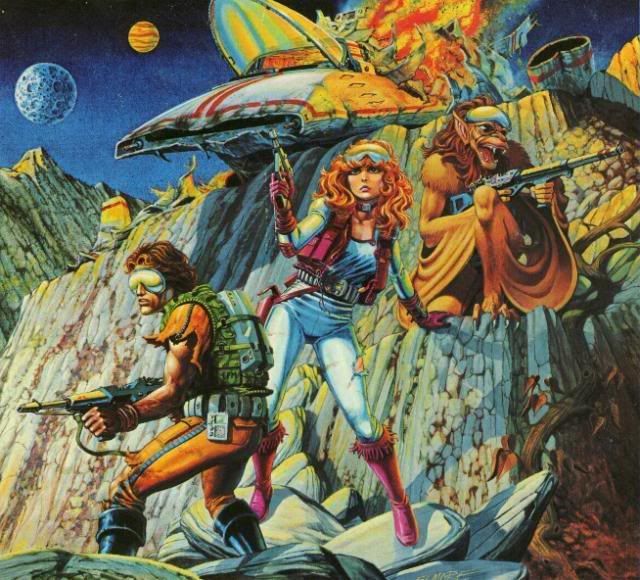
Star FrontiersIn the past few months, I’ve blogged about developments in face-to-face role-playing games (RPGs) including “retro-clones” and “rules-lite” RPGs. After some reflection, I realized that although I described the “old-school” movement, I didn’t post many examples of rules-light tabletop RPGs, so here are a few more. I’ve looked at Risus, FUDGE (the basis of FATE), MicroLite 20, Mini-Six, BASH Ultimate Edition, and Chimera. Other systems that are arguably rules-light include True20, Savage Worlds, and the upcoming e20.

In the Pathfinder: “Holy Steel” teleconferencing team, Beruk A.’s Rogue “Milos” helped Byron V.O.’s Paladin “Ibrahim” defend himself in his trial for treason in the court of Pharaoh Ramses II. The heroes turned the tables on their accusers by proving that cultists of Set led by Prince Sethemwie had desecrated the tomb of Unas. After a year of “game time” and three years of real time, it was nice to reach the climax of that quest!

Although my current gaming group has had some scheduling disruptions because of travel, the Boston-area party’s post-Dungeons & Dragons Fourth Edition period of one-shots and miniseries has continued. Greg D.C. ran his Jenga-based Dread horror game, and after demonstrating FATE 3.0 for his “Spirit of the Caribbean!” pirate scenario, Brian W. successfully used it with his “Fierce Frontier” fantasy setting.

Josh C. expects to run a Werewolf: the Apocalypse supernatural scenario using White Wolf‘s Storyteller: World of Darkness rules, and Beruk A. is preparing a D20 version of
Rifts.” Josh also hopes to run an Exalted high-fantasy one-shot, and Paul J. has expressed interest in the mythic Scion, which uses a variant of the Storyteller system.

Also in the wake of the D&D4eVanished Lands: the Faith-Based Initiative” fantasy campaign, I’ve been looking into other genres and rules systems. In addition to my D20Gaslight Grimoire steampunk/fantasy and D20 Mutants & Masterminds 2nd Ed. (D20″M&M”2e) superhero scenarios, I plan to eventually return to my “Vortex
space opera.

However, there is some question about what rules set to use. After being inspired by games such as Star Frontiers, I created homebrew rules that I used from high school through grad school. In the mid-1990s, I successfully converted to Steve Jackson Games’ Generic Universal Role-Playing System (GURPS) 3rd Ed. Space, but since then, I’ve been favorably impressed by various D20 games, including one version of Traveller (“T20”) and Star Wars: Saga Edition.

However, Hasbro’s Wizards of the Coast (WotC) unit, which also publishes D&D4e, recently announced that it was dropping its license for the Star Wars RPG. That’s too bad, but the books and online community for George Lucas’ franchise are sufficient for long-term campaigns.

WotC also said that it plans to release a new version of the Gamma World postapocalyptic setting using D&D4e, but I’ve been exploring other systems, such as Savage Worlds, Eclipse Phase, and FATE 3.0. Savage Worlds is a pulp RPG with a lot of support, and Eclipse Phase is a good example of the recent “transhumanist” strain in “hard” science fiction.

Starblazer Adventures (“SBA“) and Diaspora both use FATE, an up-and-coming system. SBA is based on 1980s British speculative fiction comics and is from Cubicle 7, which is also publishing Adventures in Time and Space and The One Ring, the latest Doctor Who and Lord of the Rings RPG adaptations, respectively.

Brian and Paul are proponents of FATE, which will also be the basis for the Dresden Files RPG and Icons, a superhero game and potential rival to D20″M&M”2e. Diaspora is a transhumanist RPG that’s a bit more portable than SBA, and after comparing them, we might combine the former‘s hard-SF concepts with the latter’s pulp style.

Ultimately, whatever rules are selected should serve the player group and my “Vortex” stories. Of course, if you ask eight role-players their opinions, you’ll get 10 responses. I’ll post more about the my plans and other genre entertainment soon.

27 February 2010: Rules-light and other RPGs

Furry fantasyIn my previous blog post, I discussed the one-shots and miniseries that I’ve participated in with other Boston-area gamers. As I noted, Dungeons & Dragons (D&D4e) is still the most popular role-playing game (RPG), but recent trends include the digitization of social games, the “retro-clone reaction, and the rules-light movement. Fellow blogger Ken G. has discussed similar phenomena in computer games.

Some hobby observers predict that emerging tools such as laptops, smartphones, micropayments, and modular programs will displace and replace conventional dice, miniatures, and Game Masters. Multiplayer online games (MMOs) have undeniably increased in popularity, but board games and face-to-face RPGs have retained their appeal, and grognards (old-school gamers) have kept up with Web publishing even as they look back to 25-year-old books.

To follow a software analogy, Wizards of the Coast’s D&D4e is like Microsoft’s Windows — ubiquitous, restrictively licensed, and overloaded with features. The “rules-lite” movement is an attempt to create and use rules sets like Linux that take less time to learn and teach (and being fan-written, often free). As with some retro-clones, the hope is to find systems that facilitate collaborative storytelling and evoke a certain mood or style.

Based on my own history with past editions of D&D, I like the retro-clones Labyrinth Lord and Basic Fantasy RPG, and the rules-light MicroLite20, which is a condensation of the D20 Open Game License. Smart game producers often publish “quick-start” guides, such as GURPS 4e Lite, Savage Worlds “Test Drive v6,” and the upcoming D&D4e boxed set.

New and promising games are still being published in book form. Where D&D4e arguably took some terminology and concepts from miniatures skirmish, collectible card, and MMO games, Warhammer Fantasy Role-Play Third Edition combines board games and role-playing. Unfortunately, its high initial price tag may discourage people from trying it.

I recently picked up the beautifully produced Shard fantasy game, which features anthropomorphic animals rather than the usual Tolkienesque races — not unlike last year’s award-winning Mouse Guard RPG — and Eclipse Phase, a “transhuman” science fiction game. While I don’t think I’ll be able to get my current gamers to try these rule sets (although Josh C.’s group just expressed interest in having me run Shard), I’m sure they’ll provide much inspiration for my campaigns.

Coming soon: Avatar review and science fiction RPGs!

24 February 2010: Winter games and retro-clones

College D&D charactersFriends, I hope you’ve had a good fortnight. Janice and I have been busy watching the Winter Olympics in Vancouver, leaving me to catch up on recorded genre television on the weekends. In addition, I’ve been comparing notes on comic books and graphic novels with new fan David I.S. and playing various games.

Since wrapping up my “Vanished Lands: the Faith-Based Initiative” fantasy campaign, which used Dungeons & Dragons Fourth Edition (D&D4e), the current role-players have been involved in a series of one-shots. While I’m taking a break from serving as primary Game Master, I’m trying to encourage the Boston-area group of about eight people to try other genres, rules systems, and styles of games.

Wizards of the Coast’s D&D4e is still the most popular tabletop (or pen-and-paper, or dice-and-pizza) game on the market, thanks to 35 years of leading the hobby, brand recognition, and wide distribution. However, the boom of the past decade thanks to the D20 Open Game License has been replaced by economic recession, a move from print to online publishing of PDFs, and fragmentation of the market.

Locally, Greg D.C. has run InSpectres, a rules-light horror/humor game, and Paul J. used D20 Mutants & Masterminds 2nd Ed. for his “Vaguely Interesting People — the Four” comedic superhero scenario. Brian W. demonstrated collaborative storytelling with FATE 3.0 in his “Spirit of the Caribbean!” pirate one-shot. In addition to a “Paranoia” cyberpunk comedy one-shot, Brian ran Savage Worlds: Hellfrost, a Nordic-themed fantasy. So far, all of these games have gone well, although we’ve had some debates about what system would be the best fit for a longer-term campaign.

These “indie”-style games are good examples of the alternatives to D&D4e. I’ve already blogged about my ongoing Pathfinder: Holy Steel” teleconferencing team and the “Gaslight Grimoire” steampunk/fantasy homebrew using D20 “Lite.” Another trend among face-to-face (F2F) RPGs is “retro-clones,” or games that emulate older editions of D&D and other games. I have fond memories of my early years as a role-player in the early 1980s.

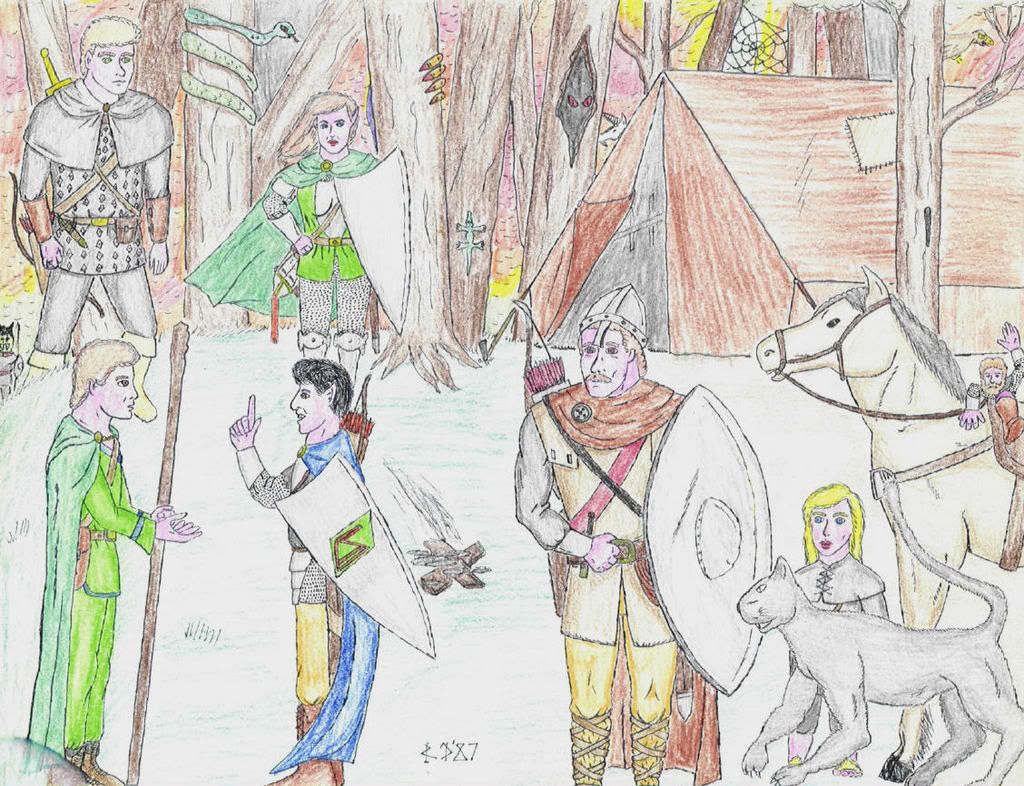
Although I’d be the first to acknowledge that game design has developed since then, I’ve downloaded several retro-clones, which remind me of a time when magic was rare and mysterious, monsters were unpredictable and deadly to Player Characters, and the games tried to evoke folkore and literature rather than second-hand adaptations into other media such as movies or computer games (not that there’s necessarily anything wrong with that if it’s your preference).

Coming soon: Space opera, the “rules-light” movement, and newer games!

11 February 2010: Snow, food, sports, and movies

Served coldFriends, I hope you’ve had a good week, despite the recent snowstorms that buried the Mid-Atlantic. New England was spared this time around, but winter is far from over for us. Work has kept me busy, as I deal with managing assignments, training on TT’s new intranet, and telecommuting. Janice and I hope to plan some vacation travel, but we may wait to see the results of our tax returns and must juggle conferences and family.

On Sunday, 31 January 2010, we went to the annual “Death by Chocolate” event at the Crowne Plaza (formerly a Sheraton) hotel in Newton, Massachusetts. As always, it was fun to sample the sweets offered by the competitors. We’ve also recently had good meals at Four Burgers in Harvard Square, Cambridge, and Minerva Indian restaurant and the British Beer Company in Norwood.

With my office soon to move from Needham to Newton, I hope to take advantage of its current proximity to home with staff lunches from/at Farm Grill, a Greek eatery; Mexican restaurants Acapulcos or Tu y Yo; and a pub such as Mick Morgans or Johnny’s Biltmore Café. My commute will get a bit longer in March, but I hope to avoid the traffic on Route 95/128, the inner beltway around Boston, by taking local roads.

In the past few weeks, former co-workers Ken G. and Brian F. and fellow blogger Thomas K.Y. had hoped to get together for genre movies, meals, or other outings, but gamer and family birthdays, rescheduled role-playing sessions, and the usual scheduling challenges prevented that. Still, I may belatedly screen James Cameron’s Avatar and the remake of The Wolf Man sometime soon. But first, there’s Valentine’s Day weekend!

I’m not a big fan of professional sports, but two events have drawn my attention: the Super Bowl and the Winter Olympics in Vancouver, B.C. I enjoyed the close football championship game but found this year’s commercials to be lackluster. I was most interested in the movie previews.

The remake of Clash of the Titans continues the recent trend of sword-and-sandals flicks (the bloody Spartacus is Starz’s TV entry), and Prince of Persia looks like the video games that inspired it rather than real-world folklore. Ridley Scott and Russell Crowe’s Robin Hood seems more focused on medieval battles than on the traditional legend of a swashbuckling highwayman.

Tim Burton’s surreal style should be a good fit for his adaptation of Alice in Wonderland, and I’m cautiously optimistic about M. Night Shaymalan’s take on Nickelodeon’s excellent fantasy anime Last Airbender.

I’m more interested in two films that won’t get as wide release: the animated Secret of Kells and the French steampunk Adventures of Adele Blanc Sec, from the director of The Fifth Element. Speaking of fantasy and steampunk, as part of the face-to-face gaming group’s period of one-shots and miniseries, I’ve been running my “Gaslight Grimoire” campaign using a stripped-down version of the D20 rules set. I’ll try to post more on that and recent genre television soon!

5 January 2010: Sherlock Holmes review

Sherlock Holmes
Jeremy Brett as the great detective

We found Sherlock Holmes to be entertaining, if not especially cerebral. Guy Ritchie did a better job of adapting Arthur Conan Doyle’s seminal mysteries than some critics had feared, using dialogue and descriptions recognizable to Holmes enthusiasts. On the other hand, the movie has the director’s trademark slow-motion fisticuffs and explosions, modern quips, and focus on the seamy side of Great Britain.

Robert Downey Jr. is as much a caricature of Oscar Wilde or other Victorian bohemians as he is the great detective. As with Iron Man, he brings appropriate charisma, nervous energy, and intelligence to the role. Jude Law is good as Dr. Watson, giving Holmes’ sidekick a more youthful energy and making him more of a true partner than he has often been portrayed.

The pretty Rachel McAdams plays Irene Adler in the largest deviation from “canon” as a recurring love interest of Sherlock Holmes, and genre veteran Mark Strong plays Lord Blackwood, the key to a nefarious plot threatening London, and by extension, civilization itself.

The story is similar to that of Young Sherlock Holmes and other pastiches, and even though I’m a big fan of the original books, I can appreciate well-done variations on the classic characters. The script leaves an obvious opening for a sequel.

I’ve argued on Facebook and elsewhere that Ritchie’s Sherlock Holmes is a decent adaptation of the literary sleuth but a better steampunk movie. I plan to blog more about this subgenre of speculative fiction, which has been growing in popularity and has had relatively few successes in film or on television.

Sherlock Holmes is an excellent example of steampunk, including social commentary implied in the Dickensian images of a gritty (and class-stratified) industrial metropolis, a few clockwork and steam-powered gadgets, opulent costumes, playful anachronisms, and a lively soundtrack inspired by Gypsy music.

Although my favorite version of Sherlock Holmes so far is the early 1980s BBC/PBS television series starring Jeremy Brett, I enjoyed the movie, which I’d rate an 8.5 out of 10 or a B+. It’s rated PG-13 for violence and some sexuality. Let’s hope that more movies this coming year are equally fun!