10 August 2010: “Vortex” decisions

The Milky Way galaxy

Fellow role-players, here are some notes from the Boston-area group’s “Vortex” planning session of Monday, 9 August 2010, which I hosted at my second duplex in Needham Heights, Massachusetts.

>>Favorite science fiction and expectations

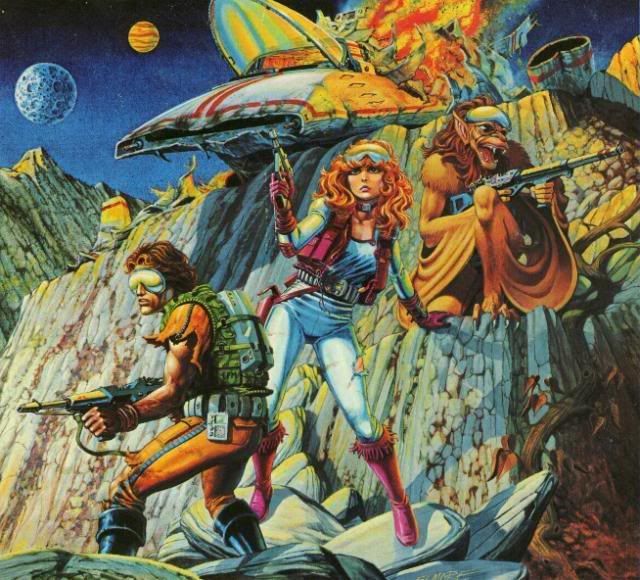
I’ve already posted about influences on my homebrew space opera setting, including the novels of Isaac Asimov, movies such as The Fifth Element, television shows including the original Battlestar Galactica, and games like Star Frontiers. I asked everyone about their favorites and found interest in traditional pulp fiction.

Paul J. cited Star Trek: the Next Generation and Deep Space Nine (“DS9”), the anime Outlaw Star and Cowboy Bebop, and Joss Whedon’s space Western Firefly/Serenity (which other people liked). Beruk A. added the British TV shows Red Dwarf and Doctor Who, which mix humor and surrealism.

Greg D.C. mentioned Edgar Rice Burroughs‘ Mars/Barsoom books and the exploratory thrills of early 20th-century planetary romances. Sarah F. named the 1990s SeaQuest DSV, Lexx, and Farscape, which featured ship-based adventures and exotic environments. Josh C. added the interplanetary diplomacy and wars of Babylon 5 and DS9. Brian W. reached further back to the 1970s for Space 1999 and classic Doctor Who, which had shaky production values but strong characters and plots, not unlike the original 1960s Star Trek.

We only touched upon cyberpunk such as Blade Runner, transhumanist speculation such as David Brin’s Uplift stories, and retro steampunk like the works of Jules Verne. We missed Dave C. last night — what’s your favorite science fiction?

>>Initial Player Character concepts

Brian described his Trinoid, a trilateral amphibious alien xenobiologist and anthropologist sent to the Sol system around the time of open and official First Contact between Terrans and galactic societies. (See my earlier post regarding nonhumans.) The strange (to human eyes) being plans to observe and conserve Earth’s lifeforms.

Josh had two human proposals: an honorable sniper that’s a hybrid between an Army Ranger and a knight Templar, and a martial artist/freedom fighter similar to early Capoeira practitioners. I noted that he’d have to specify the soldier’s code of honor and organization, which he described as one that would defend humanity and seek its place in the stars. The rebel could be a colonist struggling against control of Mars or other places by Earth-based corporate or governmental authorities.

Sara designed a Tharian, an alien with wings (like a Star Frontiers Yazirian) and reptilian skin, similar to a gargoyle. Although the Tharians aren’t technologically advanced, her character’s home village was destroyed by interstellar pirates (possibly Ru’ulok). She stowed aboard the invading vessel and was subsequently found and trained as a mechanic with some larcenous skills.

Greg described “A.R.T.H.E.R.R.,” an artificial intelligence/robot probe designed by human mining conglomerate Vimeco about a century ago (in “game time”). After the megacorporation realized that it didn’t need robots to gather information from harsh environments but that it instead wanted to control access to information, the robot worked odd jobs but retained its desire and ability to explore.

Beruk created a former government operative with communications and piloting expertise. Perhaps he saw something related to First Contact on the frontier that he shouldn’t have, or maybe he made the wrong enemies (a la Outland). He’s trying to keep a low profile but find out more.

Paul, who had to leave early, talked about a Scoundrel or Jack of all trades who is actually a near-human psychic. He uses telepathy to help him persuade people to cooperate. Overall, the gamers agreed on an exploratory theme for the campaign, so the new party will probably get access to a ship sooner rather than later. Military, diplomatic, and trade missions will still be possible, but they won’t be the group’s shared focus. I’ll try to provide a mix of environments and challenges.

>>Rules systems

With help from Josh, Sara used BASH! Sci-Fi Edition for her Tharian, and she liked the relatively simple point-buy method of character building. The d6 multiplier was a turnoff to Paul and Greg, and the group agreed that since Basic Action Super Heroes was the least supported and the least familiar to everyone, the representative of rules-light and retro-clone games should be set aside.

Beruk and Josh noted that D6 Space (similar to West End Games’ old Star Wars RPG and Marvel Superheroes) and Mecha & Manga and Tomorrow Knights for D20 Mutants & Masterminds (about to have its third edition in combination with DC Adventures) were fairly simple, but the others were more interested in other games. We’ve looked at numerous science fiction systems over the past several months.

Brian and Josh used Steve Jackson Games’ Generic Universal Role-Playing System. Unfortunately, even the combination of GURPS 4e Lite and Space was complicated for character creation, especially for Brian’s Trinoid. While it might be good for “simulationist,” lethal games, GURPS also failed to get any strong support.

Beruk and Sara (and Dave, who was absent) had looked at Star Wars: Saga Edition. They noted that it was compatible with numerous other D20 science fiction games, used the familiar species/class/level system, and supported aliens and robots. However, reservations about the Force and Jedi as imbalancing and concerns about D20/Open Game License rules proliferation put Saga in second place of the games we considered.

Brian easily created his Trinoid with Fantastic Adventures in Tabletop Entertainment, or FATE 3e. Greg and Paul eagerly looked at Brian’s hardcopy of the FATE-based Dresden Files RPG, which Josh ended up borrowing (in addition to my Pathfinder Campaign Setting). Ultimately, Brian, Paul, Greg, and Josh voted for FATE, which is the rules set we’ll be using for “Vortex!”

We’ll be using a few science fiction references for FATE. Diaspora has an online System Reference Document, brief and straightforward rules descriptions, and a “hard SF” edge. Starblazer Adventures lists numerous aspects, stunts, and pulpy tropes, but it isn’t as well organized. Mindjammer supports transhuman elements such as psionics.

In addition, we’ll be using the dice-rolling mechanic from the Icons superhero game (2d6-7), Starblazer Adventures’ “gritty” starting level (15 points for skills), and phased acquisition of aspects as part of group character/party design. Brian and I will try to post more information in the coming weeks.

Beruk, as you requested, here are some links about conversions from some space operas to FATE:

I look forward to talking with all of you about your characters’ species, occupations, motivations, and FATE 3e writeups soon! -Gene

30 June 2010: “Vortex” species — humanoids

Berkeley art

Fellow role-players, by now, you’ve probably seen my descriptions of the development of my upcomingVortexspace opera and the “future history” and tone of the homebrew campaign setting. As we get closer to beginning the game, here are some notes on available Player Character species.

In one future, humanity has begun to colonize the Sol system, but struggles for scarce resources persist. Open and official First Contact with alien societies, themselves at war, opens a wider galaxy to explore — if Terrans survive.

Humans and “near” humans

As I’ve noted previously, about 200 years from now, our solar system is home to nearly 20 billion people, most of whom are “normal” humans living on Earth. They’re still the baseline for whatever rules set we ultimately choose (the top contenders are D20 Star Wars: Saga Edition, FATE Diaspora/Starblazer Adventures, GURPS 4e Lite/Space,” and BASH Sci-Fi Edition).

In the “Vortex” universe, as in many space operas, humans are adaptable, corruptible, and lower-tech than their new galactic acquaintances. Still, the upstart children of Terra have great potential.

Also known as “metahumans,” “parahumans,” “posthumans,” and “transhumans,” the broad category of “near” humans includes mutants, genetically modified humans, and cyborgs. About one in 5 million people is born with a random but significant (and mostly helpful) mutation, and during the era of the Societe de Justice Internationale and the “Drake’s Seven,” many were costumed vigilantes or supervillains.

“Gennies” include humans born in the low-gravity environments of the Lunar Free State, the Mars Confederation, or some outer colonies (but not the orbital cities, which have mostly normal inhabitants).
Some people have been enhanced as entertainers or soldiers, while others have engaged in dangerous recreational splicing. As mentioned previously, some cloning exists, but it’s expensive and heavily regulated.

Cyborgs may not seem as high-tech as their genetically modified kin, but they can be nearly indistinguishable from normal humans (in contrast to many gennies, who often flaunt their differences and supposed superiority). Many modifications are to repair injuries, to interface with machines, or to have swappable functions.

“Synths”

“Synths,” or synthetic humanoids, include genetically modified animals and androids and mostly live in Earth’s colonies. Although humans created these client species to be more capable individually than themselves, humans have also been reluctant to grant them equal rights.

Uplifted” animals arose out of the creation of “gennies” and efforts to preserve megafauna that was going extinct. They’re commonly based on dogs and wolves (Canids), large cats (Felinoids), primates (Chims), bears (Ursoids), or cetaceans (Delphines). Uplifted animals are usually stronger than humans but not as smart, and like gennies, their reproduction is strictly controlled. Alien synths are known as “xenoids.”

By contrast, true artificial intelligences may be smarter than humans but rely on robotic bodies. Robots have industrial, exploratory, or military applications, and androids are often confused for gennies and have social or entertainment applications. Humanoid androids, nonhumanoid bots, and disembodied A.I.s all have programming and legal restrictions and are as vulnerable to computer viruses as organic beings are to
regular illness.

Coming soon: “Vortexaliens and occupations!

1 June 2010: The setting of “Vortex”

The future is now!Fellow role-players, I hope that you had a good Memorial Day weekend. I’m glad that our one-shot games have been mostly successful so far, and I know that some of you have expressed interest in a longer-term campaign. Although I don’t plan to return to the “Vanished Lands” fantasy world anytime soon with the Boston-area face-to-face group, by now, you should have seen my recent post about the development of my “Vortexspace opera.

Here’s more information about my homebrew speculative fiction setting: About 200 years from now, humanity has begun to colonize the Sol system, but ecological problems and internecine conflict persist. The rediscovery of mystical powers, plus open and official First Contact with alien societies, themselves at war, threaten Terra’s very survival. Can heroes arise to meet the challenges in time?

Demographics

Most of the solar system’s 20 billion inhabitants are human, and most live on Earth. The average person is born to a slightly smaller nuclear family than in previous generations, is educated and employed by a megacorporation, and lives in one of the megalopoli that have metastasized along rising coastlines. To picture the teeming megacities, think of Blade Runner or The Fifth Element. Despite globalization, regional and cultural differences remain.

The orbital cities around Earth, Venus, and Jupiter have millions of residents (think Babylon 5 or Star Trek: Deep Space Nine), and the Lunar Free State has megacorp and military bases. Many settlers in the Mars Confederacy (which is beginning to be terraformed) come from crowded Asia. A few generations have now been born that have never set foot on Earth.

“Near” or “trans-” humans (mutants, metahumans, and cyborgs), “Uplifted” (genetically engineered) animals, and true artificial intelligences (robots/androids) are minorities, mostly living offworld. Like the outer colonies, they’ve fought for and earned limited rights.

Technology

Once possessing one of the most diverse ecosystems in the galaxy, Earth still has an impressive variety of organisms and cultures. The “ecocrises” of population pressure, pollution, global climate change, and the depletion of fossil fuels and freshwater led to famine and wars, as well as technological innovation. “Cold fusion” is finally a reality, but disparities in the distribution of resources remain.

Outside the megalopoli, carefully maintained cropland is surrounded by vast wastelands. The average person has access to more technology but less personal space than his or her ancestors. Cyberspace mitigates that somewhat, but virtual perception overlays and mechanical telepathy bring their own hazards, such as addiction.

Communications, transportation, and combat have also changed, even if the social sciences haven’t yet succeeded in creating harmony for all citizens regardless of belief. Memes (transmittable ideas) flitter across infotainment media, and those who still want to or need to travel in person can take high-speed trains, hypersonic aircraft, or commercial submarines (to undersea cities). Unfortunately, these advances also facilitate crime, terrorism, and warfare along economic, ethnic, and ideological divisions.

First used in the colonies, mecha (powered suits) are used as heavy infantry and artillery. Interplanetary carriers, aerospace fighters, and scout ships spend long months patrolling the cold vastness of space, but a storm is approaching the Milky Way’s Orion Arm. After First Contact, Terran humans and related species have access to Transit-level faster-than-light drives, which can propel vessels at up to a parsec (3.26 light years) per day.

Medicine

Many illnesses have been cured, and the life expectancy for the 60% of people above the poverty line is 120 years (half that for those still below it). The very wealthy have access to cloned bodies, partial consciousness transfers, and android avatars, but such technology is expensive and restricted. Terran biochemistry isn’t exactly compatible with that of most aliens.

Economics and politics

Politics has become both decentralized and more centralized, with many services once delivered by local governments now performed by megacorps, and regional governments replacing states and provinces. For example, Boston is now part of the North Eastern American Megalopolis (NEAM), with most goods and services provided through Transglobe Information Company, one of the “Big Eight.” North America’s Continental Congress (NACC) is in Denver.

In response to the ecocrises and the use of weapons of mass destruction, the United Earth Authority has started to become the first true world government. It’s based in Rio de Janeiro, Brazil, and is the nominal ruling body over Terra’s colonies. Each regional state contributes to the U.E.A.’s law-enforcement, bureaucratic, and military forces. NACC’s elite force is the Aerospace Marine Corps. The U.E.A.’s Fort Olympus Mons overlooks Mars’ red outback, where bands of homesteaders, nonhuman rebels, and ecoterrorists try to eke out a living (not unlike Firefly/Serenity).

The sparsely populated Asteroid Belt and Jovian and Saturnian systems include several mining colonies, policed by the small but growing Interplanetary Patrol (think Outland). The colonies have petitioned the U.E.A. to change its name and grant them both equal and proportional representation, but that’s only one of many debates on the eve of First Contact with galactic societies, themselves at war.

The U.E.A. sponsored the United Ecumenical Movement partly in reaction to the destruction of Middle Eastern holy sites and the horrific related casualties late in the petroleum era. Although its chaplains are drawn from different faiths, the U.E.M.’s members have managed to collaborate closely on secret archaeological and paranormal research (with extraterrestrial advice).

Galactic conflict

Many of the billions of stars in the Milky Way Galaxy have planets around them, and millions of those have life. Of those, thousands are capable of sustaining intelligent life, and hundreds are inhabited at any given time. Dozens are homeworlds to Transit-capable beings. Hidden for centuries behind Kuvor’s Veil, a nebula, the Sol system has been a backwater, visited by occasional pirates, explorers, or pranksters. First Contact causes some disruptions in Terran society, but greater threats are ahead.

Although most aliens are nonhumanoid, some can (and do) interact with Terrans (think Flash Gordon, Star Wars, or Farscape). Most of the starfaring species in the Orion Arm are nonaligned, neutral, or members of the Trade Guilds, which are interested in working with Terran megacorps. A few are members of the growing Kharvamid Alliance, which seeks to defend systems like Sol’s from the approaching Zarkonian Armada….

In coming posts, I’ll outline Player Character options for species and occupations, why our choice of rules matters, and more! In the meantime, I look forward to the next Pathfinder: “the Dragonslayers” teleconferencing session and Gabe C.’s Lady Blackbird one-shot. Be seeing you!

6 May 2010: What is “Vortex?”

Star Frontiers wallpaper by ElmoreThe “Vortex” space opera has its roots in “The Zarkonian Bomb,” a film script that I wrote with Carlo R., Jon and Bill B., and Ray C. in high school in New York's Westchester County. Looking back to 1982, we were obviously inspired by the novels of Isaac Asimov, Doctor Who, the original Star Wars film trilogy, and the Star Frontiers game. I later wrote “The Adventures of Jason Delmar,” a series of short stories.

In contrast to “hard” science fiction or other subgenres like cyberpunk, space opera features relatively easy interstellar travel and human interaction with aliens, plus themes of exploration, diplomacy and heroism amid warfare, and the importance of friendship. Space opera has its roots in the “planetary romances” of the 19th and early 20th centuries, pulp fiction, and movie serials, but James Cameron's Avatar is a recent (if explicitly derivative) example.

In college in Upstate New York, I created the “Vortexrole-playing rules with my brother Peter and David I.S., influenced by Advanced Dungeons & Dragons 2nd Ed., the Star Trek franchise, books by Larry Niven and others, and the cyberpunk/fantasy game Shadowrun. Our system had several species options, five attributes (Prowess, Agility, Intellect, Respect, and Aura), skills and mystical powers, and lots of gear.

The name “Vortex” came from late-night conversations about the nature of time, human history, and perception with Carlo and Dave, touching on the works of Edward Gibbon and Mircea Eliade. Is history linear or cyclical? Are technological and social progress inevitable or transient, and what role does individual choice play? From the perspective of the present, global events seem more crowded at an ever-accelerating pace, hence the vortex (I'm not the only gamer to think of it this way). It can also represent the spiral of the Milky Way Galaxy.

After graduate school, I used the Generic Universal Role-Playing System to run successful campaigns, including GURPS 3rd Ed. Space: “Vortex,” for about a dozen people in Virginia in the 1990s. At that time, we enjoyed the books of three Davids (Brin, Gerrold, and Weber), movies like The Fifth Element, and television shows such as Babylon 5 and Space: Above and Beyond. The universe expanded as the players developed more aliens, and the crew of the P.T.S. “Venture” explored more space.

Earlier in the 1990s, I had used the original “Vortex” system for “Bay City: Visor and the Seer,” which later became the GURPS “Supers: the S.J.I.” superhero campaign (most recently using D20 Mutants & Masterminds 2nd Ed.). In addition, we used my timeline in the “Voyagers II: Adventures in the Dimensional Corps” game I co-ran with Steve M.R., Tim M.B., Jim J.D'B., and other Game Masters.

I ran GURPS “Vortex” briefly by e-mail and for Rob R. and Randy K.M. after moving to the Boston area. We then returned to my long-running “Vanished Lands” fantasy campaign using Dungeons & Dragons Third and Fourth Editions. In 2010, I expect to incorporate some “transhumanist” concepts, “retrofuturist” speculative fiction, and “rules-light” games, looking back and ahead simultaneously.

In future posts, I'll explain more of the “Vortex” setting, character options, and various space opera rules sets. Feel free to post your own questions and ideas to the “Vanished Lands” Yahoo/eGroup, the “Holy Steel” Google group, or my blog at Yahoo, MySpace, EnWorld.org, or Wizards of the Coast!

29 October 2009: Space opera on TV

Space fighter craft

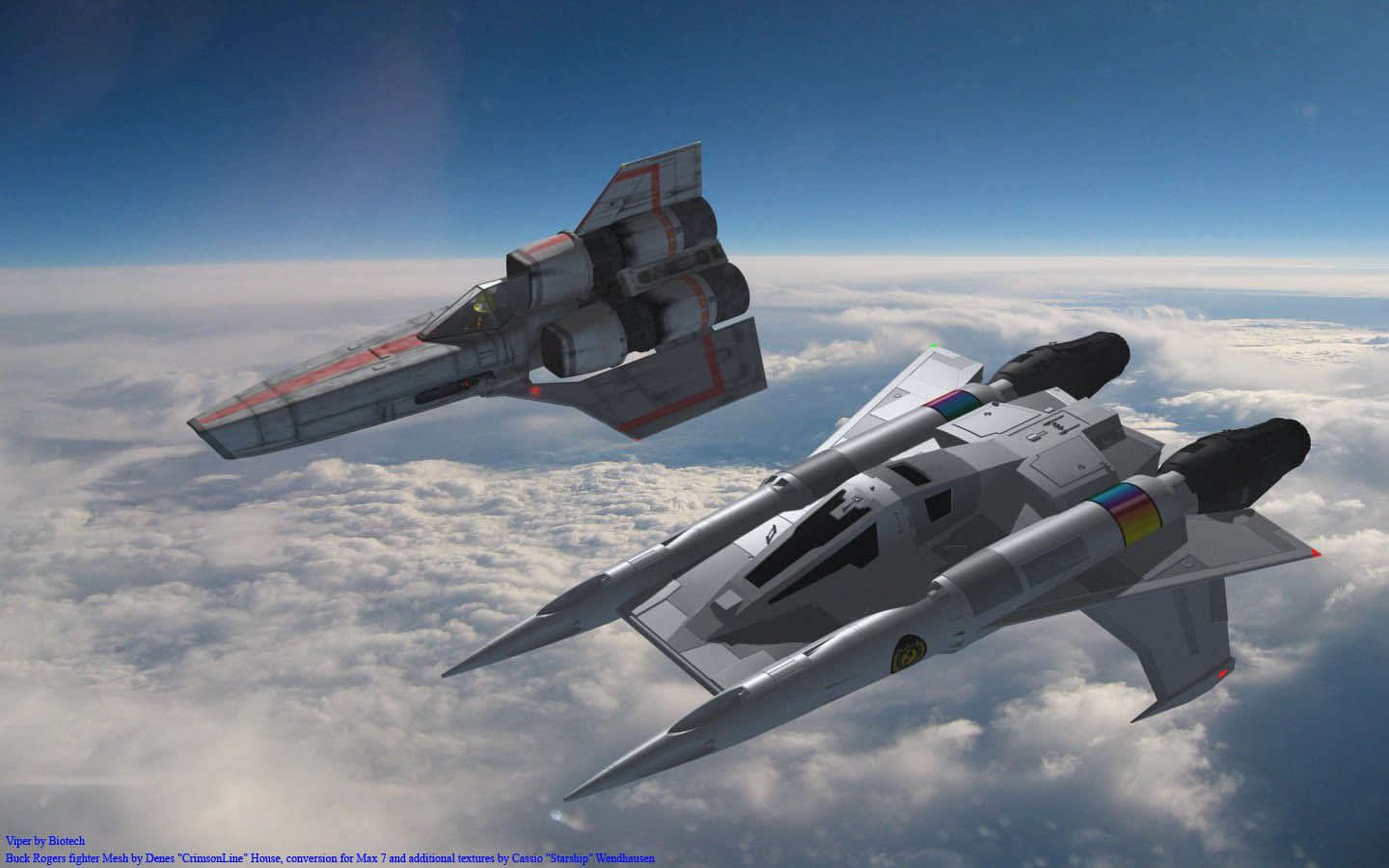
This is my fifth and last blog post (for now) looking at the new genre television season by subgenre. I’ve noted before that within speculative fiction — which starts with the question “What if?” — supernatural conspiracy shows, vampire romances, and metahuman melodramas have been more popular lately than space opera. That’s too bad, because my some of first loves in science fiction were the late-1970s TV heroes of Buck Rogers and Battlestar Galactica (see above and reruns), as well as the novels of Isaac Asimov, Robert A. Heinlein, and many others.

The recent success of Star Trek‘s cinematic reboot could be an early sign of the pendulum swinging back to rockets and ray guns. Not surprisingly, the best space opera on the air right now is the computer-animated Star Wars: Clone Wars. Loosely based on the Tartakovsky shorts that took place between Episode 2: Attack of the Clones and Episode 3: Revenge of the Sith, the pilot movie turned off some fans by focusing on young Padawan (Jedi apprentice) Ashoka Tano.

However, since then, I think that Clone Wars has done an excellent job of exploring and expanding various corners of George Lucas’ universe. It has humanized the clone troopers, showed how the Jedi knights are outmaneuvered by the cunning Sith, and demonstrated what Yoda described as the futility of war. Plus, Clone Wars has the blazing space and lightsaber battles, kid-friendly humor, and strange aliens we’ve come to expect from the Star Wars franchise.

I’m still on the fence about Stargate Universe. On the one hand, it’s part of the franchise established by the retro action movie and long-running Stargate SG1. On the other hand, the large conflict-ridden ensemble, dark and shaky cinematography, and focus on survival over heroism are more in the style of Battlestar Galactica: the Plan or Flash Forwardthan I’d prefer.

We’ll see how the major cast and crew changes coming to Doctor Who will affect that British time-travel franchise. I’ve enjoyed its mix of space opera, pseudohistorical swashbuckling, and alien horrors from the Jon Pertwee incarnation through Tom Baker and David Tennant, and I’m willing to give Matt Smith, the eleventh eponymous Time Lord, a shot. Spin-offs include the more adult-themed Torchwood,
the adolescent-aimed Sarah Jane Adventures, and the dubious reboot of K-9
and Friends
. Have a Happy Halloween!