25 July 2010: “Vortex” occupations and affiliation

Vortex occupations

Adventurers wanted! From the teeming megalopoli of Terra and the Sol system’s far-flung colonies to the vast reaches of interstellar space, humanity needs brave explorers and warriors, wise diplomats and mystics, and canny traders. Some aliens offer assistance, but others provide new dangers. Can you be a hero?

Fellow role-players, as my “Vortex” space opera approaches, here is more information for your Player Characters. While the D20 Star Wars: Saga Edition role-playing game is only one of the rules sets we’re considering (along with FATE Starblazer Adventures/Mindjammer/Diaspora, BASH Sci-Fi Edition, and GURPS 4e Lite/Space), its occupational classes are similar to those I’ve used in past versions of my homebrew campaign setting.

Diplomat (Noble): These people are interested in facilitating relationships among factions ranging from tribes to interplanetary alliances. Around the time of First Contact, diplomats can use their social talents as spies, peacemakers, or journalists. They tend to work best in the upper echelons of society.

Explorer (Scout): Just as humanity is colonizing the Sol system and encountering extraterrestrials, so too are aliens investigating Terra and numerous uncharted worlds. Scientific and survival skills are at a premium in hostile environments.

Mystic (Jedi): Terrans have just rediscovered abilities loosely classified into ecomancy (healing), elementalism (ergokinesis), probability control (luck), technomancy (machine control), telekinesis, and telepathy (drawn in part from GURPS Psionics). Unlike the Jedi knights, Mystics are secretive, specialized, and not necessarily militant. Still, their unusual abilities are much sought after.

Trader (Scoundrel): Freelance “fixers” work in gray markets, privateers and pirates ply the space lanes and cyberspace, and interstellar guilds try to control the threads of commerce linking worlds. Traders put a high priority on profit, but knowing when — and when not — to haggle is key, and they often work best
in the shadows.

Warrior (Soldier): Times of chaos increase the demand for the protection or aggression. Bodyguards, mercenaries, and members of regular militaries fight on land, under the seas, in the air, and in deep space. Martial artists and professional athletes entertain others with their feats of prowess, while Marshals enforce
frontier law.

So now you have a range of species and occupations to choose from. (If we use Saga Edition, there would be talent trees for further customization; there are similar mechanics in other systems.) What about alignment? When “Vortex” was more closely tied to AD&D2, I devised the following ethics:

-Justice (Lawful Good)

-Altruism (Neutral Good)

-Freedom (Chaotic Good)

-Order (Lawful Neutral)

-Balance (True Neutral)

-Anarchy (Chaotic Neutral)

-Might (Lawful Evil)

-Selfishness (Chaotic Neutral)

-Void (Chaotic Evil)

Those guidelines are still valid for individual beliefs, but for those gamers who prefer more nuance or flexibility, I recommend thinking about affiliations instead. Does your Player Character have a personal code of honor, and are there things he or she won’t do? How do species, personal history, occupation, group memberships, and socioeconomic status affect your P.C.’s outlook?

Returning to GURPS or FATE for a moment, each character should build ties to the “Vortex” setting through a web of associations with the following:

-Allies (peers such as fellow party members)

-Contacts (who can provide information)

-Dependents/followers (who need you for support)

-Enemies/rivals (not necessarily bad guys)

-Patrons (who can provide missions and material support)

These affiliations can be with individuals, groups of similar species/occupations (like a band of smugglers), or larger organizations such as megacorporations or militaries. I don’t expect everyone to have identical motivations or associates, but I hope they can at least be in parallel.

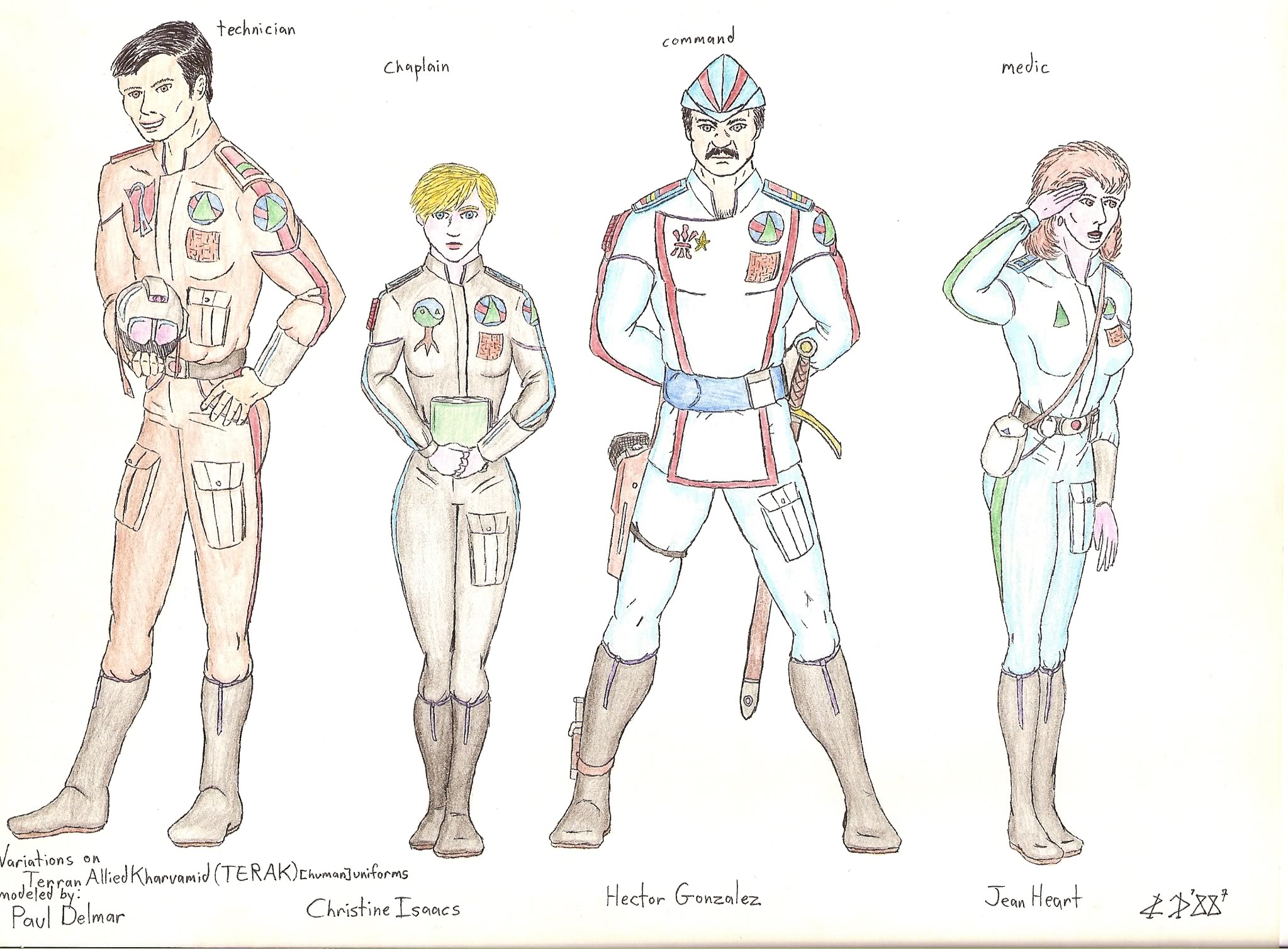
For example, “Miriam Accolon” is an Olvar Mystic stationed on Earth just after First Contact. Unlike her predecessors, who were spies disguised as Gennies or Synths, she operates openly as a Technomancer advising the United Ecumenical Movement on behalf of the Kharvamid Alliance.

I would previously have described Miriam as Altruistic, but now I’d say that her connections to the Kharvamids and U.E.M. show that she is firmly aligned with the “good guys.” That’s not to say our heroine is incapable of chaotic actions (she is Olvar, after all) or of evil, but she’ll likely use violence only in self-defense, try to help those weaker than herself, and behave in a rational fashion.

By contrast, “Adam Reutan” is a Terran human serving as a gunner in the North American Aerospace Marine Corps. He’ll follow the military code of honor only when necessary and is always “looking for an edge,” whether it’s against someone playing cards, a girl in a spaceport bar, a competitor for a mech suit assignment, or an enemy vessel. This Warrior isn’t malicious, just a bit self-absorbed, so I designated his ethics as Freedom in the past and would note that his orders are sometimes outweighed by his impulsiveness.

Regardless of the rules set we ultimately use, I plan to have some group character creation and discussion of party goals, and I’d also like your help developing relevant N.P.C.s and groups — Jim J.D’B. and Byron V.O. have already offered ideas.

I hope these examples are helpful, and I’ll post soon on why our choice of rules matters! -Gene
7 July 2010: “Vortex” alien species

Vortex aliens

In one future, humanity has begun to colonize the Sol system, but strife over resources and ideology persists. Open and official First Contact with galactic societies, themselves at war, thrusts Terrans onto a larger stage, but can they survive?

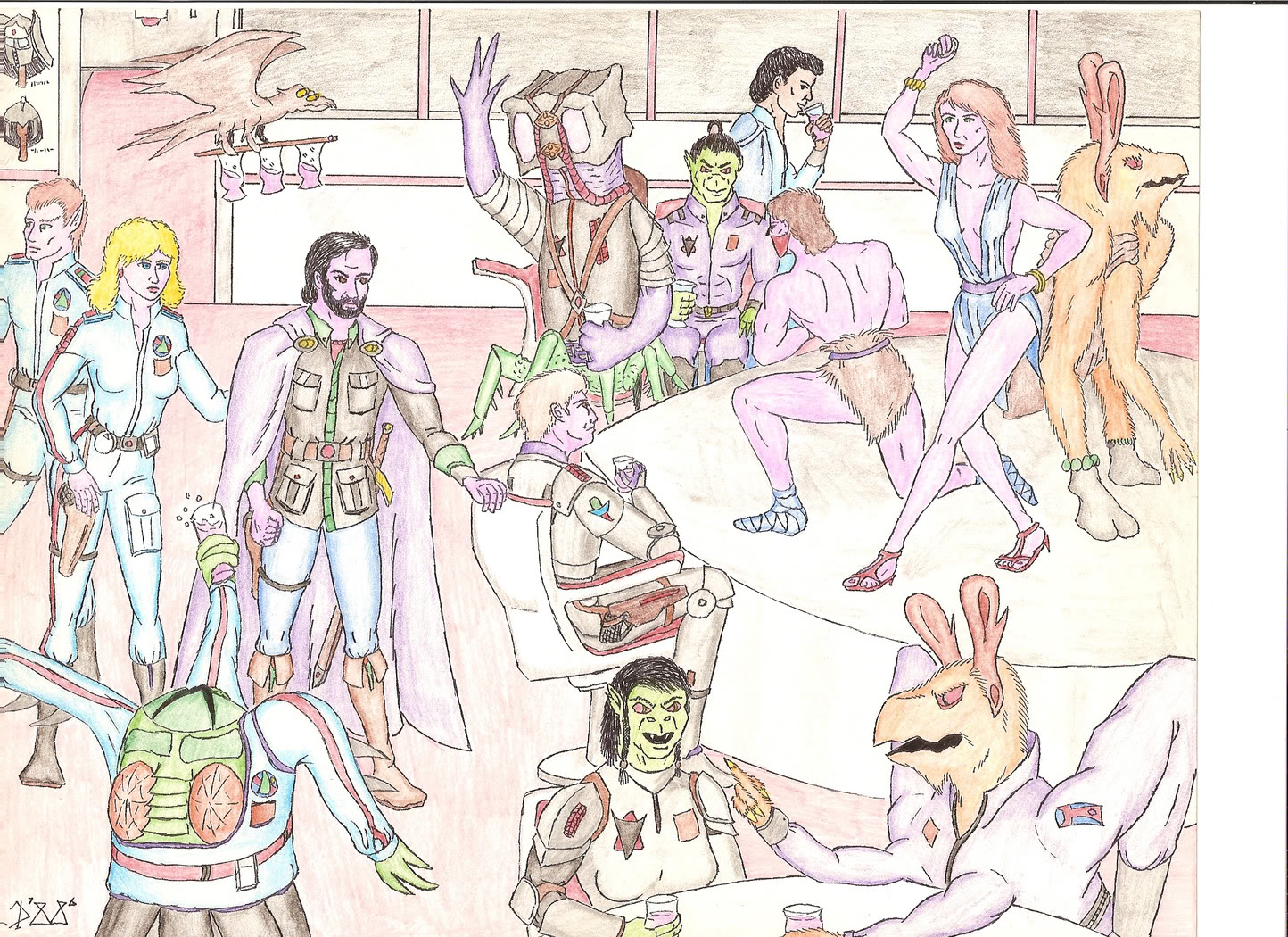
Fellow role-players, here is my latest post about my upcoming “Vortexspace opera campaign. I recently outlined the options for humans and “nearhumans,” and here is information about extraterrestrial species that interact with humans and that can be used for Player Characters.

Any sentient species within 300 light years of the Sol system is aware of humanity, but most of them have their own methods of communication and had little interest in one of several noisy backwaters, until recently….

Gustrall — flightless avian warriors

These bipeds evolved on the temperate plains of Irioth, the seventh moon of gas giant Birkomax, which orbits Firneq. They resemble flightless birds or raptors, with large beaks and muscular legs. However, they have hooves, orange fur, and antlers (actually breathing tubes), as well as small, double-jointed arms under
the “shoulders” of their legs.

The Gustrall (singular and plural are the same) have a long history of warfare, not unlike Terrans, and they had conquered all nearby solar systems before their greatest strategist, Kroac, became a pacifist. Gustrall tend to be reserved, honorable, and stubborn. They are only slightly more technologically advanced than the Sol system and can eat all Terran foods.

Nethians — insectoid scientists

The vegetarian Nethians evolved in the highlands of Oromekl 6 (which has a bit less gravity than Earth), and these explorers have named each planet they’ve settled since a supernova destroyed their homeworld thousands of years ago “Oromekl.” Each Nethian has six legs, all ending in three-clawed hands. They tend to walk on the rear two sets, have four eye/ear/nose stalks, and are covered in a smooth, gray exoskeleton. Nethians breathe through breathing holes along their thoraxes and have foldable wings for gliding. They are
excellent climbers but poor swimmers.

Nethians have an extremely hierarchical culture, but they do not have a hive mind and no longer enslave other species. In fact, these sentients enjoy public debate, and unlike many aliens, they discovered interstellar Transit on their own in vast, mazelike ships. Nethians are longtime allies of the Trinoids and appreciate
Terran inventiveness but are at a loss when faced with Gustrall tempers, Olvar humor, or human diversity.

Olvar — mammal-like mystics and pranksters

Of all the aliens that humans first encounter, they’re predisposed to liking the Olvar, which resemble primates or felines with tails, pointed ears, and multicolored short fur. (Yes, they’re similar to Elves or James Cameron’s Na’vi, but they were created years ago.) The Olvar evolved in the forests and mountains of Velthis Major, also known as Thurbast 3b. They can eat some human foods, and like chocolate, which is intoxicating to them.

The Olvar are known for their artistic sense, tribal organization, and sense of humor, and they are fond of ever-shifting Terran popular culture. In fact, generations ago, gray-suited Olvar adolescents were responsible for some human folklore of extraterrestrial visitors! Of the species presented here, the Olvar are most likely to study mysticism, and they are serious about recording and preserving history.

Ru’ulok — heavy-G reptilian pirates

The Ru’ulok are bipeds from Ru’okkal/Cralari 5 but are shorter and stockier than Terrans. They’re covered in small green scales and have gills where human ears would be, and their faces look somewhat simian. Although Ru’ulok internal organs are arranged in much the same way as human organs, these carnivores’ biochemistry isn’t compatible.

After generations of an oppressive caste system, the Ru’ulok distrust organization, such as those of the Nethians and Trinoids, and they don’t like the wealth disparities among humans. Although they communally share booty, the Ru’ulok compete to see who can get the best deals, find the most valued artwork or trade goods, or impress the most of their peers.

Trinoids — trilateral amphibious terraformers

The least humanoid of the aliens listed here, Trinoids evolved in the shallow areas of their “Home Sea,” or Hydronicus 2. They resemble Terran anemones or squid and have a barrel-shaped body, six stubby legs/feet, and three flexible arms ending in two spikes and three tapered fingers each. Trinoids have three sensory organs around a beaked mouth at the top of their blue-green torsos, but they communicate subsonically from ventral gills.

Trinoids have slowly but patiently expanded into the Orion Arm and are the founders of the Kharvamid Alliance to respond to the approaching Zarkonian Armada. Humans have difficulty understanding Trinoid society, which is based on the “Six Legs” — budding, food and photosynthesis, ethics, technology, strategy,
and Galactic commerce — with no clear divisions between the individual and government or corporate and religious affairs. However, Trinoids do have individual personalities, and they enjoy interacting with other species.

Some other aliens:

Cestolar — short, hairy clients of the Olvar

Laransans (created by Erik B.L.) — telepathic humanoid guardians

Ma’ari (created by Jenna P.) — diminutive wanderers

Meorr (created by David F.R-B.) — blue-furred lion-like berserkers

The aliens of “Vortex” are intended to be different, relatable, and worthwhile alternatives to human Player Characters. Interstellar travelers communicate via robotic translators, telepathy, or approximations via “Galactic standard” languages. While most of you are probably thinking of Star Trek or Star Wars, I’d also recommend looking at Star Frontiers, David Brin’s Uplift novels, or Farscape.

Coming soon: Occupations, factions, and rules!

6 May 2010: What is “Vortex?”

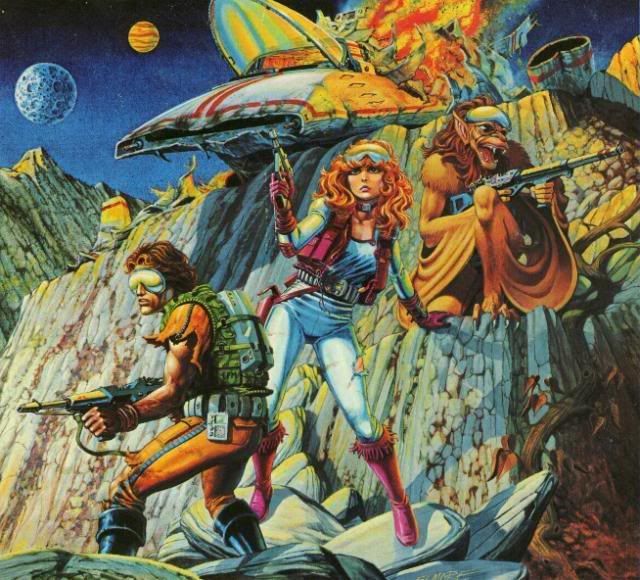
Star Frontiers wallpaper by ElmoreThe “Vortex” space opera has its roots in “The Zarkonian Bomb,” a film script that I wrote with Carlo R., Jon and Bill B., and Ray C. in high school in New York's Westchester County. Looking back to 1982, we were obviously inspired by the novels of Isaac Asimov, Doctor Who, the original Star Wars film trilogy, and the Star Frontiers game. I later wrote “The Adventures of Jason Delmar,” a series of short stories.

In contrast to “hard” science fiction or other subgenres like cyberpunk, space opera features relatively easy interstellar travel and human interaction with aliens, plus themes of exploration, diplomacy and heroism amid warfare, and the importance of friendship. Space opera has its roots in the “planetary romances” of the 19th and early 20th centuries, pulp fiction, and movie serials, but James Cameron's Avatar is a recent (if explicitly derivative) example.

In college in Upstate New York, I created the “Vortexrole-playing rules with my brother Peter and David I.S., influenced by Advanced Dungeons & Dragons 2nd Ed., the Star Trek franchise, books by Larry Niven and others, and the cyberpunk/fantasy game Shadowrun. Our system had several species options, five attributes (Prowess, Agility, Intellect, Respect, and Aura), skills and mystical powers, and lots of gear.

The name “Vortex” came from late-night conversations about the nature of time, human history, and perception with Carlo and Dave, touching on the works of Edward Gibbon and Mircea Eliade. Is history linear or cyclical? Are technological and social progress inevitable or transient, and what role does individual choice play? From the perspective of the present, global events seem more crowded at an ever-accelerating pace, hence the vortex (I'm not the only gamer to think of it this way). It can also represent the spiral of the Milky Way Galaxy.

After graduate school, I used the Generic Universal Role-Playing System to run successful campaigns, including GURPS 3rd Ed. Space: “Vortex,” for about a dozen people in Virginia in the 1990s. At that time, we enjoyed the books of three Davids (Brin, Gerrold, and Weber), movies like The Fifth Element, and television shows such as Babylon 5 and Space: Above and Beyond. The universe expanded as the players developed more aliens, and the crew of the P.T.S. “Venture” explored more space.

Earlier in the 1990s, I had used the original “Vortex” system for “Bay City: Visor and the Seer,” which later became the GURPS “Supers: the S.J.I.” superhero campaign (most recently using D20 Mutants & Masterminds 2nd Ed.). In addition, we used my timeline in the “Voyagers II: Adventures in the Dimensional Corps” game I co-ran with Steve M.R., Tim M.B., Jim J.D'B., and other Game Masters.

I ran GURPS “Vortex” briefly by e-mail and for Rob R. and Randy K.M. after moving to the Boston area. We then returned to my long-running “Vanished Lands” fantasy campaign using Dungeons & Dragons Third and Fourth Editions. In 2010, I expect to incorporate some “transhumanist” concepts, “retrofuturist” speculative fiction, and “rules-light” games, looking back and ahead simultaneously.

In future posts, I'll explain more of the “Vortex” setting, character options, and various space opera rules sets. Feel free to post your own questions and ideas to the “Vanished Lands” Yahoo/eGroup, the “Holy Steel” Google group, or my blog at Yahoo, MySpace, EnWorld.org, or Wizards of the Coast!

24 February 2010: Winter games and retro-clones

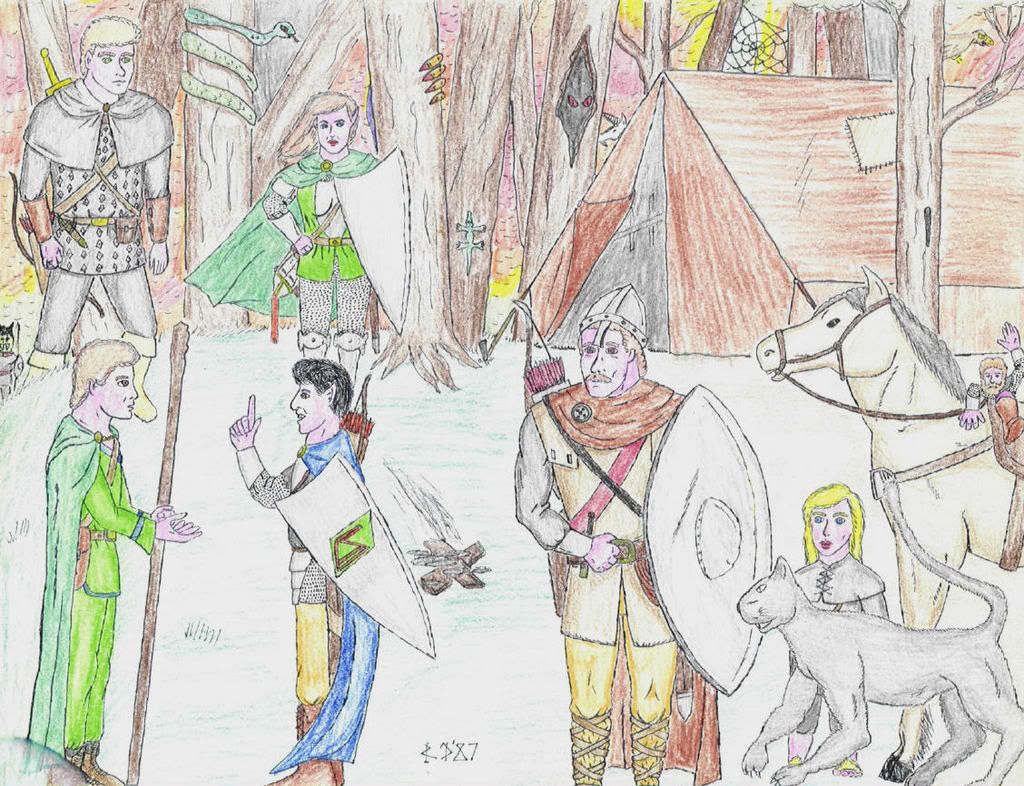
College D&D charactersFriends, I hope you’ve had a good fortnight. Janice and I have been busy watching the Winter Olympics in Vancouver, leaving me to catch up on recorded genre television on the weekends. In addition, I’ve been comparing notes on comic books and graphic novels with new fan David I.S. and playing various games.

Since wrapping up my “Vanished Lands: the Faith-Based Initiative” fantasy campaign, which used Dungeons & Dragons Fourth Edition (D&D4e), the current role-players have been involved in a series of one-shots. While I’m taking a break from serving as primary Game Master, I’m trying to encourage the Boston-area group of about eight people to try other genres, rules systems, and styles of games.

Wizards of the Coast’s D&D4e is still the most popular tabletop (or pen-and-paper, or dice-and-pizza) game on the market, thanks to 35 years of leading the hobby, brand recognition, and wide distribution. However, the boom of the past decade thanks to the D20 Open Game License has been replaced by economic recession, a move from print to online publishing of PDFs, and fragmentation of the market.

Locally, Greg D.C. has run InSpectres, a rules-light horror/humor game, and Paul J. used D20 Mutants & Masterminds 2nd Ed. for his “Vaguely Interesting People — the Four” comedic superhero scenario. Brian W. demonstrated collaborative storytelling with FATE 3.0 in his “Spirit of the Caribbean!” pirate one-shot. In addition to a “Paranoia” cyberpunk comedy one-shot, Brian ran Savage Worlds: Hellfrost, a Nordic-themed fantasy. So far, all of these games have gone well, although we’ve had some debates about what system would be the best fit for a longer-term campaign.

These “indie”-style games are good examples of the alternatives to D&D4e. I’ve already blogged about my ongoing Pathfinder: Holy Steel” teleconferencing team and the “Gaslight Grimoire” steampunk/fantasy homebrew using D20 “Lite.” Another trend among face-to-face (F2F) RPGs is “retro-clones,” or games that emulate older editions of D&D and other games. I have fond memories of my early years as a role-player in the early 1980s.

Although I’d be the first to acknowledge that game design has developed since then, I’ve downloaded several retro-clones, which remind me of a time when magic was rare and mysterious, monsters were unpredictable and deadly to Player Characters, and the games tried to evoke folkore and literature rather than second-hand adaptations into other media such as movies or computer games (not that there’s necessarily anything wrong with that if it’s your preference).

Coming soon: Space opera, the “rules-light” movement, and newer games!

28 August 2009: Game updates

Fantasy RPG wallpaper
"D&D3.75"

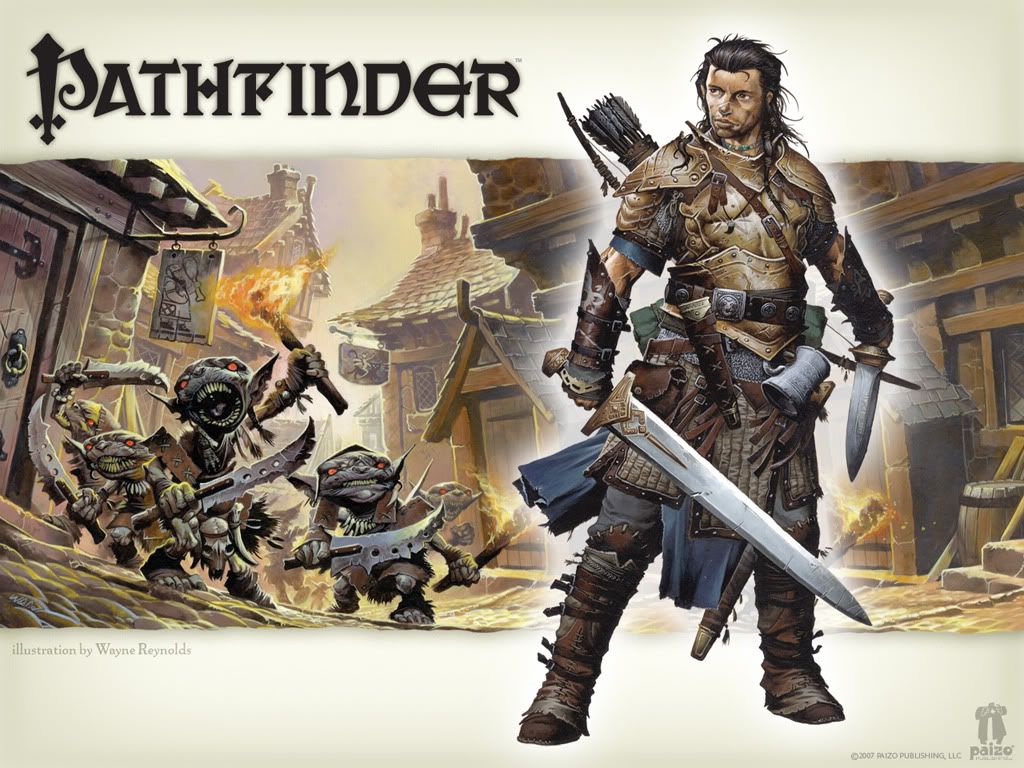
On Sunday, 23 August 2009, the “Holy Steel” teleconferencing team resumed, now using the Pathfinder core book, which revises the Dungeons & Dragons Edition 3.5/D20 System Reference Document. So far, despite this rule set’s complexity and the tome’s heft, I like Paizo’s iteration of the world’s most popular fantasy role-playing game more than Wizards of the Coast’s Dungeons & Dragons Fourth Edition (D&D4e)/Game System License.

Although Dexter V.H. has been too busy with family commitments to rejoin our virtual sessions as Drow Ranger “Faelonia,” Byron V.O., Beruk A., and Paul J. have
continued their exploration of the
pyramid of Unas as Paladin “Ibrahim,” Rogue “Milos,” and Wizard “Derek,” respectively. Their adventuring party has fought monsters and is searching for the Book of Thoth, which it believes cultists of Set are also after.

I’ve had to cancel two weeks’ worth of D&D4e “Vanished Lands: the Faith-Based Initiative” face-to-face (F2F) games because of work. We’ll probably meet again around Labor Day. After about 50 consecutive sessions, I don’t think missing a few Monday nights will hurt the momentum of that party, which is investigating smugglers in the
Hifalendorin human capital of Hesolin. Overall, “Holy Steel” has had more interesting investigations by Player Characters (P.C.s), and the “F.B.I.” has had more action scenes. A good group has a balance of the two.

I’m still looking forward to taking a break after the “F.B.I.” winds down, although that has taken longer than I expected. On the one hand, several people prefer Pathfinder or other systems to D&D4e, and the Player Characters (P.C.s) are approaching Tenth Level, which used to be “name level” — the midrange in power that usually marks the end of my campaigns.

On the other hand, the current Boston-area P.C.s have been gaining in experience and knowledge, and some gamers are understandably interested in maximizing their abilities. I still hope to give other Game Masters a shot and to run shorter-term steampunk, superhero, and/or space opera scenarios, most likely using a D20 variant, although I’ve seen mostly favorable reviews for the rules-light and pulp-flavored Savage Worlds.

I don’t expect my F2F game to return to the “Vanished Lands” setting, probably using Pathfinder, until spring of 2010. Since I’ve been building that fictional world since 1982, I’d like to take some time to tweak it to properly challenge and entertain
another party, which won’t be easy because most of the current group is now
familiar with it.

I ended my subscription for Lord of the Rings Online because college chums David I.S. and Dexter haven’t had the time to play regularly. The “Dimensional Corps Online” supergroup for the City of Heroes multiplayer online game is still going strong, and Dex invited me to try Champions Online (now separated from the Hero System 6th Ed. license). I have, however, enjoyed Wii Sports Resort. Batman: Arkham Asylum also looks cool, but it isn’t available for the Wii.

Coming soon: Superheroes and work!