Welcoming the latest DC Comics reboot

DC Comics' revived Justice League
First look at DC Comics reboot

DC Comics announced today that it will be rebooting its universe with 52 titles with Issue No. 1 in September, after the current “Flashpoint” summer crossover, in which the Flash deals with an alternate reality (one of many parallels).

While this may get some attention in the mainstream news media, it’s too soon to tell whether this will be good or bad for DC’s iconic characters or the comics industry in general. I’ve noted before how superhero stories have been fodder for popular movies, even as print sales decline. DC’s announcement that digital versions of its comics will be available on the same Wednesdays as individual issues is a strong attempt to address this decline.

I also doubt that this will have the same long-lasting effect as Crisis on Infinite Earths, which reset DC’s timelines in the mid-1980s, just as I was returning to comic books and graphic novels as a young adult. Marvel Comics tends to reboot individual characters (see One More Day for Spider-Man) or teams (such as the Avengers Reborn) rather than its entire continuity at once.

The reason for such reboots is simple: Fans want their favorite characters, such as Batman or Captain America, to be relatively unaging, while real-world and fictional events (such as the maturing of sidekicks) pile up around them. To bring in younger or more casual readers, a periodic housecleaning makes sense.

In “comic book time,” how long has Superman or Wolverine been a costumed vigilante? Is Dick Grayson, Jason Todd, Tim Drake, or Damien Wayne the youngster in the Robin costume? Which president is considering the Mutant/Metahuman Registration Act?

I don’t mind clearing the cobwebs around continuity, as long as it leads to fresh looks at characters without changing their core concepts (most superheroes don’t kill) or to mere rehashing of well-known or recent stories. “Nerd rage” will focus on Jim Lee’s costume redesigns, the economics of renumbering issues, and the impermanence of any historical revisions. I prefer to wait and see how drastic DC’s reboot will be.

On a related superheroic note, I watched the latest episode of Avengers: Earth’s Mightiest Heroes and the direct-to-video Thor: Tales of Asgard this past weekend. The animated feature focused on a young god of thunder, and was a decent parallel/companion piece to the live-action film.

Horror and fantasy thrive on TV

Camelot wallpaper
Starz's Camelot

Since horror is one of the more accessible genres, supernatural dramas are perennially popular on television. I’ve enjoyed BBC America’s Being Human, and I can appreciate why SyFy’s U.S. version, as well as Supernatural, Vampire Diaries, and HBO’s True Blood, all have strong fan bases. I don’t know if any of them will have the popularity or influence of Buffy: the Vampire Slayer, but Joss Whedon always had an eye for talent and an ear for dialogue. Greg D.C. has been running a Dresden Files game using FATE.

In fact, after the demise of superhero shows and the struggles of space opera on TV, the networks are again banking on fairy tales and police procedurals for their fall schedules, with Alcatraz, Awake, Gifted Man, Grimm, Once Upon a Time, Person of Interest, River, Secret Circle, and Touch. Never mind that shows such as Journeyman, New Amsterdam, Eli Stone, Reaper, and Eastwick all failed. Of the upcoming shows, I may check out Grimm and Awake.

For more traditional sword-and-sandals action, I wonder how Season 2.5 of Spartacus will manage with a new star. I’ve seen only the premiere of the fantasy Game of Thrones, which sports strong writing and production values, but Camelot on Starz should satisfy my sword-and-sorcery (and sex) quota and is not to be confused with the BBC/SyFy young-adult Merlin.

Camelot is based on Thomas Malory’s Le Morte de Arthur, which isn’t my favorite version of the legends, but the series has taken a new look at mythic Britain’s romantic intrigues and attempts to establish chivalrous code. I recently enjoyed Tony Hays’ The Beloved Dead, the third book in a series of Arthurian mysteries that Janice pointed me to. They’re more historical than mystical, like The Last Legion and the 2004 King Arthur.

I’ve considered including court intrigues in my current Pathfinder/Skype: “the Vanished Landstelecom fantasy campaign, but the current teleconferencing party is rather low in experience/power level. If I was to run an Arthurian scenario, I might use GURPS Camelot, D20 Legends of Excalibur or Relics & Rituals: Excalibur, or FATE 3e Legends of Anglerre.

As far as scheduling goes, it looks like Friday nights will again be crowded, with Young Justice, Star Wars: Clone Wars, Chuck, Fringe, and Grimm, among others. It’s worth remembering that for every successful genre TV show, there are many that never make it out of the pilot phase. What upcoming programs are you looking forward to? Have a good Memorial Day weekend!

Animation endures on TV

Earth's Mightiest Heroes
Marvel's Avengers

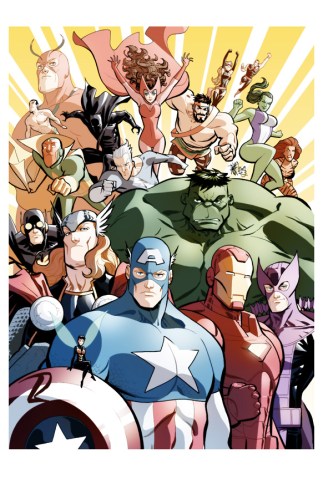
Despite the decline in live-action TV superheroes, The Avengers: Earth’s Mightiest Heroes is both faithful to the comic books and relatively popular. I’ve already mentioned the cancellation of the campy and fun Batman and the Brave and the Bold, but I hope that Young Justice (whose animation is smoother than most Marvel projects) and defiantly kid-friendly Super Hero Squad keep going.

I haven’t watched the latest iteration of Transformers, and it’s too bad that Genndy Tartakovsky’s SymBionic Titan didn’t get the support it deserved. The counterterrorist, anticorporate, and on-the-run take on G.I. Joe is interesting, but I’ve only seen a little of it. Many of the cartoons on the Cartoon Network, Fox, and Nickelodeon aren’t really my style, but I am looking forward to the anthropomorphic animals of the upcoming Thundercats and Teenaged Mutant Ninja Turtles reboots.

The Looney Tunes Show is an interesting sitcom approach to the classic Warner Brothers characters, and I wonder whether Seth McFarlane’s revival of The Flintstones can succeed alongside the postmodern sarcasm of The Simpsons and its ilk.

In direct-to-video tie-ins, I just picked up Marvel’s Thor: Tales of Asgard, and I’m looking forward to DC’s animated Green Lantern: Emerald Knights, Batman: Year One, and Justice League: Doom. Between live-action movies, video and TV, and of course comic books, it’s no surprise that several role-players in my groups have asked about D20 Mutants & Masterminds 3rd Ed. or Icons! Fellow Game Master Jason E.R. may run a one-shot of Dark Pages this coming summer.

Coming soon: Horror and fantasy TV and games!

Space opera’s TV struggles

Comparison of fictional space vessels
Starship comparisons

Like other genres, space opera has also taken a beating on television this year, with Doctor Who facing a minor backlash for being too scary and continuity-driven, Stargate Universe ending that long-running franchise, and Caprica getting canceled in favor of Blood and Chrome, another spinoff of the “reimagined” Battlestar Galactica (“BSG”).

I’m surprised that the producers of science fiction shows haven’t learned from the experiences of Star Trek and Babylon 5 (“B5”). Both Star Trek: the Next Generation and Stargate SG1 featured humanity’s best and brightest exploring a dangerous galaxy (not to mention the original 1960s Star Trek). Like B5, their sequels, Deep Space Nine and Atlantis, respectively, took place on remote space stations surrounded by war.

However, the next wave — Star Trek: Voyager, Babylon 5: Crusade and Legend of the Rangers, and Stargate Universe — all “darkened” the tone of their respective universes with postapocalyptic themes and wandering ships without the inspirational heroes and occasional humor of their predecessors.

The newer BSG also followed that trend in its melodramatic makeover of the 1970s series, while Andromeda, Firefly, and Farscape tried to balance heroes and antiheroes and were quickly canceled. (I am, however, cautiously optimistic about Doctor Who spinoff sequel miniseries Torchwood: Miracle Day, but Doctor Who and Torchwood are more about time travel and conspiracies than space opera.)

Like Star Trek: Enterprise, Caprica was a BSG prequel that filled in backstory that we either already knew or that wasn’t as engaging as the main exploration and conflicts. That’s not to say that each of these programs didn’t have compelling moments and good actors — they all did — but they didn’t hold onto audience goodwill or ratings with obviously rehashed plots or continuity conflicts.

On the other hand, Star Wars: Clone Wars shows that a space opera prequel can be done well. Initially dismissed as entertainment only for children who like George Lucas’ inferior movie prequels, the computer-animated Clone Wars has redeemed Episodes I through III with intertwined plot threads, actual character development, and blazing action in keeping with the tone of the entire saga. Sure, Season 3 had its share of heavy-handed political episodes, but they provided a context for the Sith’s schemes and Republic’s battles.

I know that human spaceflight hasn’t captured the public’s imagination as it did during the Cold War, but I think that the concepts of unity, exploration, and adventure are as valuable as ever. As a fan of serials from the 1930s Flash Gordon through Clone Wars, I hope that good space opera continues to find a place on TV. What do you think?

Coming soon: Animation and fantasy TV!

Transitions in TV thrillers

Cast of the late Fox thriller
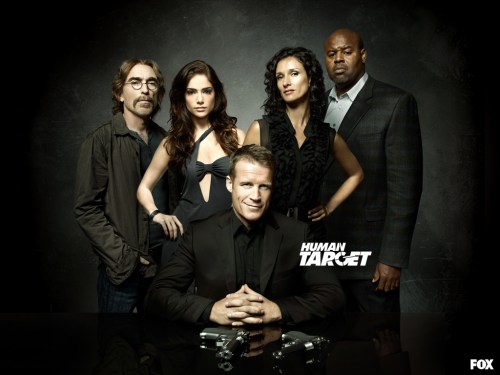
Human Target's TV cast

Continuing my look at seasonal television turnover, espionage has fared slightly better than live-action superheroes. I was disappointed, but not surprised, by the cancellation of Human Target, which was a fun throwback to the action shows of the 1980s.

I had already dropped Undercovers and Nikita and was somewhat surprised that the latter (the fourth version of the waif turned assassin) got renewed. Spy spoof Chuck, which I’ve kept watching just as I stuck with Smallville, managed to avoid the axe one final time, and we’ll see whether the Charlie’s Angels remake is any good.

In related genres, conspiracy dramas V, The Event, and Survivors joined Flash Forward and Dollhouse in cancellation. I had kept up with the V remake, although the alien invasion plot took a long time to develop suspense. Speaking of aliens, Spielberg’s Falling Skies and time-travel Terra Nova are getting a decent amount of prelaunch hype, but we’ll see if they can avoid similar disappointment.

Cryptozoology and weird science fans still have Fringe, Sanctuary, and Warehouse 13, which may even have a steampunk spinoff. I thought that the season finale cliffhangers of Fringe, Chuck, and Castle were all pretty good this year.

Comedic procedural Psych and related caper shows Burn Notice, White Collar, and Leverage are similar to Castle but no doubt managed to hang on because they’re on cable, which has more modest audience expectations. Breaking In, which featured Reaper and V‘s Bret Harrison, wasn’t so lucky.

It’s too soon to say whether this autumn’s batch of shows will do any better, but let’s hope the best rise to the top in the networks’ game of trial and error.

Coming soon: Space opera, animation, and fantasy on TV!