On July 4, we all went to Kimball Farm northwest of Boston. It had a range of attractions for families, including food, a craft shop, animals, and bumper boats. There was something for everyone, including miniature and “pitch and putt” golf, as well as an arcade. The weather was warm, but it didn’t slow us down too
much. Janice and I left her folks after dinner at T.G.I.Friday’s and made it home in time for Needham’s fireworks.
Melinda had to leave early on Monday for Amanda’s swim class, but Janice’s parents joined us for a pancake breakfast, Needham’sannual parade, and lunch at Wild Willy’s Burgers. The food theme continued after they left, as Janice and I ate leftovers and watched Anthony Bourdain’s No Reservations on the Travel Channel.
Unfortunately, we missed the Minuteman Model Yacht Club’s “Independence Day Open” regatta
on Rosemary Pond. My Pathfinder: Holy Steel/Dragonslayers” teleconferencing team and the face-to-face role-playing gamers didn’t meet this past weekend, but we hope to get back on track after assorted scheduling disruptions. As I’ve recentlyposted, we’re gearing up for a new adventuring party in the virtual fantasy group and my “Vortex” space opera campaign.
In a previous post, I blogged about the first few days of Janice’s and my vacation in England. The Internet enabled us to act as our own travel agents, conducting research on sites to visit and helping us book travel through Expedia. The London Pass program allowed Janice and me to get into museums (although most were free) and other attractions without waiting in line/queue for tickets.
On Wednesday, 23 June 2010, Janice and I went to the Tower of London. Janice remarked that it isn’t so much a tower as a castle (based on a Norman keep). We saw the crown jewels and Traitor’s Gate, and I noticed that the armorexhibit had changed since my previous visit 24 years ago. We had lunch at the Armories Café and then walked past the Golden Hinde (Sir Francis Drake’s ship) to the reconstruction of Shakespeare’s Globe Theater.
We weren’t able to tour the theater because a production of Macbeth (the “Scottish play”) had just begun, so we walked across the MillenniumBridge to St. Paul’s Cathedral, observing a range of architecture on the way. The church is as much a testament to British nationalism as to the Anglican faith, having been redesigned by Christopher Wren after the Great Fire of 1666. St. Paul’s magnificent crypt contains grave stones of numerous notable scientists, artists, statesmen, and military leaders.
Janice and I then strolled by the antique stores of Portobello Market and Notting Hill, made famous by movies. Many of the stores were empty, but the pubs were overflowing with fans and spectators of soccer’s World Cup. The Wimbledon tennis tournament was also occurring that week, but we couldn’t tell if it affected traffic or tourism. We later enjoyed Indian cuisine at Masala Zone, which I liked even more than Wagamama because of a friendly and informative staff, healthy and tasty food, and reasonable prices.
The next day, Janice and I went to the grand British Museum, which had a special exhibition of Renaissance drawings. We also checked out the significant collection of artifacts from ancient Mesopotamia, Egypt (such as the Rosetta Stone, mummies, and statuary related to my Pathfinder: “Holy Steel” campaign), Greece (including the Elgin Marbles or contested sculpture from Athens’ Acropolis), Rome, and several other civilizations. We could easily have spent more time exploring London’s many museums and palaces, just as there are other sites in the U.K. that would be worthwhile destinations for day trips.
Janice and I had dinner at Pret a Manger, which is similar to and slightly nicer than Au Bon Pain in the U.S. We then walked through Bloomsbury and Soho (no relation to Manhattan’s Soho, other than being a neighborhood frequented by artists). Among other things, we stopped in at some comic book shops, including Gosh!, Comicana, Orbital Comics, and the multimedia extravaganza of Forbidden Planet, which has few equivalents here at home.
On Friday, June 25, I mailed two boxes of books and a few souvenirs home to lighten our luggage for our return. Since Janice and I had been unable to get inside the Globe Theater two days before, we returned for a tour. Whenever we return to England, Janice and I would like to try to take in a show.
Janice and I flew back to Boston on Saturday, June 26, watching most of Up in the Air on the way. (I screened the OK juvenile fantasy Percy Jackson and the Lightning Thief on the flight to Chicago.) After “comfort food” at Wild Willy’s Burgers in Needham, Massachusetts, we began catching up on chores such as mowing the lawn, doing laundry, and grocery shopping.
In addition, I’ve enjoyed the latest episodes of Doctor Who (continuing our Anglophilia) and Leverage. I’ll have to try to post more soon about the end of the regular television season and this summer’s genre shows.
On Sunday, June 27, we met Janice’s middle sister Shelly, her husband Melvin, and our nieces Rebecca and Laura for lunch at a Chili’s in Worcester, Mass., after they dropped off our nephew David at a summer camp for kids with diabetes. We had seen them a few weeks ago at Becky‘s high school graduation party in Utica, New York.
This past week, the “Holy Steel/Dragonslayers” teleconferencing team and face-to-face group skipped more sessions, but we’ll soon be getting back to the fantasy game, a few more one-shots, and the upcoming “Vortex” space opera (about which I’ve been blogging).
This coming weekend, Janice’s parents and the family of her youngest sister Melinda will be visiting us around Independence Day. College chums David I.S. and Dexter V.H. also hope to visit the Boston area. So much to do, so little time!
In one future, humanity has begun to colonize the Sol system, but struggles for scarce resources persist. Open and official First Contact with alien societies, themselves at war, opens a wider galaxy to explore — if Terrans survive.
Humans and “near” humans
As I’ve noted previously, about 200 years from now, our solar system is home to nearly 20 billion people, most of whom are “normal” humans living on Earth. They’re still the baseline for whatever rules set we ultimately choose (the top contenders are D20 Star Wars: Saga Edition, FATE Diaspora/Starblazer Adventures, GURPS 4eLite/Space,” and BASH Sci-Fi Edition).
In the “Vortex” universe, as in many space operas, humans are adaptable, corruptible, and lower-tech than their new galactic acquaintances. Still, the upstart children of Terra have great potential.
Also known as “metahumans,” “parahumans,” “posthumans,” and “transhumans,” the broad category of “near” humans includes mutants, genetically modified humans, and cyborgs. About one in 5 million people is born with a random but significant (and mostly helpful) mutation, and during the era of the Societe de Justice Internationale and the “Drake’s Seven,” many were costumed vigilantes or supervillains.
“Gennies” include humans born in the low-gravity environments of the Lunar Free State, the Mars Confederation, or some outer colonies (but not the orbital cities, which have mostly normal inhabitants).
Some people have been enhanced as entertainers or soldiers, while others have engaged in dangerous recreational splicing. As mentioned previously, some cloning exists, but it’s expensive and heavily regulated.
Cyborgs may not seem as high-tech as their genetically modified kin, but they can be nearly indistinguishable from normal humans (in contrast to many gennies, who often flaunt their differences and supposed superiority). Many modifications are to repair injuries, to interface with machines, or to have swappable functions.
“Synths”
“Synths,” or synthetic humanoids, include genetically modified animals and androids and mostly live in Earth’s colonies. Although humans created these client species to be more capable individually than themselves, humans have also been reluctant to grant them equal rights.
“Uplifted” animals arose out of the creation of “gennies” and efforts to preserve megafauna that was going extinct. They’re commonly based on dogs and wolves (Canids), large cats (Felinoids), primates (Chims), bears (Ursoids), or cetaceans (Delphines). Uplifted animals are usually stronger than humans but not as smart, and like gennies, their reproduction is strictly controlled. Alien synths are known as “xenoids.”
By contrast, true artificial intelligences may be smarter than humans but rely on robotic bodies. Robots have industrial, exploratory, or military applications, and androids are often confused for gennies and have social or entertainment applications. Humanoid androids, nonhumanoid bots, and disembodied A.I.s all have programming and legal restrictions and are as vulnerable to computer viruses as organic beings are to
regular illness.
Fellow genre entertainment fans, in the past month or two, I’ve been catching up on comic books and graphic novels. As I’ve noted to new enthusiast David I.S., most, but not all, of the titles I pick up monthly involve costumed superheroes.
On Saturday, 1 May 2010, Janice and I drove to New England Comics and Newbury Comics in Norwood, Massachusetts, for the annual Free Comic Book day. Although weekly comics are supposedly endangered (along with all print publications), I was
pleased to see many younger readers.
Since I’ve been following Batman for years in various media, it comes as no surprise that the “Batfamily” is the largest portion of my print subscriptions. Dick Grayson, formerly Robin and Nightwing, has acquitted himself well in the cape and cowl while his mentor Bruce Wayne tries to find his way back to the present after being lost in time (not unlike Steve Rogers/Captain America over at Marvel). While Grant Morrison’s metatextual take on Batman has been interesting, I’m looking forward to Wayne’s eventual return.
In the meantime, Batman & Robinand Streets of Gotham have focused on the team of Grayson as the caped crusader and Wayne’s bratty son Damien as sidekick Robin. Other former Robins include the vengeful Jason Todd as Red Hood, detective Tim Drake as Red Robin, and Stephanie Brown (formerly Spoiler) as the latest Batgirl. I’ve been enjoying all of these books lately. Some DC Comics stories, such as Kevin Smith’s Widening Gyre and the Eurocentric Batman in Barcelona, are out of continuity (fictional history/news) and explore other facets of the Dark Knight’s career.
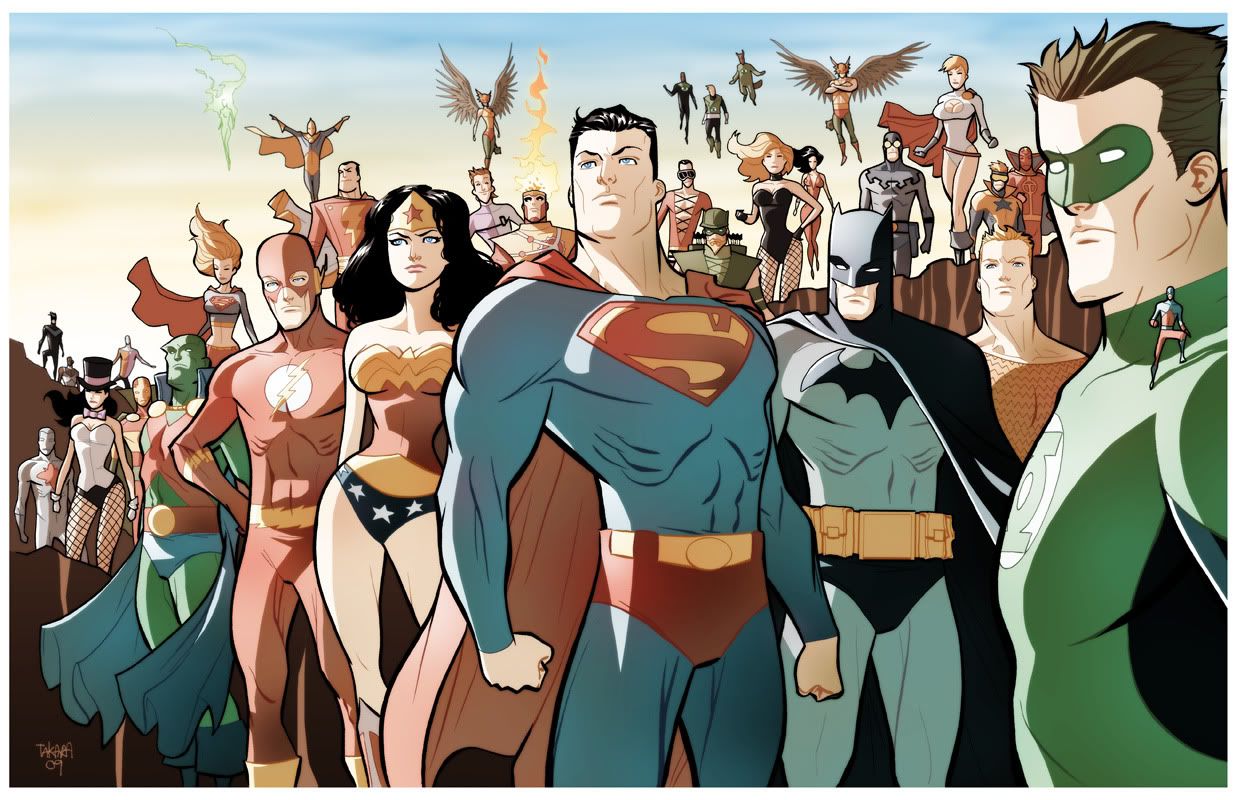
Batgirl isn’t the only female member of Gotham City’s vigilante community. I’ve been reading the bad girls trying to be good in Gotham City Sirens and am looking forward to the revived Birds of Prey. The magician Zatanna, who made a faithful cameo in this past season of Smallville, will join Wonder Woman as one of the few superheroines to have her own title in a market dominated by male metahumans — and readers.
Unfortunately, the teams that I’ve followed, such as the Justice Leagueand Titans, have dipped in quality in the wake of last year’s Final Crisis crossover event. I haven’t kept up with the large ensembles of Justice Society or Legion of Superheroes, although Green
Lantern Hal Jordan has gotten lots of attention in Darkest Night/Brightest Day, First Flight, and an upcoming cartoon and live-action movie.
Hal Jordan’s pal Oliver Queen/Green Arrowhasn’t fared as well, with his marriage to Dinah Lance/Black Canary (see Birds of Prey) on the rocks, his granddaughter slain, and adoptive son Roy Harper/Arsenal maimed by villains. I’ve been a fan of Ollie ever since Mike Grell’s Longbow Hunters in the 1980s, so it pains me to see the “Arrow family” disbanded.
While I appreciate efforts to bring Ollie back to being an urban hunter and crimefighter, I think the character has been dragged through enough suffering and “reimaginings” lately, even without the ill-advised SuperMax flick on hold. Even Justin Hartley’s surprisingly good portrayal of Ollie in Smallville has been marred by similar attempts to strip away his daredevil sense of humor.
I’ve fallen behind in reading and bloggingagain, partly because of business travel to San Francisco and Chicago, but I hope to post soon about Marvel Comics releases, summer television and movies, my trips, and various games!
On Friday, 7 May 2010, Janice and I met Ken G. and his colleague Bill B. to screen Iron Man 2 at the IMAX theater at Jordan’s Furniture in Natick, Massachusetts. We liked the superhero sequel, which had much of the action and witty dialogue of its predecessor and continued building to an eventual Avengers movie.
Man of Iron
Robert Downey Jr. brought the same charisma and internal conflict to Tony Stark/Iron Man that he had to the first movie and to Guy Ritchie’s recentSherlock
Holmes. Gwyneth Paltrow returned as his “gal Friday” Pepper Potts, and Jon Favreau (who plays chauffeur Happy Hogan) juggled the development of multiple characters better than many sequel directors.
They were joined by newcomers including Scarlett Johansson as Natalia Romanov and Don Cheadle (replacing Terence Howard) as Lt.Col. James Rhodes/War Machine, plus Samuel L. Jackson returning as Nick Fury, director of SHIELD. As usual, Stan “the Man” Lee had a brief cameo. I had worried that an enlarged cast and multiple villains would bog down the plot, but Favreau managed to keep the story moving, and the script had a lot of humor to balance the pyrotechnics.
Mickey Rourke played Ivan Vanko, a composite of the comic book villains Whiplash and Crimson Dynamo, Viggo Mortensen’s tough guy in Eastern Promises, and his own comebacks in The Wrestler and Sin City. While Vanko is a mix of brains and brawn, Sam Rockwell’s military industrialist Justin Hammer (channeling Gary Oldman’s Zorg in The Fifth Element) tries to match Stark’s ego. I also just watched Rockwell in the more quiet science fiction film Moon, which harkened back to 2001: A Space
Odyssey and Outland.
Without giving away any “spoilers,” the plot ofIron Man 2 follows closely after the origin story. Billionaire industrialist Tony Stark has revealed his identity as the armored vigilante, increasing his fame and ego but also endangering everything he has built by drawing out new rivals.
I liked how the movie portrayed next-generation human-computer interfaces, the role (or lack thereof) of security technology and its social implications, and the use of the World’s Fair grounds in Flushing, Queens, near where I once lived.
Iron Man 2‘s cinematography was pretty good, with the excellent costumes again inspired by Adi Granov’s designs. The chase and fight scenes could have been a bit clearer, though. I understand that setting them at night, in water, or at high speeds
makes the transitions between actors and computer-generated images smoother, but on the large IMAX screen, my eyes didn’t always know where to track. Several critics have also complained about the movie’s pacing, militarism, and snarky tone.
On the other hand, as a longtime fan of comic book superheroes, I was pleased to see several “Easter eggs,” or clues to the larger Marvel universe. Favreau stayed true to the history and spirit of the source material. Kenneth Branagh’s Thor will be next, in early 2011. Overall, I’d give Iron Man 2, which was rated PG-13 for language and violence, an 8 out of 10, a B+, or three stars.
The strong box office for Iron Man 2 marked the beginning of the summer movie season. Let’s hope that it’s a good one! I’ll probably see Ridley Scott and Russell Crowe’s Robin Hood or the video game adaptation Prince of Persia: Sands of Time next.




 Gene's Worlds